

 AU & NZ
 SG
SG
 MY
MY
 US
US
 IE
IE
 Engage
Best Employee Benefits Schemes and Providers for Large UK Businesses
Large UK businesses rarely struggle to offer employee benefits, but they do struggle to manage them at scale. As organisations grow, benefits are often added over time across multiple providers, creating fragmentation, administrative overhead and poor visibility for employees.
To address this, most large employers combine individual employee benefit products with a central employee benefits scheme. Providers deliver specific schemes, while platforms bring them together in one place to improve access for employees and control for HR teams.
This guide explains which employee benefit products large UK businesses typically offer, which providers are commonly used, and how leading employee benefits schemes compare, helping organisations make informed decisions as their workforce scales.


In this article we are going to explore:
- What employee benefit products should large UK businesses offer?
- The most popular employee benefits and perks for large UK businesses
- Best employee benefits providers for specific schemes
- Best employee benefits schemes for large UK businesses
- Why large businesses choose Access Engage
- Access Engage vs other employee benefits schemes
- How to choose the right employee benefits scheme
What employee benefit products should large UK businesses offer?
Employee benefit products are the individual schemes offered to employees, rather than the technology used to manage them. In large UK businesses, these typically include core benefits such as pensions and life assurance alongside optional benefits that support attraction, retention, wellbeing and financial security.
CIPD research shows that larger organisations are significantly more likely to take a formal, strategic approach to wellbeing. In 2025, 86% of organisations with 250+ employees provided occupational health services, and they were three times more likely than small employers to have a standalone wellbeing strategy.
This reflects a shift away from reactive benefits toward preventative, accessible support that can address the main health risks across large, diverse workforces.
As organisations grow, consistency, compliance and ease of administration become more important, which is why many employers work with established employee benefits providers that can support complex schemes across multiple locations or entities.
The table below outlines the most common employee benefit products offered by large UK businesses, with examples of why they are used and the types of providers typically involved.
Large organisations build a benefits offering that combines several of these schemes and review them regularly to reflect workforce demographics, regulatory change and employee expectations. This is often supported by an employee benefits platform, which brings these products together in one place for employees and HR teams.
The most popular employee benefits and perks for large UK businesses
The employee benefits and perks offered by large UK businesses are shaped by competitiveness, cost control and ease of administration. While approaches vary by sector and workforce type, certain benefits are widely adopted because they are well understood, valued by employees and scalable. Most employers focus on benefits that support attraction and retention, offer practical financial value and work across different roles and working patterns, typically delivered through a mix of core schemes, optional perks and a central platform.
Our platform usage data shows that everyday benefits, particularly discounts, continue to deliver consistent value across large workforces, with 35% of annual employee discount usage occurring during seasonal peaks, particularly spring and the festive period. Discover more findings in our Employee Benefits Impact Report.
Best employee benefits for attracting and retaining staff
For large employers, attraction and retention benefits are typically those that have a clear impact on employee security, wellbeing and work–life balance.
Common examples include:
- Private medical insurance, which remains one of the most recognised benefits among professional and skilled workforces
- Employee discount programmes, offering everyday savings on shopping, travel and utilities
- Flexible working arrangements, including hybrid and remote options where roles allow
- Additional annual leave, either as a contractual benefit or through holiday purchase schemes
- Recognition programmes, designed to reward performance, milestones and long service
- Enhanced family leave, including improved maternity, paternity and adoption policies
Employee expectations around flexibility and family support increasingly influence how benefits are perceived:
“We’re not just happy with a salary anymore. We want so much more from our employers in terms of investment in me as a professional, employee benefits that make my work-life balance easier. The flexibility—there are so many stats saying people would take less money over flexibility. And if you’ve got really good family-friendly benefits, people care a lot more about that balance between work and home and whether the company does that well.”
Zoe Wilson, Director at ReThink HR, Attracting the Best Talent | Do the Best Work of Your Life Ep. 2
These benefits are often seen as table stakes in large organisations, particularly in competitive recruitment markets. Even when these benefits are in place, many organisations still experience high levels of avoidable churn. Employees often leave for marginal pay increases elsewhere, unaware of the value of the benefits they are giving up.
The Employee Benefits Buying Guide for Employee Retention examines the real cost of this turnover and the platform features that help make benefits visible, relevant and retention-focused. It provides a practical framework for evaluating benefits solutions based on their impact on retention rather than headline features.
Best low cost employee perks
Large UK businesses also place emphasis on benefits that deliver broad employee value without significantly increasing cost. These perks are often voluntary or digitally delivered, making them easier to scale across large populations.
Popular low cost options include:
- Discount and cashback portals, which provide access to third party offers rather than employer funded rewards
- Financial wellbeing tools, such as budgeting support and financial education resources
- Employee recognition schemes, where peer to peer recognition is emphasised over monetary reward
- Flexible benefits choices, allowing employees to select benefits that suit their circumstances
These perks are commonly used to improve engagement and perceived value without adding complexity to reward structures. Discount usage data shows that four major supermarkets consistently rank in the top 10 most used employee discount retailers, highlighting the importance of practical, day-to-day savings. (Employee Benefits Impact Report)
Best employee benefits for frontline and shift based workforces
For organisations with frontline, shift based or non desk workforces, benefit uptake is often driven by accessibility and immediate value. Our Dispersed Workforce Benefits Report explores how employers have improved engagement across retail, manufacturing, transport and healthcare workforces, using real usage data rather than theory.
Benefits that rely on complex enrolment processes or desktop access tend to be less effective in these environments.
Benefits commonly prioritised for frontline workforces include:
- Employee discounts and cashback, which provide immediate, practical savings
- Health cash plans, offering reimbursement for everyday healthcare costs
- EV and cycle salary sacrifice schemes, where pay structures allow
- Flexible benefits platforms, designed for mobile access and simple navigation
- Wellbeing and communications tools, helping employers reach employees who are not regularly on email
Large employers with diverse workforces often tailor their benefits mix by role or location, while maintaining a consistent overall offering through a single platform.
Bringing popular benefits, everyday perks and communications into one place with a platform like Access Engage can significantly increase employee awareness and engagement across large workforces.

Best employee benefits providers for specific schemes
Large UK businesses typically work with different employee benefits providers for specific schemes, depending on factors such as regulation, risk, cost and employee demand. Some benefits require specialist underwriting or clinical support, while others focus on financial administration or access to consumer discounts.
Best health and wellbeing providers
Health and wellbeing benefits often involve regulated services, clinical governance and data protection requirements. As a result, large businesses usually work with established providers that can support high employee volumes and consistent service delivery. According to the CIPD, the most commonly offered wellbeing benefits in large organisations include access to counselling services (71%), employee assistance programmes (67%), occupational sick pay (66%), and 24/7 mental health support (52%).
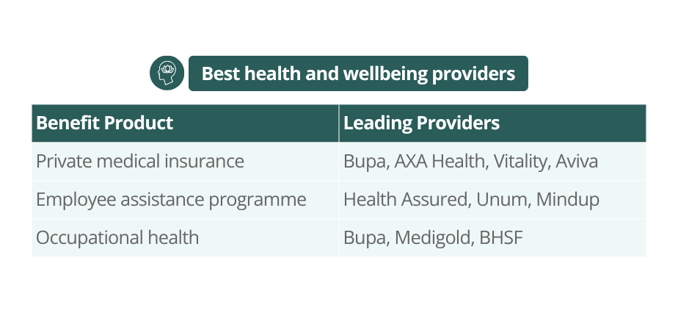
These providers are commonly used by large employers because they can support national coverage, predictable pricing models and integration with wider wellbeing strategies.
Best salary sacrifice providers
Salary sacrifice schemes are widely used by large UK businesses because they offer tax efficiency for both employers and employees. These schemes require careful administration to remain compliant with HMRC guidance, which is why specialist providers are often used.
Cost-effectiveness is the single most important factor organisations consider when selecting health related benefits, cited by 56% of employers, according to the CIPD. Rising business costs have made budget control the top wellbeing challenge for 39% of organisations, even as many continue to invest due to the link between wellbeing, absence reduction and performance.
Recent scheme data shows Bike Scheme application values increased by 42% year on year, with employers saving an average of £142.11 per application in National Insurance, reinforcing the financial case for salary sacrifice at scale. (Employee Benefits Impact Report)
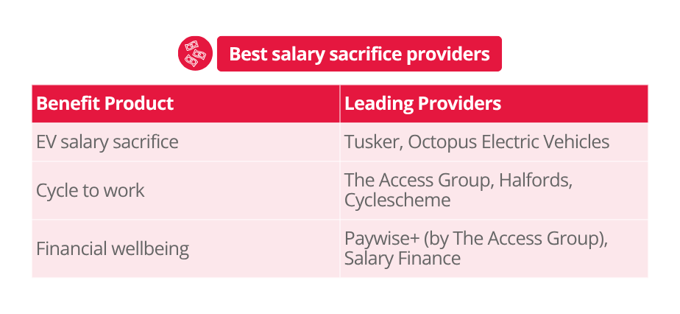 For large organisations, key considerations when selecting salary sacrifice providers include payroll integration, employee eligibility rules and ongoing scheme administration.
Best employee discounts and rewards providers
Employee discounts and reward schemes are typically used to provide everyday value at relatively low cost. These benefits are often voluntary and funded through third party offers rather than direct employer spend.
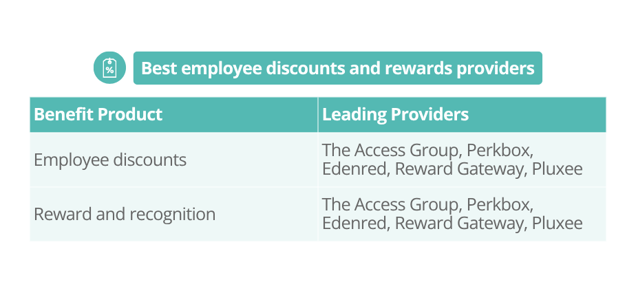
Large employers often prioritise providers with broad discount networks, reliable uptime and simple employee access, particularly for diverse or frontline-heavy workforces.
While these providers typically focus on specific benefit areas, many large UK businesses bring them together through an employee benefits platform. This allows employees to access multiple schemes in one place and helps HR teams manage reporting, communications and administration more efficiently.
Best employee benefits schemes for large UK businesses
Employee benefits schemes bring multiple schemes into one place, giving employees a single point of access and HR teams central control. For large UK businesses, platforms are typically chosen for their ability to support complex structures, multiple entities or locations, payroll integration and high employee usage, while reducing manual administration through reporting and compliance tools.
The table below compares some of the most used employee benefits schemes by large UK businesses, based on their core focus and suitability for scale.
While each platform offers a different focus, large UK businesses typically look for solutions that can support growth, simplify administration and give employees consistent access to their benefits.
The right platform will depend on workforce size, structure and the level of flexibility required across benefit schemes.
Why large businesses choose Access Engage
Large UK businesses choose Access Engage when they want a single platform that can support a broad benefits strategy without adding unnecessary complexity. Rather than focusing on one benefit type or a narrow use case, Access Engage is often selected by organisations that want to bring benefits, rewards and employee communications together in one system.
The reasons below reflect the most common factors that influence platform selection at scale.
Comprehensive
Access Engage brings together multiple elements of the employee experience within a single platform. This typically includes employee benefits, rewards, recognition, wellbeing tools, communications and existing company benefits. For large organisations, this reduces the need to manage multiple systems and gives employees a clearer, more consistent way to access what is available to them. This challenge is common in large organisations where benefits exist but are not clearly visible to employees:
“We had an engagement survey and it came back that employees didn’t see that we had a lot of benefits on offer—which, when you looked at the details, we hadn’t. So I spoke to my CEO and said, ‘I’ll take on the benefits side and let’s see what we can do to bring a platform into the business so employees have a one-stop shop to see their benefits."
Dianne Hoodless, Head Of Group Compensation and Benefits TFG Brands, Reward, Engage, Retain | Do the Best Work of Your Life Ep. 7
By consolidating these areas, HR teams can manage benefits centrally while maintaining visibility across different schemes and initiatives.
Flexible
Large businesses often require flexibility to reflect different roles, locations and business units. Access Engage is designed to support this by offering configurable branding, flexible scheme selection and tailored employee journeys.
This allows organisations to apply different benefits or rules across entities while maintaining a consistent platform experience. Flexibility at this level is particularly important for businesses with complex structures or mixed workforces.
Highly consultative
Access Engage is commonly chosen by organisations that value ongoing support alongside technology. This includes guidance on benefit selection, support during implementation and access to expertise built through long-term experience in the benefits market.
For large employers, this consultative approach helps ensure that benefits remain relevant, compliant and aligned to business priorities, rather than becoming static or underused over time.
Strong administration
Administration is a key consideration for large businesses, particularly where benefits are offered across multiple entities or locations. Access Engage focuses on reducing manual effort through automation, clear workflows and support for compliance-related tasks.
This approach helps HR teams manage complex benefit structures more efficiently and reduces the risk of errors associated with manual processes.
Cost-effective
Large organisations often use several tools to manage benefits, recognition, communications and wellbeing. Engage is frequently chosen because it can replace multiple separate systems with a single platform.
By consolidating capability, businesses can simplify their technology landscape and often reduce overall costs while maintaining or expanding the benefits available to employees. Via East Midlands, for example, used Access Engage to transform their benefits offering and saved £190k in 2 years through the platform’s salary sacrifice schemes. Going beyond savings, the benefits platform is making real-life changes for employees, as Melanie details:
“To give you a working example, at Christmas we were able to give personalised gift cards to all our employees and it was seamless. Everyone received recognition of their work, and the feedback was really positive. Many of our employees sent notes of appreciation that their contribution to the business had been recognised.”
Customer Success Story
Discover how TFG Brands London delivered immediate benefits across a massive workforce, with Instant Discounts gathering 1000+ clicks in the first month alone. Hear more about the success from Dianne in the full story.
Access Engage vs other employee benefits schemes
Large UK businesses often compare employee benefits schemes based on how much functionality they can consolidate into a single system and how well each platform supports complex organisational requirements.
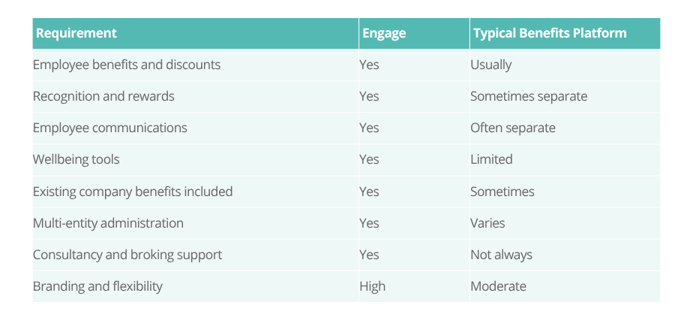
For large organisations, the comparison often comes down to whether the platform can replace multiple tools while still offering flexibility, administrative control and support at scale.
How to choose the right employee benefits scheme
For large UK businesses, choosing an employee benefits scheme is less about individual features and more about whether the platform can support scale, complexity and long term change.
Schemes that work well for smaller organisations often struggle when employee numbers increase or organisational structures become more complex.
When comparing platforms, large employers typically assess the following criteria:
- Workforce size support: Can the platform reliably support 500 or more employees without performance or usability issues?
- Multi entity and location management: Does it allow different benefit rules, branding or access by business unit, location or legal entity?
- Integration with payroll and HR software: Can the platform integrate with existing payroll, HRIS and finance systems to reduce manual administration?
- Single point of access for employees: Can employees view and manage all benefits, rewards and wellbeing tools in one place?
- Breadth of functionality: Does the platform include benefits, discounts, recognition, wellbeing and communications, or will additional tools be required?
- Administration and compliance support: How much manual effort is required to manage schemes, eligibility and reporting?
- Ongoing support and expertise: Is guidance available beyond implementation, particularly as benefits and regulations change?
For large organisations, the right platform is usually one that simplifies administration, improves employee access to benefits and can adapt as the business grows or restructures.

A single platform for employee benefits at scale
Choosing the right mix of employee benefits providers and a platform that can support scale is a key consideration for large UK businesses managing complex workforces and benefit structures.
For organisations looking to bring benefits, rewards, wellbeing and communications together in one place, Access Engage provides a single platform designed to support large, multi entity organisations with flexibility and strong administrative control.
To see how Engage works in practice and explore whether it is suitable for your organisation, request a demo.

Personalise your demo
One of our HR software experts will be in touch to build a demo with the features you need to see.

Contact us
Get in touch and our friendly team will contact you to discuss any queries you have.

Download brochure
Find out how our Employee Engagement Software can help you achieve your business goals.