

 AU & NZ
 SG
SG
 MY
MY
 US
US
 IE
IE

Embracing AI in Hospitality Without Losing the Human Touch
AI in hospitality is already shaping how operators manage costs and deliver memorable experiences for their guests. With rising labour costs, staff shortages and fragmented technology putting more pressure on margins, the question we hear most from operators is how AI will shape the next year for them. What is the most effective and important thing they can do to impact their numbers?
And these concerns are valid. Our AI research report shows that 13% of operational expenditure is wasted through unconnected systems and managers lose 286 hours every year switching between platforms. That is the equivalent of 36 working days spent on tasks that add no value.
For food-led venues this inefficiency can cost up to £30,000 annually and even smaller sites lose around £23,000. These figures highlight why operators are looking for smarter ways to work. At Access we speak to operators every day about how disconnected systems slow them down and we work with them to build connected technology that supports growth.
In this guide we will explore what AI really means for hospitality, how it is solving costly inefficiencies, the applications that deliver the biggest impact and the steps to implement AI successfully. We will also share insights from our experts and show how Access Evo enables operators to use AI effectively.
Discover:
Understanding AI in hospitality
What AI really means for hospitality operators
Artificial intelligence in hospitality isn’t about replacing people but about using data-driven technology to automate repetitive tasks and provide insights that improve decision-making. When implemented correctly, AI driven technology should augment your teams so they can focus on what matters most, delivering great guest experiences and running a profitable operation.
Why adoption is accelerating
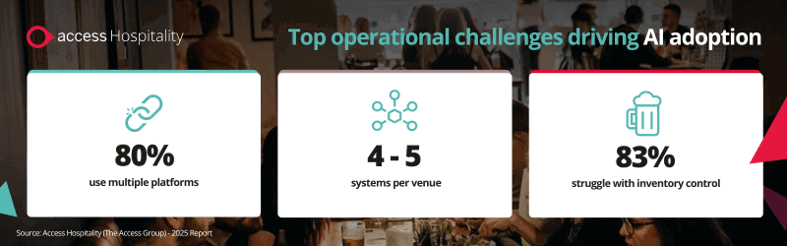
Operators are under pressure to do more with less. Ongoing challenges like labour shortages and rising operational costs mean efficiency is critical. At the same time, most businesses are juggling multiple disjointed systems. Our research shows that 80% of operators use multiple software platforms and the average venue runs four to five different systems. This creates complexity and slows down service. But adopting AI software may not be as complicated as it seems, and can help reduce risk of the biggest challenges facing hospitality operators, such as:
-
Labour shortages and rising costs
-
Fragmented systems slowing service
-
80% of businesses using multiple platforms
-
Average venue running four to five systems
What our hospitality software experts say:
Jules Hailstone, Director of Product Marketing at Access, explains the challenge:
“Stitching together an understanding of business and customer analytics is a huge drain on time. Gluey processes are everywhere. Ordering, invoice management, all of it is a headache.”
Martin Verdon-Roe, GM Front of House, adds:
“Front of House tasks like seating, order taking, payment handling and guest requests eat up huge amounts of time. AI can help by automating these workflows and reducing friction for both staff and guests.”
The business case for AI
Hospitality operators know that every pound counts. Rising costs and operational inefficiencies are eating into margins, and our research shows just how significant the impact can be. On average, 13% of operational expenditure is wasted through disconnected systems. For food-led venues this can mean up to £30,000 lost every year, while drink-led venues see around £15,000 disappear. Even smaller sites lose approximately £23,000 annually. These figures are hard to ignore.
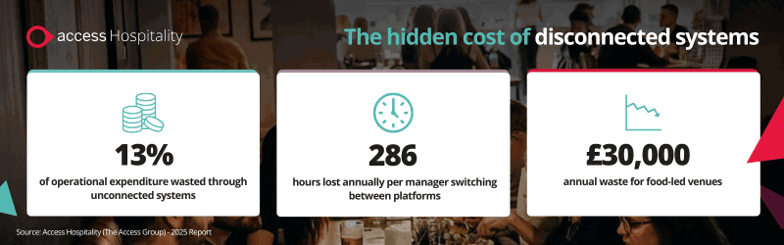
Time is another hidden cost. Managers spend 286 hours a year switching between systems, which is the equivalent of 36 working days. Hotels lose 322 hours annually and food and beverage teams waste 250 hours. These inefficiencies do not just affect profitability, they also slow down service and frustrate staff.
AI offers a practical solution. By connecting systems and automating routine tasks, operators can reduce waste, improve forecasting and make better decisions faster.
Jules Hailstone, Director of Product Marketing at Access, explains:
“Understanding and aligning different pieces of tech is one of the most costly inefficiencies. Data is the key and AI helps bring it together.”
Martin Verdon-Roe, GM Front of House, adds:
“Slow table turns and inaccurate wait time quotes are among the biggest drains on revenue. AI can address these issues by predicting demand and optimising seating and staffing.”
The business case is clear. AI is not about replacing people, it is about removing friction and giving operators the tools to run a tighter, more profitable operation.
The financial impact of disconnected systems:
-
£30,000 annual waste for food-led venues
-
£15,000 annual waste for drink-led venues
-
£23,000 annual waste for smaller sites
-
286 hours lost per manager every year switching systems
AI applications across hospitality
AI is already making a difference in the areas that matter most to operators. From front-of-house to back-of-house to head office, the right applications can reduce waste, improve efficiency and create better guest experiences without adding complexity.
Smarter reservations and table management with AI-powered booking software
Bookings remain one of the biggest operational challenges for hospitality businesses. Our research shows that 40% of operators expect AI to streamline reservations and this expectation is becoming reality. AI-powered booking software uses smart availability and capacity management to calculate real-time table availability, helping venues maximise covers and reduce wait times.
These tools go beyond simple scheduling. AI booking assistants can:
-
Handle guest queries and special requests
-
Suggest alternative times and manage waitlists intelligently
-
Predict wait times and adjust tables dynamically
-
Automate confirmations and reminders to reduce no-shows
-
Manage phone bookings through AI-driven call handling, answering calls and taking reservations without staff intervention
Martin Verdon-Roe, GM Front of House, explains:
“Smarter availability and capacity management, AI booking assistants and waitlist intelligence are transforming reservations. These tools help operators deliver a better experience and keep revenue flowing.”
Reducing food waste and improving stock control with intelligent forecasting
Stock management remains one of the biggest challenges for hospitality operators. Our research shows that 83% of businesses struggle with inventory control and poor visibility often leads to waste and lost profit. For food-led venues this can mean up to £30,000 wasted every year. AI-driven forecasting will help operators predict demand more accurately, and deliver more functionality for streamlining ordering.
AI-powered inventory systems will:
-
Automate ordering based on real-time sales and supplier data
-
Learn from historical trends and performance to optimise stock levels
-
Flag supply chain issues before they happen and suggest alternatives
-
Support dynamic supplier selection to protect margins
Imagine a system that prevents over-ordering, reduces shortages and keeps menus profitable without manual intervention.
Creating personalised guest experiences through data-driven insights
Guests expect more than just good food and drink, they want experiences that feel tailored to them. AI makes this possible by turning data into actionable insights that help operators personalise every interaction.
AI-powered CRM and Guest Wi-Fi solutions can:
-
Analyse guest behaviour and booking history to create dynamic loyalty programmes
-
Automate personalised offers and communications based on real-time data
-
Capture insights from Wi-Fi usage such as visit frequency and dwell time
-
Link Wi-Fi data to CRM profiles for a complete view of the customer journey
Martin Verdon-Roe adds:
“AI can work seamlessly in the background to make the guest experience slick and personalised while predicting issues and capacity. This means teams can focus on delivering the experience rather than firefighting problems.”
Optimising labour costs with predictive scheduling tools
Staffing is one of the biggest costs for any hospitality business and getting it wrong can lead to overspending or service gaps. AI-powered scheduling software helps operators plan with confidence.
These tools can:
-
Analyse historical sales and booking patterns to predict demand
-
Create rotas that match staffing levels to expected footfall
-
Reduce overstaffing and avoid costly overtime
-
Automate compliance checks for working hours and right-to-work rules
-
Provide real-time updates so managers can adapt to last-minute changes
-
Support team retention by identifying dips in morale early, helping operators address issues before they become problems
The result is having the right number of employees at the right time, meeting demand, delivering service excellence and avoiding burnout or unnecessary overspend.
Transforming staff training with adaptive learning technology
Training and compliance are ongoing challenges for hospitality operators, and high staff turnover makes this even harder. CIPD benchmarking data shows hospitality has the highest employee turnover rate at 52% compared to a UK average of 34%. This constant churn means operators are repeatedly investing time and money in onboarding and training new staff. At the same time, compliance requirements such as food safety and allergen regulations remain strict, and failure to comply can result in fines of up to £20,000 per incident.
AI-powered learning systems will make this easier by:
-
Delivering personalised training paths based on role and performance
-
Automating compliance tracking for health and safety standards
-
Identifying skills gaps before they impact service
-
Providing mobile access so staff can learn on the go
-
Offering AI-driven support agents to answer compliance and training-related questions instantly
This helps operators maintain high standards while reducing time spent on manual training administration.
Improving compliance and consistency with AI-enhanced checklists
Daily checks are critical for food safety, hygiene and operational standards, but manual processes can be slow, inconsistent and hard to monitor. Missed tasks can lead to compliance breaches, reputational damage and costly fines. AI-enhanced digital checklists transform this process by automating routine checks and providing real-time visibility across every site.
An AI-enabled checklist solution can:
-
Automate daily compliance tasks for hygiene, safety and service standards
-
Flag missed actions instantly and send alerts to managers for quick resolution
-
Answer policy or procedure questions on demand using AI-powered assistance
-
Push updates across all locations in real time, with read receipts for accountability
-
Analyse completion data to identify recurring issues and predict risks before they escalate
-
Generate automated reports and dashboards for a single view of compliance performance
“Broken workflows and poor communication have long been a costly inefficiency for operators. AI simplifies this by automating checks, surfacing issues instantly, and ensuring everyone who needs to know is in the loop, removing hours of admin and reducing compliance risk.”
Louis MacDonald, Pre-Sales Consultant
The result is consistent standards, reduced risk, and less admin for busy teams, helping operators stay compliant without adding complexity.
Smarter, faster, more reliable AI-enabled property maintenance
Equipment failures and maintenance delays disrupt service, inflate costs and damage guest experience. Traditional workflows often involve multiple handoffs between sites, managers and contractors, creating inefficiencies that drive up labour costs. AI-enabled property maintenance systems transform this process by automating tasks and improving communication.
These systems can:
-
Use sensor data and historical trends to anticipate equipment failures before they happen
-
Streamline routine maintenance to prevent costly breakdowns
-
Rank repairs based on operational impact and guest experience risk
-
Empower staff to resolve minor issues without external callouts
-
Monitor expenses and recommend adjustments for smarter asset management
-
Surface maintenance records to inform decisions on repairs versus replacements
"The broken workflow around maintenance is one of the most costly inefficiencies for operators," says Louis.
"AI removes the need for multiple handoffs, ensures contractors have all the information they need, and even helps teams fix issues themselves, reducing downtime and labour costs."
The result is faster fixes, fewer emergency repairs and venues that consistently deliver exceptional guest experiences.
Driving streamlined operations with AI in hotels
Compared to other hospitality sectors, hotels face a range of unique challenges spanning across multiple departments such as high guest expectations, complex operational workflows and fluctuating occupancy. The rise of the AI age is helping combat these obstacles for hoteliers by streamlining processes and transforming guest experiences without losing the human element.
Our report found that 48% of hotel operators agree that AI integrations have helped with their hotel-specific challenges that were difficult to overcome, with a further 40% expecting AI to streamline bookings. This shows that hospitality businesses are seeing the benefits AI can bring to the table without the worry of operators losing control. So, what can hoteliers expect from AI-powered hotel management tools?
Smarter reservations and room allocations
Having an efficient booking system is crucial for maximising room occupancy and revenue opportunities. With an AI-powered booking engine, hoteliers can:
-
Analyse real-time availability and automatically optimise room allocation.
-
Predict peak demand periods and adjust pricing.
-
Handle special requests and upsell room upgrades.
-
Automate confirmations and reminders to reduce no-shows.
Personalised guest experiences
The modern-day traveller now expects that extra level of detail and attention to their stay. Using a CRM system and guest engagement tools that are AI-enabled, it allows hotels to:
-
Use booking history and preferences to personalise offers.
-
Automate pre-arrival communications and upsell relevant services.
-
Capture insights from Wi-Fi usage and in-stay behaviour for loyalty programmes.
Digital check-ins and guest arrivals
AI driven check-in tools are the key to seamless guest journeys for hoteliers wanting to free up their front desk and optimise guest offerings. Check-in kiosks and mobile room keys will help:
-
Reduces queues at reception.
-
Frees staff to focus on personal welcomes rather than admin.
-
Improves first impressions and guest satisfaction.
AI-powered hotel management tools are taking the hotel industry by storm, with our Senior Product Manager at Access, David Esteban, explaining:
“AI is helping by acting as intelligent middleware. It normalises data, automates API connections and creates a unified layer of insight without forcing you to rip out everything you already have.”
The system integration challenge
Disconnected systems are one of the biggest barriers to efficiency in hospitality. Many operators run separate platforms for EPoS, inventory, HR and reservations, which creates duplication and slows down service. Our research shows that 12 percent of annual software spend is wasted on redundant licences when systems do not talk to each other. This is money that could be invested in improving guest experience or reducing operational costs.
Integration matters because it directly impacts return on investment. When data flows between systems, managers gain real-time visibility of sales, stock and labour costs. This means faster decisions and fewer errors. Without integration, teams spend hours reconciling reports manually, which adds no value and increases the risk of mistakes.
Common pitfalls include:
-
Using spreadsheets as a workaround for disconnected platforms
-
Paying for overlapping features across multiple systems
-
Losing data accuracy when transferring information manually
-
Delays in reporting that prevent proactive cost control
It’s something we hear a lot from our prospects. Jules Hailstone, Director of Product Marketing at Access explains:
“It takes a huge amount of effort to unplumb systems that are already in place. Even large businesses still rely on spreadsheets for critical processes. AI and integrated technology remove this friction and give operators the clarity they need to run a tighter operation.”
Consumer perspectives on AI in hospitality
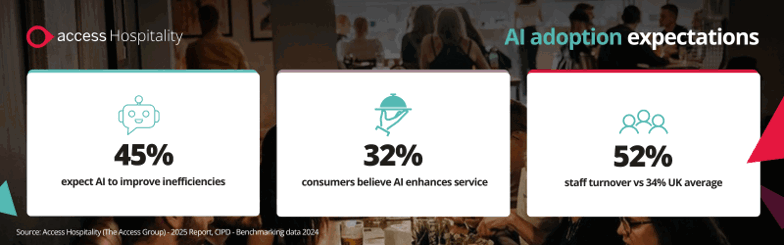
Guests are increasingly aware of technology in hospitality and many expect it to improve their experience. Our research shows that 32 percent of consumers believe AI will enhance service quality and make interactions more personalised. This expectation is growing as people become more comfortable with digital tools in everyday life.
The key question for operators is whether guests trust AI recommendations. The answer is yes, when technology works in the background and supports human interaction rather than replacing it. AI can help predict wait times, personalise offers and manage capacity without guests even noticing the process. The result is faster service and a smoother experience.
Martin Verdon-Roe, GM Front of House at Access added:
“AI can work quietly behind the scenes to make the guest experience slick and personalised while predicting issues and capacity. This means teams can focus on hospitality rather than firefighting problems.”
Implementation Roadmap for AI in Hospitality
Adopting AI doesn't need to be overwhelming. A clear roadmap helps operators move from concept to measurable results without disrupting day-to-day operations. The goal is to start small, build confidence and scale over time.
4 steps for successful implementation:
1. Audit your current systems and processes
Identify where inefficiencies exist and which tasks consume the most time. Look for duplicated data entry, manual reporting and disconnected platforms.
2. Select a pilot area with high impact potential
Choose one function such as inventory control or staff scheduling. This allows you to test AI tools in a controlled environment and measure results quickly.
3. Train your team and communicate benefits
Staff adoption is critical. Explain how AI reduces repetitive tasks and frees time for guest service rather than replacing roles.
4. Measure ROI and refine the approach
Track metrics such as time saved, cost reductions and guest satisfaction scores. Use these insights to expand AI applications across the business.
45 percent of operators expect AI to improve inefficiencies within the next year, making early adoption a competitive advantage.
Common AI myths in hospitality
AI adoption often raises concerns among operators, but many of these fears are based on misconceptions. Understanding what AI does and does not do is essential for making informed decisions.
Here are the common myths we hear every day:
Will AI replace my staff?
No. AI is designed to automate repetitive tasks and provide insights, not to remove the human element from hospitality. It frees your teams to focus on what matters most: creating memorable guest experiences and driving revenue-generating activities.
Is AI too expensive for smaller businesses?
Not anymore. Modern AI tools are scalable and affordable, allowing operators to start with targeted applications such as inventory control or staff scheduling without major upfront costs. You don't need to overhaul your entire operation to benefit from AI—you can implement solutions incrementally based on your most pressing challenges and budget.
Is AI only for big hotel chains?
Far from it. Independent restaurants, pubs and small venues are already using AI to reduce waste and improve efficiency. The technology is accessible and practical for businesses of all sizes. Whether you're managing a single site or a small group, AI applications can be tailored to your specific operational needs without requiring enterprise-level resources.
Is AI secure enough to handle customer data?
Yes, when implemented properly. Reputable AI systems are built with robust security measures including encryption, access controls and compliance with data protection regulations like GDPR. The key is working with established providers who prioritise data security and regularly update their systems. In many cases, AI can actually enhance security by detecting unusual patterns and flagging potential breaches faster than manual monitoring.
What if AI makes mistakes?
AI systems are designed to support human decision-making, not replace it entirely. While AI can process vast amounts of data and identify patterns, the best implementations keep humans in the loop for critical decisions. Modern AI tools also learn and improve over time, becoming more accurate as they process more data from your specific operation. The reality is that AI-assisted processes often have lower error rates than purely manual workflows, particularly for repetitive tasks like inventory tracking or compliance checking.
Will AI be too complicated for my team to use?
Today's AI tools are designed with user experience in mind. The best systems work in the background or integrate seamlessly into existing workflows, requiring minimal training. Your team doesn't need to understand how AI works, they just need to use intuitive interfaces that make their jobs easier. Many operators find that staff adoption is quick because AI tools genuinely reduce workload rather than adding complexity.
Ready to get started with AI in hospitality
In this article we have explored the current state of AI in hospitality and what it means for operators today. We looked at the challenges of rising costs and fragmented systems, the financial impact of inefficiencies, practical applications that deliver real results and the steps to implement AI successfully. We also addressed common myths and shared expert insights on how AI can improve guest experience without replacing the human touch.
Access Evo makes this journey simple. With tools like Copilot for real-time insights, Analytics for smarter decisions and Spaces for team collaboration, operators can connect systems, reduce waste and improve profitability. These solutions are designed to work in the background so your teams can focus on what matters most, delivering great hospitality.
Ready to see how AI can transform your business?
