AU & NZ
 SG
SG
 MY
MY
 US
US
 IE
IE

How can AI reduce operational costs in your restaurant or hotel without adding complexity?
If you're managing a restaurant, hotel, or multi-site hospitality business, you're likely juggling rising costs, staff shortages and increasing compliance demands, all while trying to maintain excellent guest experiences.
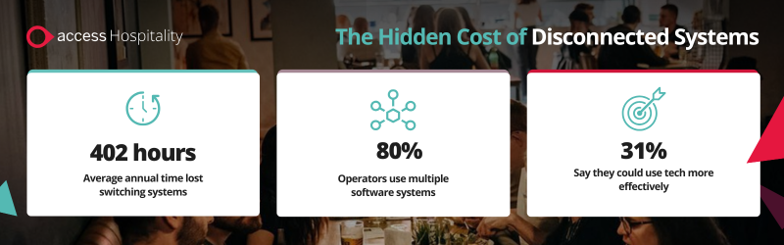
The hidden cost? UK hospitality managers waste 286 hours per year (equivalent to 36 working days) simply switching between disconnected systems according to our AI Hospitality Report. Hotels lose 322 hours annually, while food and beverage venues waste 250 hours. That's time that could be spent on revenue-generating activities or improving service quality.
As AI in hospitality continues to evolve, operators are finding practical applications that address these fundamental operational challenges without requiring wholesale technology replacements.
This guide shows you practical ways AI is already helping hospitality operators automate procurement, predict demand more accurately and streamline compliance processes. You'll see real applications that reduce food waste, save management time and improve profitability, without requiring technical expertise or wholesale system changes.
We'll also explore how integrated platforms like Access Evo bring these capabilities together, eliminating the system-switching problem while delivering measurable operational improvements.
The real cost of disconnected systems
Your managers are making critical business decisions with incomplete information. Not because they're incompetent, but because your procurement data sits in one system, your sales performance in another and your labour costs in a third. By the time someone manually pulls it all together in a spreadsheet, the insight is already outdated.
This fragmentation has measurable consequences. You're carrying excess inventory because ordering isn't connected to actual consumption patterns. You're missing revenue opportunities because upselling relies on staff guessing what's in stock. Your labour costs creep up because scheduling decisions aren't informed by accurate demand forecasting.
Access research shows 80% of hospitality operators are running four to five disconnected software platforms, with 31% acknowledging they're not extracting full value from their technology investment. Each year, this means hundreds of management hours spent on manual data reconciliation that could be directed toward strategic growth initiatives.
Louise Agostini-Krasucki, Commercial Director at Access Hospitality, sees this playing out daily: "The real cost isn't just the manual work. It's the opportunities we miss because we're too busy firefighting to focus on growth initiatives. Conservative estimate? We'd save £40-50k annually just in time recovered, not to mention the revenue we'd protect by catching issues earlier."
Your current systems aren’t fundamentally broken, it's that they don't communicate with each other. AI solves this without requiring expensive system replacements. By connecting your existing platforms, automating routine data consolidation, and surfacing actionable insights, AI enables faster, more informed decisions that directly impact your bottom line.
Can AI actually fix your inventory and procurement challenges?
If you're looking for quick wins from AI implementation, start with your supply chain. This is where the technology pays for itself fastest.
The inventory problem eating your margins
According to our AI in Hospitality Report, inventory management creates a perfect storm of lost revenue:
-
83% of operators struggle with stock and inventory control
-
More than half miss revenue opportunities by running out of key items
-
44% regularly over-order stock, tying up cash and generating waste
-
48% under-order, leading to menu limitations and disappointed guests
Every case of prawns that spoils, every premium wine you can't offer, every last-minute emergency order at inflated prices, these all show up in your GP%. The challenge is that manual ordering processes can't keep pace with the variables affecting your stock needs.
How AI fixes procurement decision-making
AI-driven procurement uses your historical sales data, seasonal patterns and upcoming bookings to recommend precise order quantities. Instead of your kitchen manager estimating based on gut feel or last week's numbers, the system analyses consumption trends across comparable periods while factoring in upcoming events, weather forecasts, supplier lead times, and current stock levels with shelf-life considerations.
Modern integrated platforms can automate this entire workflow, setting intelligent par levels, comparing supplier performance and monitoring GP% in real-time. This eliminates the spreadsheet reconciliation that currently consumes management hours every week, with tools like Access Evo's Procure Wizard bringing these capabilities into your existing operational systems.
What you'll see is smarter purchasing decisions that reduce waste and improve margins, delivered through workflows your team already understands. No technical expertise required, just better data informing better decisions.
How can you prevent equipment failures before they disrupt service?
A commercial oven failing during Saturday lunch service doesn't just mean calling an engineer. It means turning away covers, disappointing guests and watching revenue walk out the door.
Louis MacDonald, Pre-Sales Consultant for Access Maintain and Trail, explains the cascading delays: "Sites contact a manager, who then contacts an engineer, who then has to communicate back to sites about when they'll arrive. This broken communication channel means contractors are often missing critical information, which results in fewer first-time fixes, more fees, and longer time spent on site."
For multi-site operators, these emergency situations multiply across locations, with repair costs escalating through emergency callout premiums and extended downtime.
Moving from reactive repairs to predictive maintenance
AI-enabled equipment monitoring analyses sensor data and historical performance patterns to flag potential failures weeks before they happen. Rather than waiting for your commercial dishwasher to break down mid-service, you're scheduling maintenance during quiet periods when it won't impact operations.
The system tracks performance indicators that signal wear and tear:
-
Temperature fluctuations in refrigeration units
-
Cycle times in dishwashers
-
Heating consistency in ovens
When patterns deviate from normal operating parameters, you receive alerts with enough lead time to plan repairs around your business needs rather than emergency availability.
What this means for your operation
You're extending the lifespan of expensive capital equipment while avoiding the premium costs of emergency repairs. More importantly, you're maintaining service consistency. Guests don't experience menu limitations because equipment failed unexpectedly. Your team isn't scrambling to work around broken kit during peak periods.
Integrated platforms can consolidate maintenance schedules, compliance checks, and performance monitoring in one place. Access Maintain Evo brings these capabilities together, so your management team isn't toggling between equipment dashboards, paper logbooks, and calendar reminders.
Your kitchen environment becomes more reliable. Your service quality becomes more consistent. Your maintenance budget becomes more predictable. All of this gets managed through systems your team already uses daily.
Can AI reduce your compliance burden without compromising safety standards?
Compliance sits at the intersection of high risk and high admin burden. From Natasha's Law allergen labelling to FSA hygiene checks, maintaining accurate records and meeting legal requirements demands constant management attention. Manual processes and disconnected systems amplify both the workload and the risk of costly errors.
The data accuracy problem
Our research reveals significant gaps in how operators manage compliance information:
-
60% of operators believe their data is incomplete or missing
-
50% cannot trace where data comes from or how it was calculated
-
20% lack confidence in the accuracy of data from their current systems
The consequences go well beyond administrative headaches. When your allergen information is incomplete, you're putting guests at genuine risk. If temperature logs are missing during an FSA inspection, you're facing potential enforcement action. And when data provenance is unclear, demonstrating due diligence becomes impossible at the exact moment you need it most.
How AI automates compliance management
AI-driven compliance tools monitor food safety tasks, allergen information and audit trails in real time rather than relying on paper logs or multiple spreadsheets. The system creates an automated record of when tasks were completed, by whom, and what the results were. This gives you complete traceability without manual documentation.
When potential issues emerge, you receive alerts before they become problems. A missed temperature check triggers a notification. An allergen declaration that conflicts with ingredient data gets flagged for review. Your audit trail builds automatically as your team works through their normal routines.
Platforms like Access Evo integrate these capabilities through Trail Evo Copilot, using AI to streamline compliance workflows across all your sites. Your management team spends less time chasing paperwork and more time ensuring operational standards are actually met. When the inspector arrives, your documentation is complete, accurate, and immediately accessible.
How much profit are you throwing away with food waste?
Food waste doesn't just affect your sustainability credentials. It cuts directly into your profit margins every time an ingredient spoils before you can use it. Our AI in Hospitality Report found that 44% of operators regularly over-order stock while 48% under-order. You're either watching produce rot in your walk-in or scrambling to substitute menu items because you've run out.
Why traditional forecasting falls short
Most operators rely on historical averages or gut instinct when placing orders. The problem is that neither accounts for the variables actually driving demand. A sunny bank holiday weekend generates different consumption patterns than a rainy Tuesday in February. A local event can double your covers. Manual estimation simply can't process these factors fast enough to inform accurate purchasing.
AI-driven demand forecasting
AI analyses your real-time sales data alongside seasonality patterns, weather forecasts and upcoming events to recommend precise order quantities. The system learns which menu items sell together, how preparation affects ingredient yield and which dishes underperform so you can adjust purchasing accordingly.
Operators using AI-driven forecasting have achieved up to 4% reductions in food waste. For a business turning over £2 million annually with a 30% food cost, that's roughly £24,000 moving from waste bins back into your bottom line.
Connecting purchasing to menu performance
Integrated platforms can link inventory management directly to menu engineering insights. If a dish consistently underperforms, you'll see the impact on ingredient usage before you place your next order. These capabilities integrate directly into your inventory and menu management systems so purchasing decisions align with actual consumption patterns rather than assumptions.
Reducing waste improves your operational efficiency while strengthening your environmental positioning. You're buying smarter, your kitchen team is working with fresher ingredients, and your sustainability story becomes quantifiable rather than aspirational.
Is AI ready to work for your business?
This guide has shown you how practical applications of AI in hospitality are already solving real operational challenges. From reducing the 286 hours managers waste switching between systems to cutting food waste by 4%, preventing equipment failures before they disrupt service, and automating compliance documentation, the technology delivers measurable improvements when applied to genuine business problems.
The operators seeing results aren't implementing AI as a standalone project. They're addressing the system fragmentation that prevents any technology from working effectively. When your procurement data can't talk to your sales performance, and your compliance records live separately from your operational workflows, AI can't access the complete picture it needs to generate useful insights.
Access Evo is our unified hospitality management platform that connects your entire operation. From front-of-house and EPoS to procurement, menu engineering, and workforce management, everything works together in a single system. Your data flows in real-time across your business rather than sitting trapped in disconnected silos.
AI capabilities are built directly into Access Evo's workflows. You're not adding another system for your team to learn or another dashboard to monitor. Instead, AI works within the tools your managers already use daily, surfacing insights from the data you're capturing, automating routine tasks, and flagging issues before they impact service. Faster decisions, reduced waste, improved profitability, and elimination of those 286 wasted hours happen through your existing processes, not alongside them.
Ready to see how Access Evo eliminates system fragmentation while delivering AI-powered operational insights? Explore the platform built for hospitality operators who need integration and intelligence working together.