

 AU & NZ
 SG
SG
 MY
MY
 US
US
 IE
IE
How to make savings in your hospitality procurement process
If you’re reading this, then you have probably identified that your current procurement processes need to be streamlined. Now, that might be coming from the top level down, and you need to find ways to implement more efficient processes across your estate or maybe you are looking for some quick wins to implement in your own processes to make them more cost effective.
In the dynamic realm of large-scale hospitality operations, where restaurants, hotels, pubs, and bars orchestrate intricate supply chains, the role of procurement stands as a linchpin for success. As operators contend with the ever-present challenges of cost fluctuations, supplier management and operational efficiency, the need for a strategic approach to procurement has never been more crucial.
How to make savings in practice
Here at Access Hospitality, Procure Wizard Evo helps customers surface the data they need on stock, recipes and ordering, so they can pinpoint underperformance, high costs and avoidable waste across their procurement process. By combining mobile‑first workflows with AI‑driven insights, it supports more targeted strategies to drive savings, protect margins and ensure the right products are available when and where they are needed.
In this article, we will focus on practical ways to make savings in your hospitality procurement – from reviewing purchasing requirements to capturing credits and using better data – and then show how Procure Wizard Evo can support these approaches in a real‑world operation.
Why automating procurement unlocks savings
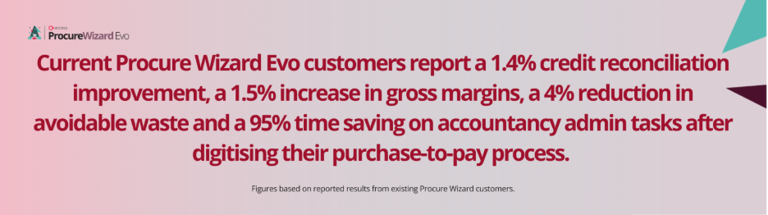
Effective procurement is one of the fastest ways for hospitality operators to improve margins – but only if you have the right data and controls in place. Current Procure Wizard Evo customers report a 1.4% credit reconciliation improvement, a 1.5% increase in gross margins, a 4% reduction in avoidable waste and a 95% time saving on accountancy admin tasks after digitising their purchase‑to‑pay process.
Automating and centralising your purchase‑to‑pay process reduces admin costs, improves accuracy and visibility, and makes it easier to spot and act on opportunities to save.
When a business relies on manual procurement, the time taken to collate spreadsheets from multiple sites – plus the risk of human error – creates delays and makes it harder to trust the data you’re using to make decisions.
In contrast, using a purchase‑to‑pay platform gives immediate visibility of key KPIs across the business, enabling a more proactive approach to performance and profitability.
However efficient your current supply chain is, it still needs a robust system and clear focus areas if procurement savings are to be maximised and changes are to have a real impact on reducing costs and increasing gross profit.
How to make savings in practice
Review your current purchasing requirements
A procurement process that has been in place for some time may no longer fit an evolving operation. Ordering more stock than is needed results in higher outlay, increased storage costs and unnecessary wastage. Buying what is needed, when it is needed, remains the most efficient approach, but there are usually opportunities to consolidate requests and reduce order frequency to cut delivery costs and admin.
You can build this review around a few simple questions:
-
Are we consistently over‑ or under‑ordering specific products across sites?
-
Where could we consolidate deliveries or suppliers without compromising quality?
-
Which products are still specified at a higher spec or brand than we actually need?
A regular review of specifications helps rationalise expenditure. Rather than sticking with the status quo, procurement teams should evaluate whether lower‑cost substitutions can deliver comparable quality and performance, as maintaining higher‑spec supplies without assessing alternatives can quietly erode margins.
Rethink supplier strategies
Supporting local and small businesses and being loyal to suppliers is admirable, as long as pricing, quality and availability stay aligned. A regular review of supplier performance and pricing can highlight potential savings without undermining relationships. Adjusting purchasing patterns, consolidating orders, or re‑negotiating minimum order quantities can all unlock better rates.
A few principles help here:
-
Pre‑authorise suppliers and define their products and pricing centrally, to avoid duplication and inconsistent deals across sites.
-
Channel spending on specific products through nominated suppliers where possible, so you can secure volume‑based discounts and avoid uncontrolled one‑off purchases.
-
Use a preferred supplier list that allows suppliers to upload products and prices directly, with any changes automatically highlighted to show the impact on your business.
This approach maintains control at head office level, while giving local teams clarity on what they can order and from whom.
Simplify the process
The more links in a chain, the more likely it is to break. Automating key elements of the supply chain reduces the risk of errors and delays. A suitable technology solution can handle every step – from sourcing and agreeing terms, to creating and approving purchase orders, matching receipts against orders and validating invoices – while reducing paper and manual keying.
By removing complexity, technology simplifies the procurement process:
-
Cost centres are captured in one place.
-
Purchase orders are automatically assigned to the right location.
-
Accruals and approvals are collected in the background as part of everyday workflows.
Invoice processing is a good example. Manually processing invoices can be time‑consuming and labour‑intensive; automating matching and approvals through purchase‑to‑pay software gives time back to your team for more productive work, without losing control.
Capture those credits
With time at a premium, capturing credits rarely reaches the top of the list. Cross‑checking prices and deliveries is often seen as laborious and not worth the effort. Yet within hospitality, around 0.2% credit capture is typically achieved manually, whereas the average when using purchase‑to‑pay technology rises to about 1.5%.
Even at modest levels of F&B spend, that uplift can be significant – particularly over a year or more and across multiple sites. If you know your F&B spend, you can quickly estimate how much your credit capture could be using an ROI calculator designed for this purpose.
If the system has told me I'm going to make £7,000 today, therefore I need twenty-nine burgers, then I'm going to prep salad for twenty-nine things. I'm going to leave the rest of the tomatoes in the fridge and not cut them.
Andy Sestak, our Procure Wizard Evo Commercial Specialist who worked as a Head Chef at Wagamama
How Procure Wizard Evo helps deliver procurement savings
While the principles above apply regardless of system, modern purchase‑to‑pay tools can make them much easier to apply day‑to‑day.
Procure Wizard Evo is our next‑generation, AI‑powered purchase‑to‑pay platform for hospitality, designed to move operators from reactive procurement to proactive, intelligent control.
Instead of simply reporting what has already gone wrong, the system uses AI models trained on live purchasing, stock and waste data to predict what is likely to happen next, so teams can act before issues hit profitability. Operators see recommended actions alongside real‑time insights and alerts, helping them make smarter buying decisions, tighten cost control, reduce wastage and lift margins with less admin and operational burden.
Key capabilities that support the savings described in this article include:
-
Ordering Portal as the new home of P2P: A refreshed, e‑commerce‑inspired buying experience with modern UX and mobile‑friendly design, giving a consistent journey across devices and making it easier for teams to order on the move.
-
Enhanced product catalogue and supplier collaboration: Suppliers can upload rich product images and updated pricing directly, with improved price comparison, clearer cost differences and suggested better‑price alternatives to help users optimise baskets automatically.
-
Intelligent prompts and forecasting: Machine‑learning‑based prep and PAR tools dynamically suggest the right products, at the right price and quantities, aligned to demand patterns, cutting over‑ordering, reducing holding stock and supporting more consistent gross margins.
-
Access Evo Copilot and Feed: Secure, ring‑fenced AI assistance and live activity feeds surface predictive alerts, recommended actions and key tasks from across purchasing, stock and waste data, so operators can focus on exceptions rather than hunting through reports.

Ready to make savings in your procurement process?
In this article, we have explored some of the key areas to focus on when identifying pain points and saving opportunities in your procurement processes. Streamlining procurement through automation and centralisation can unlock significant cost savings, reduce waste and free up your teams’ time – but sticking with manual workflows or basic tools can make it hard to sustain those gains.
The ideal solution will always depend on your estate, systems and priorities. Factors like budget, existing tech stack and team capacity all shape what “good” looks like for your operation. Procure Wizard Evo is our reimagined purchase‑to‑pay platform for hospitality, designed to bring stock, recipes and ordering into one mobile‑first, AI‑powered workflow so you can turn these ideas into day‑to‑day practice.
If you would like to understand what this could look like for your venues, why not arrange a demo with our team and explore how Procure Wizard Evo could support your procurement strategy?