

 AU & NZ
 SG
SG
 MY
MY
 US
US
 IE
IE

The 'Golden Thread' in Construction: What IT Leaders Must Deliver to Support BSA Compliance
Could your systems produce a 'golden thread' tomorrow? For construction companies and contractors working on higher-risk buildings, that is not a hypothetical question.
The Building Safety Act 2022 and the regulations under it require a digital record that keeps every old version of a document, logs each change against a name and a date, and can be handed on intact. That has been the rule in England since October 2023.
This guide covers what the 'golden thread' of information is, the ten principles behind it, what has to be recorded at each stage, what happens at handover, and where Access Coins Evo and Access Fonn come in.

Contents
- What is the 'golden thread’ in construction?
- What does the Building Safety Act 2022 require?
- Who is checking the ‘golden thread’?
- What are the principles of the 'golden thread’ in construction?
- What information do construction contractors need for the 'golden thread’?
- Building the 'golden thread’ with Access Coins Evo and Access Fonn
What is the 'golden thread’ in construction?
The 'golden thread’ is the digital record of all the information and documentation needed to understand a building and keep it safe, from design through to occupation. The requirement for new buildings in the UK to maintain a ‘golden thread’ was established into law under the 2022 Building Safety Act and came into force on October 1st 2023.
Think of it as the building's current, complete picture: how it was designed, what was actually built, what materials were used, what changed along the way and why, and what has been inspected or tested since. When a design changes or an inspection is signed off, the record moves with it. That makes it a ‘living record’ rather than a folder of drawings handed over at completion.
The 'golden thread’ also covers the process of how information is created, checked, updated, and passed on, so anyone who needs it later can find it and trust it.
The idea came from Building a Safer Future, Dame Judith Hackitt's 2018 review after the tragic Grenfell Tower fire in 2017., Grenfell exposed how haphazardly building information had been managed: records missing, changes undocumented, with nobody accountable for keeping any of it straight. It is now law.
It does not apply to every project. In England, a higher-risk building is 18 metres or 7 storeys with at least two homes in it, and hospitals and care homes at that height count too. Wales has its own regime, brought in during 2026, with a different threshold.
On projects in scope, the duty is shared. Clients, principal designers, and principal contractors hold the 'golden thread’ through design and construction. Once people move in, the accountable person takes over.
The client has to supply the electronic facility that holds the record, plus the rules for who has access to it. The ‘golden thread’ lives in a system that requires an owner.

What does the Building Safety Act 2022 require?
The Building Safety Act 2022 received royal assent on 28 April 2022 and redefined how higher-risk buildings are designed, approved, and managed. It created the Building Safety Regulator, set up an approvals process built around multiple gateways, and brought in duty holder roles with legal responsibility at each stage.
What the law asks for
‘Golden thread’ regulations arrived in two stages, and the gap between them is part of why construction professionals are unclear about what applies to them.
The first covers design and construction. Since 1 October 2023, the client has had to set up and maintain an electronic facility for the 'golden thread’ and define who has access to it..
The second covers occupation. From January 2024, the same responsibility falls to the accountable person.
Alongside the evidence that the work meets building regulations, the ‘golden thread’ record has to hold:
- The change control record for every proposed controlled change, including a note when one does not go ahead.
- Any mandatory occurrence reports
- Notices appointing a new principal contractor or principal designer
- Applications for a completion certificate
One rule applies throughout: whenever a document is updated, all previous versions are retained. Principal contractors carry three duties of their own:
- Work inside the client's system rather than a parallel one
- Keep the evidence that work meets building regulations
- Handle change control with the design team
Who is checking the ‘golden thread’?
The Building Safety Regulator is the body created by the Act to oversee the new legislation, and since October 2023 it has acted as the building control authority for every higher-risk building in England. Contractors working on a higher-risk building now answer to the BSR instead of local authorities or private sector companies.
The ‘golden thread’ is checked at three gateway points: planning, building control approval before work starts, with a completion certificate awarded at the end of the build.
Each gateway acts as a stop. Construction cannot begin until the BSR has approved the Gateway 2 application, and the building cannot open until the completion certificate is issued.
Between those gateways sits the construction phase, where the approved design meets the realities of the site. The 'golden thread’ is the record of what happened during that gap, and it is what the regulator relies on when deciding whether the building it approved at Gateway 2 is the building that got built.
Manage Your Golden Thread Information with Construction Management Software from Access Construction
Access Fonn, the mobile-first site management tool, and Access Coins ERP are both powerful solutions to help you securely manage your 'golden thread'.
What are the principles of the 'golden thread’ in construction?
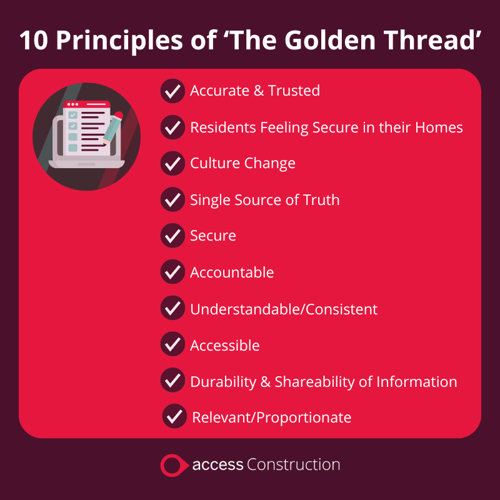
1. Accurate and trusted
The 'golden thread’ must be accurate, structured, verified, and trusted so that relevant people can reliably use it.
2. Residents feeling secure in their homes
Information will be provided to residents, to enable them to feel safe in their homes. A well-maintained 'golden thread’ will support accountable persons in providing residents with assurances that their building is being managed safely.
3. Culture change
The 'golden thread’ should be considered an enabler for better and more collaborative work. It will require increased competence and capability, new working practices, updated processes, and a focus on information management and control.
4. Single source of truth
The 'golden thread’ will bring all information together into one single source of truth. This will involve tracking all changes and the reason for these changes.
5. Secure
The information within the 'golden thread’ must be secure to protect personal information and control access, complying with GDPR legislation at all stages.
6. Accountable
The 'golden thread’ will record all changes alongside who made them. This will foster improved accountability, ensuring there is a responsibility for all parties involved from the client to the accountable person.
7. Understandable and consistent
The information in the 'golden thread’ must be clear, understandable, and focused on the needs of the user. It should be presented in a way that can be easily understood.
8. Simple to access
All information should be readily available to those who need it. This means that the information needs to be stored in a structured way so people can easily find, update, and extract the right information.
9. Longevity, durability, and shareability of information
The 'golden thread’ must be maintained throughout the entire life cycle of a building. Therefore, the information should always be relevant and shareable across different parties.
10. Relevant and proportionate
The 'golden thread’ does not require every bit of historical information to be tracked and kept. Instead, it should always include the most relevant information required to accurately maintain building safety.
Building higher-risk projects?
See how Access Coins Evo and Access Fonn work together to keep your golden thread in one place.
What information do construction contractors need for the 'golden thread’?
When the 'golden thread’ was first introduced, the specifics were left open to interpretation. That has since changed. Regulation 31 sets out what must go into the record during design and construction, and Schedule 1 of the Higher-Risk Buildings Regulations 2024 sets out what the accountable person maintains once the building is occupied.
Firstly, all information stored must be proportionate and essential for the ongoing development or maintenance of a building's fire safety. Depending on the building's stage of development, the information stored and shared as part of the 'golden thread’ will need to be altered.
During the pre-construction and build stages, priority goes to information about the building's intended safety measures and how they comply with current regulations.
Alongside the evidence that work meets building regulations, the ‘golden thread’ must hold the change control record for every proposed controlled change, any mandatory occurrence reports, notices appointing a new principal contractor or principal designer, and applications for a completion certificate.
This is not paperwork to be filed and forgotten. The Building Safety Regulator has been the building control authority for higher-risk buildings in England since October 2023, and that information forms part of the gateway application it assesses before work can start.
Once people move in, a different list applies. Schedule 1 sets out what the accountable person keeps, sorted into named categories. They include:
- Building compliance and scheme work
- Registration, and key building information
- The building assessment certificate application
- Fire safety management and evacuation
- Structural risks
- Management of building safety risks
- Building design
Moving between those two lists means moving between two organisations, and usually two systems. What the contractor captures has to land in a form the accountable person can keep using.

How do you manage 'golden thread’ information?
All ‘golden thread’ information about a building must be:
- Kept digitally
- Kept securely
- Accurate and up to date
- A building's single source of truth
- Available when someone needs it to do their job
- Readable, with a key to any codes or abbreviations
- Changed in a way that records who did it and when
- Consistent in the words and terms it uses, as far as is reasonably practicable
- Able to move to another party without anything being lost
The 'golden thread’ is more than the information stored. It is also the process teams follow to control it.
On larger projects, managing all this by hand stops working fast. Most large contractors now run software instead: a construction ERP for the commercial and document record, plus a mobile platform that captures what happens on site. Systems vary a lot on version history, permissions, and export, so it is worth testing any of them against ‘golden thread’ principles first.
Why do construction contractors need to manage 'golden thread’ information?
The 'golden thread’ is now a key part of a stricter regime for building safety in higher-risk buildings, and managing it properly does more than protecting residents. It helps protect construction companies and contractors too.
The ‘Golden thread’ information passes to whoever takes the building on, and it must arrive with its filing structure intact, indexes and keys included, in a format the recipient can read, keep, and update. The Building Safety Regulator must be satisfied that handover is complete before it issues a completion certificate. If it is not satisfied, it must reject the application, and without that certificate the building cannot be occupied.
A poorly managed record is therefore not a problem that surfaces some vague distance down the line. It is a delay to handover a building the client is waiting to fill, and a rejected application means correcting the problem and applying again.
It is also why reconstructing the record after the fact tends to fail. Filing structures, indexes, and keys are either maintained as the work goes, or they are not, and the evidence beneath them is either captured on site at the time, or it is not.
Managing 'golden thread’ information well is not only a matter of Building Safety Act 2022 compliance. It is what allows construction companies and contractors to finish the job and hand it over cleanly.
Building the 'golden thread’ with Access Coins Evo and Access Fonn
The 'golden thread’ has two halves, and most contractors keep them apart. The commercial record sits in one system; the evidence made on site every day sits somewhere else, if it is captured at all.
Access Fonn covers the site half. Every drawing revision is version controlled, earlier versions kept, read receipts showing who saw what. Changes carry a timestamped audit trail. Its Forms module adds inspection and compliance forms with signature capture, geo-tagged and timestamped where the work happens.
Access Coins Evo covers the rest. Documents sit against the requisitions, orders, and invoices they belong to, with role-based access and a full audit trail of every change and who made it. Its supply chain tools track insurance and accreditations per subcontractor, with ConstructionLine monitored automatically and expiries flagged before anyone starts on site. When the BSR asks how a contractor manages its subcontractors, that is the record to answer from.
Then the two connect. A project set up in Coins Evo appears in Fonn, and subcontractors join without extra licenses. Kept apart, the two halves have to be squared up later, under deadline, from memory. Kept as one, the record accumulates as the work does.
For UK contractors working towards 'golden thread’ compliance, Access Coins Evo and Access Fonn together are the shortest route to a record that is complete at handover, not assembled in a hurry before it.

See a 'golden thread’ that builds itself
The commercial record in Access Coins Evo. Site evidence in Access Fonn. One system, one record, and nothing to reconcile at the end.
'Golden thread’ in construction FAQs
Does the golden thread apply to every construction project?
No. The 'golden thread’ only applies to higher-risk buildings. In England that means 18 metres or 7 storeys with two or more homes, plus hospitals and care homes at the same height. Wales runs its own regime with a different threshold
What is the 'golden thread’ of information in construction?
It is the digital record of everything needed to understand a higher-risk building and keep it safe, maintained from design through to occupation. It covers the building as designed, as built, and as changed, along with the process for creating, checking, and updating that information.
Who is responsible for the 'golden thread’ during construction?
The client provides the electronic facility and sets the access rules. Principal designers and principal contractors keep the information current as work progresses. Once the building is occupied, the accountable person takes over.
Does 'golden thread’ compliance require specific software?
No. The regulations describe how the information has to behave, not which product holds it: digital, secure, accurate, readable, searchable, changed only in a way that records who did it and when, and able to move to another party without anything being lost. Many tools fall short of that, so it is worth testing against the list rather than assuming. Access Fonn is built around version control and timestamped audit trails for exactly this reason.
What has to happen to the 'golden thread’ at handover?
The client hands the record to whoever takes the building on, with its filing structure intact, including every index and key, in a format the recipient can read, keep, and update. The Building Safety Regulator must be satisfied that this is complete before issuing a completion certificate, and without that certificate, the building cannot be occupied.
How do Access Coins Evo and Access Fonn support the ‘golden thread’ required by the Building Safety Act?
Access Fonn captures site evidence as work happens. Version-controlled drawings, timestamped audit trails, and inspection forms with signature capture are included as standard. Access Coins Evo holds the commercial and document record, with role-based access, time-stamped approvals, and subcontractor accreditation tracking. The two connect, so the record accumulates as the work does.