

 AU & NZ
 SG
SG
 MY
MY
 US
US
 IE
IE

The Future of L&D Report 2026
How learning and development is evolving, and the role of AI, skills and human expertise
For learning and development (L&D) teams, 2025 was defined by one question: how do we adopt AI safely?
Twelve months on, adoption is no longer the primary challenge. Instead, organisations are asking a more complex, more consequential question: how do we use AI to drive meaningful performance outcomes?
Access Learning’s Future of L&D Report 2026 brings together perspectives from leading industry voices, alongside our own insights, to explore how the role of L&D is changing in response to these shifts.
It builds on last year’s findings – where AI was positioned as both a disruption and an opportunity – and examines how that conversation is maturing in practice. The result is a clear shift in focus. From experimentation to execution, from content creation to capability building, and from technology-first thinking to a more balanced, human-centred approach.
So, what does the future now look like for L&D professionals? How is AI reshaping the function, and what parts remain fundamentally human? As the pace of change accelerates, how can L&D stay credible, strategic and impactful?

Performance, not adoption, will define AI success in L&D
Key points:
- Focus is shifting from AI adoption to measurable performance impact
- Organisations are embedding AI into workflows, not layering it on top
- Capability building is moving from awareness to contextual application
- Defining clear performance problems remains a key challenge
- Those aligning AI to business outcomes are starting to see greater value
In our 2025 L&D report, the conversation around AI in L&D was dominated by caution: governance, risk, and whether organisations were ready to adopt it at all.
In 2026, our contributors identified a clear shift: the focus is no longer on whether to use AI, but on whether it’s actually making a difference. Organisations are starting to integrate AI into the flow of work, using it to support decision-making, performance support, and day-to-day capability.
Andy Lancaster, chief learning officer at Reimagine People Development, explains how this shift is translating in practice:
“Previously, the conversation was how do we adopt AI safely, or what tools can we use and how can we test those. Now it’s moving far more to how AI can measurably improve performance. It’s not about layering AI onto existing processes, it’s about redesigning those processes so AI sits at the heart of them.”
However, this shift has also exposed some performance challenges, reflecting how organisations have chosen to apply AI so far.
Lancaster points to a key weakness in how organisations have approached AI capability:
“We’ve seen a slight kick back to AI literacy training: there was a push to train everybody up in basic AI skills, but we’re now recognising that it’s too generic, and doesn’t really influence performance. There’s much more thinking now around ensuring AI is contextual, as AI knowledge alone is not enough.”
This highlights a broader issue: AI has been introduced to speed things up rather than solve a clearly defined performance problem. Without that connection to real work, both training and application will be less impactful.
Tom McDowell, founder and principal consultant at Evolve, sees this pattern across organisations that are struggling to realise value from AI:
“Organisations that are struggling tend to be treating AI adoption as a technology project. Without a clear performance problem to anchor the technology, AI becomes a solution searching for a question – and that’s where you see the pattern of generating more content nobody needs, slightly faster than before.”
Without a clear understanding of where performance gaps exist, AI can accelerate the creation of learning content, but it won’t necessarily improve performance or business outcomes on its own.
Elliot Gowans, General Manager at Access Learning, outlines what more outcome-focused AI use actually looks like day-to-day:
“We’re entering a phase where AI can take care of much of the heavy lifting in L&D. Identifying learning needs, curating relevant content, and configuring programmes that once took hours can now be completed in minutes.
“Crucially though, nothing goes live without human oversight. L&D professionals remain firmly in control - but instead of spending a lot of time on administrative tasks, they can focus on making informed decisions and driving meaningful outcomes.
“The organisations that will see the greatest impact are those that use this time to get closer to the business. That means understanding where performance challenges exist, identifying the root causes, and ensuring learning is directly linked to the outcomes that matter most.”

AI-generated content could make achieving engagement harder
Key points:
- Learners are becoming more sceptical of AI-generated content
- Authentic, human-led content is becoming more valuable
- There is a growing need to differentiate learning experiences
- AI is accelerating content creation, but not necessarily improving engagement
With AI making it easier than ever to generate learning content, contributors suggest that this is creating a saturation point. As more organisations adopt similar tools and approaches, learning can become less distinctive, and ultimately less engaging.
Sara Mian, director of learning content at Access Learning, reinforces this, noting that learners are becoming more selective:
“There’s become this instinct now where people are asking, ‘is that AI-generated?’, and the minute they think it is, it suddenly becomes less valuable. This reflects a broader change in perception. As AI-generated content becomes more common, learners are becoming more aware of it, and in some cases, more sceptical.
“People are seeking out more human, authentic content, placing greater value on real stories, real experts, and real practitioners.”
There seems to be a growing resistance towards AI-generated content. People can tell when something feels generic. People are more likely to trust and engage with content that reflects real experience or expertise.
This challenge is compounded by how AI is being applied in practice. As content creation becomes faster and easier, there is a risk that organisations prioritise speed and scale over relevance and quality.
Tom McDowell says “Most of what I’ve seen over the past year has been AI deployed to do the wrong things faster – particularly content generation, when the speed of content creation was never our bottleneck. The problem is understanding performance gaps well enough to design something worth producing at all.”
These insights suggest that as AI accelerates content creation, the challenge for L&D will not be producing more – but ensuring what is produced is authentic, credible, differentiated, and worth attention.
Critical thinking will become more discipline specific
Key points:
- Critical thinking remains a priority, but progress has been limited
- Skills needed to use AI accurately and responsibly are not keeping pace
- Organisations are struggling to define and measure critical thinking effectively
- Critical thinking is becoming more discipline-specific
- Embedding critical thinking into real tasks will become essential
In our 2025 report, critical thinking was consistently identified as one of the most important skills for the future of work. Since then, progress appears to have been limited.
Across contributors, there is a clear sense that while organisations recognise the importance of critical thinking, it is still not being meaningfully developed in practice.
Jo Cook, L&D specialist at Lightbulb Moment and editor at Training Journal, highlights this gap:
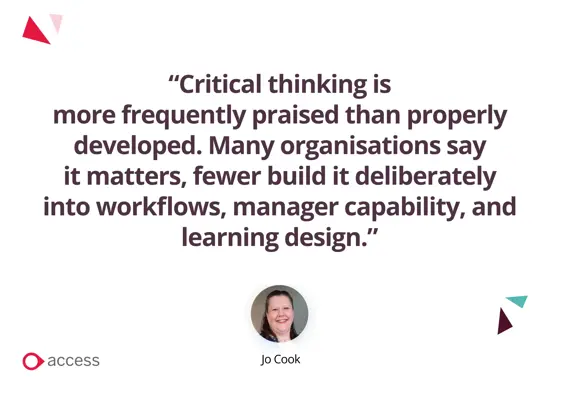
“Critical thinking is more frequently praised than properly developed. Many organisations say it matters, fewer build it deliberately into workflows, manager capability, and learning design. It’s still too often treated as a general virtue rather than a practical skill that needs practice, feedback, and application in real decisions.”
As AI becomes more integrated into day-to-day tasks, the need for critical thinking becomes more immediate. Employees are increasingly required to interpret, question and validate AI-generated outputs, yet many have not been equipped to do so effectively.
Mike Osborne, founder & CEO, Accessible Me Ltd, points to the risk this creates:
“If people rely on AI for everything and do not question what it gives them, their own thinking weakens over time. The ability to ask “Is this real?”, “Is this accurate?” and “Is this ethically sound?” will make a huge difference.”
At the same time, contributors suggest that critical thinking is becoming more discipline-specific. Sarah Mian says:
“It's become very easy for people to disavow what they know when reviewing AI outputs, because AI tools can appear so knowledgeable that you can begin to doubt yourself. Critical thinking is becoming much more about deeply knowing and understanding your discipline, then being able to sense-check AI outputs against what you know. Without that depth, it’s much harder to spot when something isn’t right.”
While critical thinking skills have widely been identified as critical to the effective use of AI in L&D, they’re also difficult to define, measure, and assess. This means they’re often deprioritised in favour of more tangible capability-building initiatives and technical skills.
As a result, there’s a risk that while AI adoption accelerates, the skills needed to use it effectively lag behind. Looking ahead, organisations that make progress in this area are likely to be those that find real value in embedding AI into tasks and workflows, through creating opportunities for people to question and apply judgement in the context of their discipline.

Gaps in understanding could widen the learning accessibility divide
Key points:
- Organisations continue to underestimate the scale of accessibility needs
- AI has the potential to improve inclusion through adaptive learning
- Poorly designed AI can scale exclusion as quickly as innovation
- Much learning content still follows outdated, inaccessible formats
- Accessibility will become a key differentiator in learning strategy
Last year’s report highlighted the transformative potential of AI for making learning truly inclusive. A year on, contributors warn that without careful design and understanding, AI could just as easily reinforce exclusion – particularly as much learning content still follows outdated, non-inclusive formats.
Susi Miller, founder of eLaHub, highlights a common misconception within organisations, fuelling a lag in inclusive content production:
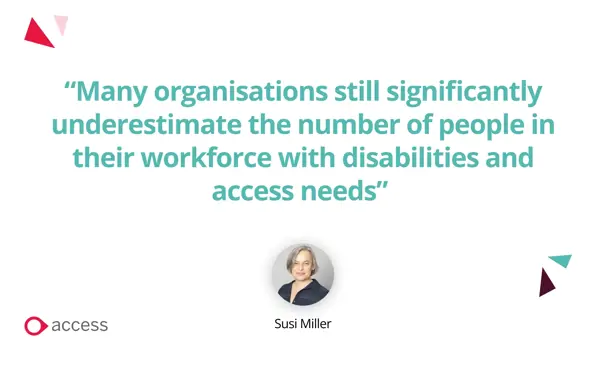
“Many organisations still significantly underestimate the number of people in their workforce with disabilities and access needs, often assuming it is around 4 to 7 percent, when the reality is closer to 25 percent. As AI platforms and tools evolve, there is a real risk that learning moves forward in a way that leaves people behind.”
This gap in understanding creates a significant risk. As organisations move quickly to adopt AI-driven learning tools, accessibility is not always prioritised at the design stage, meaning new barriers can be introduced, even as technology advances.
When designed effectively, AI can support more adaptive learning experiences by adjusting content, format, and delivery in response to individual needs.
Mike Osborne highlights this potential:
“The real value lies in systems that can respond to individual nuance. Not understanding it this way? Try another way. Need a simpler explanation? Offer one.”
AI has the potential to make learning more inclusive, but only if inclusion is built in from the outset. Otherwise, it risks scaling existing inequalities at pace.
Demand for accessibility will be a defining factor in how organisations evaluate their learning strategies. Those that prioritise it early will be better positioned to create learning that works for a wider range of people, while those that do not may find that innovation comes at the cost of inclusion.

The role of L&D will shift from content creation to in-role performance support
There is a growing consensus that the role of L&D is moving away from content creation, and towards enabling performance directly, supporting people in the flow of work, rather than delivering learning as a separate activity.
As expectations of learning continue to evolve, so too do the expectations placed on L&D teams. This shift does not mean AI is replacing the role of L&D, but making its value more visible.
As earlier sections have shown, the rapid increase in AI-generated content has not necessarily led to better learning. In many cases, it’s highlighted that content alone, however quickly produced, is not what drives performance or engagement.
Instead, the value of L&D lies in understanding individual performance in the context of the wider organisation. It works across functions to identify where change is needed, and ensure people are equipped not just for today’s demands, but for the roles they move into over time. As Laura Overton, founder at Learning Changemakers explains:
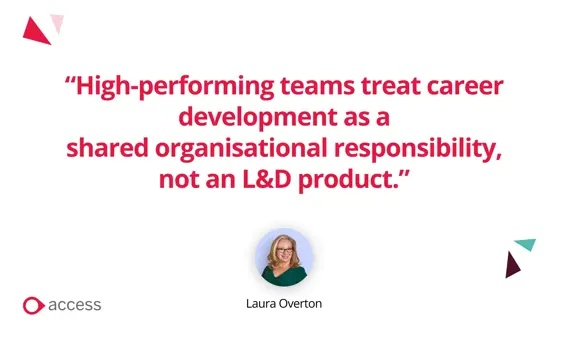
“High-performing teams treat career development as a shared organisational responsibility, not an L&D product. Instead, L&D is actively involved in breaking down the silos between talent, skills, onboarding and recruitment, ensuring people are ready for each stage of that journey means we need to be working actively with other parts of the organisation, not just delivering programmes to individuals in isolation.”
This requires L&D to take on a more consultative role within organisations, working closely with stakeholders to diagnose challenges, identify the right interventions, and ensure learning is aligned to real business needs.
Erica Farmer, founder of Quantum Rise Talent Group Ltd and EricaFarmer.AI Ltd., also points to this shift towards more intentional, outcome-driven thinking:
“It’s less about ‘why AI’ and more about ‘what problem are we looking to solve?’ and ‘where does it genuinely improve performance? requiring stronger consulting skills within L&D”
Laura Overton highlights how L&D could stay closely connected to the organisation:
“There are three core principles for achieving L&D impact – tuning in, responding, and improving – all of which are ongoing and part of a continual process, all of which are essentially human. This involves using our humanity to understand what individuals and an organisation need, enabling solutions that match the real problem, and responding appropriately to the humanity and the complexity we're seeing in the organisation.”
This shift is not just about new tools, but unlocking new capabilities. L&D professionals will be increasingly expected to understand performance challenges, work across functions, and apply learning in context, while ensuring that any use of AI is grounded in real business needs.
In this next phase, the role of L&D will be defined not by what it produces, but by how effectively it enables performance, combining human judgement, business understanding, and technology to solve real problems.
So what next?
This year's report shows that the challenge for L&D is no longer understanding what’s changing, but deciding what to prioritise next.
Over the next 12 months, progress will depend on a more focused and practical approach. This starts with a stronger emphasis on performance – working more closely with the business to identify where performance needs to improve, and ensuring learning is aligned to those outcomes.
At the same time, as content becomes easier to produce with AI, the focus will need to shift from volume to relevance. Creating learning that is engaging, credible and grounded in real experiences will become increasingly important, as people place more value on human-led, authentic content they can trust and relate to.
There’s also a clear need to strengthen core capabilities. Skills such as critical thinking will need to be developed in context, giving people the confidence to question, interpret and apply judgement to AI-generated content in their day-to-day roles.
Alongside this, accessibility and inclusion will require greater attention. Understanding the needs of different learners, and designing with those needs in mind from the outset, will be critical to ensuring learning works for everyone.
Elliot Gowans reflects on what this year’s report has shown, and what it points to next, concluding:
“What comes through clearly across all these conversations is that the fundamentals of good L&D haven’t changed. What’s changed is the urgency around all of it. AI is developing faster than most organisations are able to keep up with, and L&D teams are under increased pressure to bridge that gap.
“We’re already seeing learning technology that can handle the routine groundwork, freeing up professionals to focus on the decisions, relationships and strategy that make a real difference to their people. At Access Learning, that’s where we’re focused: helping organisations spend less time on administration and more time improving performance.
"The organisations that will thrive in this next phase won't be those creating the most learning content, but those most effectively connecting learning to business outcomes. AI capability building will be critical to that - equipping both L&D teams and the wider organisations they support with the skills and confidence to use these tools well. The opportunity for L&D is not simply to do more, but to have a greater influence on the performance and success of the organisation as a whole."

Thank you to our survey respondents:
People surveyed include:
Andy Lancaster, Reimagine People Development
Elliot Gowans, Access Learning, The Access Group
Erica Farmer, Quantum Rise Talent Group Ltd and EricaFarmer.AI Ltd.
Jo Cook, Lightbulb Moment and Training Journal
Laura Overton, Towards Maturity
Michael Osborne, Accessible Me Ltd
Sarah Mian, Access Learning, The Access Group
Tom McDowall, Evolve


Explore further
The themes in this report - AI, performance, capability and the evolving role of L&D — are explored in depth in Access Learning's Learning Ecosystems Hub. From practical guidance on building connected learning strategies to a free ebook by report contributor Andy Lancaster, it's a useful starting point for L&D teams thinking about what comes next.
