

 AU & NZ
 SG
 MY
 US
 IE
 Donorfy
Fundraising platform CRM integration: because your data shouldn't need a middleman
A supporter runs a 10k for your cause. Friends chip in, the donations roll through your fundraising platform, and it's a brilliant result for all involved. Then, somewhere behind the scenes, someone on your team exports the data, tidies it up, removes the duplicates, matches it to existing records and uploads it to your CRM.
Only then can the thank-yous begin and, by that point, the post-race glow might just be wearing off.
A fundraising platform CRM integration is designed to close that gap. This article covers what it is, why it matters, what to look for – and how Enthuse and Donorfy do it, if you'd like a concrete example.
TL;DR: A fundraising platform CRM integration sends donations and supporter records straight into your CRM, so there’s no exporting, cleaning or re-uploading after an event. That means quicker thank-yous, cleaner data and Gift Aid that stays matched to its transaction.

What is a fundraising platform CRM integration?
In a nutshell, it's a direct, automatic connection between the platform where supporters give and the database where you manage those relationships.
Your fundraising platform is where the action happens: donation pages, peer-to-peer fundraising, event registrations and branded giving experiences. Your CRM is where the relationship lives: supporter history, communication preferences, Gift Aid records and campaign tracking.
Connect the two, and when a supporter donates or sets up a fundraising page, that data moves straight into your CRM. It's matched to existing records where possible, checked for duplicates and ready to act on, without anyone downloading a file or copying a row!
Effectively, it's the same principle as when you connect any two pieces of your software, like when you connect your CRM to your website.
Why does it matter?
Simply, your team finally stops being the bridge
Without integration, each event usually means a manual export, a data clean, a deduplication exercise and a reconciliation against CRM records. For some teams, that runs to two or three days of work before follow-up can even start. That's time that could go to supporters instead!
Thank-yous land while the moment still means something
A supporter who ran a marathon for your cause and receives a generic thank-you three weeks later is less likely to lace up again next year. When data arrives within minutes, you can reach people while their achievement still feels fresh and make it personal.
That really matters for retention, as supporters who feel seen after their first gift are more likely to give again. The integration doesn't write the thank-you, but it means the thank-you can go out much faster.
Your database earns back its reputation
Duplicate records lead to inconsistent communications. Inconsistent communications erode trust in the database. Then teams start working around it, which creates more inconsistency. Checking data before it lands stops that cycle before it gets going.
A well-configured charity CRM fundraising integration doesn't just move data, it screens it. Incoming records are checked against what's already in your CRM, flagged if they look like duplicates, and held for review rather than landing unchecked. Your team stays in control of what goes in!
There's a security dimension here too. Manual data movement – exports, copy-pastes, spreadsheet hand-offs – creates points where information can be altered by accident, duplicated or exposed. Removing those hand-offs doesn't just save time; it closes the gaps where risk hides.
"Having worked with hundreds of charities on their data flows, a pattern I see often is that risk hides in the gaps between systems. Every time information moves manually between platforms, you create a point where it can be altered by accident, duplicated or exposed."
- Shaf Mansour, Head of Charity Product, The Access Group
If data security is a concern for your organisation, it's worth reading more about cyber security for charities, too.
Gift Aid stays where it belongs
A Gift Aid claim that can't be matched to a transaction is genuinely money left on the table. When Gift Aid status travels with the transaction automatically, your claims are built on accurate, current data, and the admin of chasing it down disappears too!
You can see what's working
Connected data means you can segment by fundraising behaviour, not just donation history, and spot which campaigns are bringing in new supporters versus reactivating lapsed ones. That kind of insight is hard to come by when the data turns up days later in a spreadsheet.
What to look for when you connect your fundraising platform to your CRM
From speaking to so many customers, we know not all integrations are built the same! These questions are worth asking before you commit to any combination of your tools.
- Does it sync automatically, and how often?
Manual syncs generally beat manual exports, but automatic beats both. Check the frequency, too. An integration that syncs every 15 minutes is meaningfully different from one that runs overnight, even if both are really useful. Also check whether there's a manual override for when you need data sooner.
- How does it handle data quality before it lands?
Does the integration check for duplicates before they reach your CRM, or does it import everything and leave you to tidy up? Look for an integration that flags problems at the point of entry, not after the damage is done.
- Can you see what's happened?
A sync history showing what transferred, when, and what was flagged is the difference between trusting an integration and second-guessing it. If something goes wrong , like a transaction that didn't come through, or a record that didn't match, it helps to be able to find it without calling support.
- Do campaigns and transactions link up correctly?
Income tracking works best when transactions land against the right campaign. An integration that moves supporter records but loses campaign references can ultimately create a reconciliation problem. Check that campaign codes, transaction links and payment types all travel with the data.
- Does Gift Aid travel with the transaction?
For UK charities, it really should. An integration that loses or mismatches Gift Aid data can create a compliance risk and costs you money. Confirm this is handled before you go live.
- What's included in the cost?
Some integrations need middleware, third-party connectors or extra licences. Others come included with the platforms you're already paying for. Know what you're buying before you commit.
How Enthuse and Donorfy do it
Enthuse is a branded fundraising platform built for charities, covering donations, peer-to-peer fundraising, events and giving pages. Donorfy is a fundraising CRM built around how charities work, with supporter management, Gift Aid processing, campaign tracking and income reporting included.
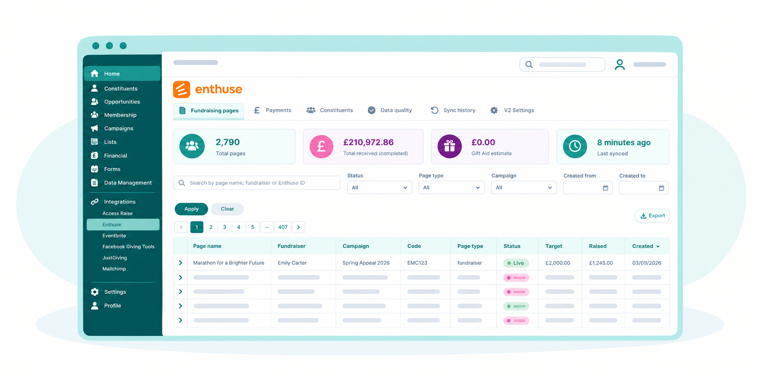
The Donorfy and Enthuse integration connects the two directly. Fundraising pages, payments and supporter records created in Enthuse flow into Donorfy automatically, matched, screened and ready to use.
A few things make it worth a closer look.
Eighteen match rules check incoming records before they reach Donorfy. Duplicates, missing data and records that need a human eye are flagged and held in a queue, complete with resolution history, rather than landing unchecked. Campaigns created in Enthuse appear in Donorfy automatically, with the campaign codes and transaction links that keep income tracking accurate. And a self-serve sync history table shows each sync action: who triggered it, when, and what happened, with an export option for finance reconciliation.
For charities already using both platforms, the integration is included in current pricing. There's nothing extra to buy, just a one-time configuration and the sync runs on its own.
We have a volunteer that comes in on a Monday and she'd spend about two hours inputting numbers. [The integration means] that's now zero.
The short version
From speaking to so many customers, we know that a fundraising platform CRM integration isn't usually a nicety, but the difference between a team that spends the days after an event reconciling data and a team that spends them talking to supporters.
The data your fundraising platform collects – who gave, how much, to which campaign, through which page – is some of the most valuable information your charity holds. When it lands in your CRM automatically, matched and clean, your team can focus on the work that means more.
Explore the Donorfy and Enthuse integration or discover Donorfy CRM and see how it connects with the fundraising tools you already use.
Fundraising platform CRM integration FAQs
What's the difference between a fundraising platform and a CRM?
A fundraising platform, like Enthuse, handles the supporter-facing side: donation pages, peer-to-peer campaigns, event registrations and payment processing. A CRM manages the relationship side: supporter records, communication history, Gift Aid, segmentation and reporting. They do different jobs, which is why connecting them matters – each one becomes more useful when it has the other's data.
Do I need technical skills to set up an integration?
That depends on the platforms, but it's generally easy to connect your fundraising platform to your CRM!
Some integrations require API configuration or middleware. Others, like the Enthuse Donorfy integration we've been discussing, are designed to be set up without technical knowledge, through a guided configuration in the platform itself. It's worth checking what's involved before you choose.
How quickly does data appear in the CRM after a donation?
It depends on the sync frequency. The Enthuse Donorfy integration syncs every 15 minutes, with a manual option if you need data sooner. Some integrations run less frequently – overnight batch syncs are common in older systems.
Is a charity CRM fundraising integration expensive?
It varies, but most integrations are included in existing platform pricing, while others need a third-party connector or additional licence. The Enthuse Donorfy integration is included for charities already using both platforms.
