AU & NZ
 SG
SG
 MY
MY
 US
US
 IE
IE

 Donorfy
What is a charity CRM website integration, and do you need it?
If your website and your CRM aren't talking, the CSV loop might sound familiar.
Donations are streaming through your website, your team is flat out, and somewhere in the background, someone is downloading a CSV, cleaning it up, and manually uploading it into your CRM.
A website integration with charity CRM is a popular fix. When your website and CRM are properly connected, data moves on its own: supporter records update, Gift Aid is capture, and your team feel a little less ... stretched.
This article explains what that connection involves, why it matters, and what to look for.

To start, what is a charity CRM website integration?
A charity CRM website integration is exactly what it sounds like: a connection between your public-facing website and the CRM you use to manage supporters.
When someone donates, signs up for an event or fills in a form, that data flows directly into your CRM. No manual export, no copy-pasting, and no one working late to reconcile a spreadsheet!
The two platforms themselves stay separate. Your website, Access Raise for example, handles the public-facing experience, while your CRM, like Donorfy, handles the data. They just start to share information automatically, so neither is ever working from an incomplete picture.
The slight catch is that not all website and CRM combinations make this easy or native, which is worth knowing before you commit to either.
Why does it matter?
1. You might just get your Friday afternoon back
Without an integration, moving data between systems is a manual job. That means downloading a CSV from your donation platform, cleaning it up, and uploading it to your CRM, often days after the gift was made.
By then, a thank-you email might be overdue, a Gift Aid declaration might be missing, and there's a decent chance a duplicate record has crept in.
Website integration with charity CRM removes that loop entirely. Donations, supporter details, communication preferences and Gift Aid status arrive in your CRM automatically, matched to existing records where possible.
2. You get to know your supporters
When your website and CRM are connected, every interaction a supporter has, be that a donation, an event sign-up, or a campaign page visit, feeds into a single, growing record. You can see the full journey, not just the moments when data happened to be transferred.
The difference between a generic thank-you email and one that references someone's third consecutive gift, or their attendance at last year's event, is the difference between a supporter who feels seen and one who doesn't. It's simply more difficult to write that email if the data isn't there.
3. Gift Aid you don't have to chase
Gift Aid declarations made on your website need to reach your CRM somehow. Without integration, there's always a risk that declarations get lost in transit, or that a donor's status is out of date by the time you submit to HMRC. Given that Gift Aid is essential free money for eligible charities, losing any of it to a data gap is a particularly painful waste.
An integrated system captures Gift Aid status at the point of donation and carries it straight through, so your claims are based on accurate, current data rather than whatever made it across in the last manual upload.
Helpful reading: Guide to Gift Aid rules for charities
4. Communications likely to land
Marketing automation is only as good as the data behind it. If your email platform knows a supporter just made their third gift, or signed up for an event last month, it can send something that reflects that. If it's working from a data export that's two weeks old, it's ... guessing.
Connecting your website to your CRM means your communications tools always have fresh, accurate data to work with. That's the difference between a message that feels relevant and one that gets ignored.
5. GDPR compliance that doesn't rely on memory
Consent preferences captured on your website should be reflected in your CRM. If a supporter opts out of marketing on a donation form but that preference doesn't make it across, you risk contacting them when you shouldn't. That's a compliance issue and a trust issue in one.
Integration means consent travels with the data, automatically. No one has to remember to update it separately, and no one has to hope the last manual sync caught it.
What should you look for in a website integration with charity CRM?
Not all CRMs make website integration straightforward. Some need custom development; others rely on third-party connectors that add cost and complexity. Here's a few things worth checking:
- Does it have a documented API? A well-documented API means developers, yours or a partner's, can build connections to almost anything.
- What integrations come out of the box? Ready-to-use connections to common platforms (donation tools, email marketing, payment processors) save significant time and reduce the risk of things going wrong.
- How does it handle duplicates? When data flows in from multiple sources, duplicate records are a real risk. A good CRM will match incoming data to existing records rather than creating new ones blindly.
- Does Gift Aid travel with the donation? Specific to UK charities, but it matters. If Gift Aid declarations don't sync automatically, you'll be chasing them manually.
Donorfy, for example, integrates with the platforms most UK charities already use: JustGiving, Stripe, Eventbrite, Xero, GoCardless and more. Supporter data, donations and Gift Aid flow in without manual input.
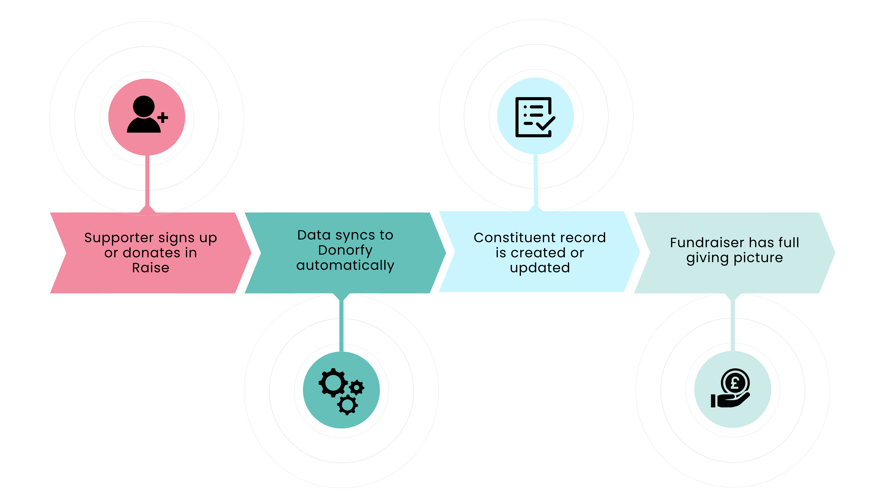
For charities using Access Raise as their website and digital fundraising platform, there's a direct integration with Donorfy that syncs donor and transaction data automatically, including supporter information and communication preferences. Here's how it works:
Does my CRM need to integrate directly with my website, or can I use a connector tool, is something we're also often asked.
Honestly? Both approaches can work, and we're big advocates for choice and open APIs. Direct integrations tend to be easier to maintain, but connector tools (like Zapier, or specialist charity platforms) can bridge gaps where a direct integration doesn't exist. The key question is whether the connection is robust enough to handle your data volumes during busy campaign periods.
Integration in action
Caring in Bristol uses the Access Raise and Donorfy integration to take the manual work out of their busiest campaigns.
When a supporter donates through their Raise website, the data syncs directly into Donorfy, without anyone on the team having to touch it. During their biggest campaigns, that means thousands of donations landing in Donorfy automatically.
"It's taken away a layer of stress. The integration means we don't have to manually upload every donation. We're not technical experts, and we don't need to be."
Others Charity CRM website integration FAQs
What data actually syncs between a website and a CRM?
Typically: donation amounts and dates, donor contact details, Gift Aid declarations, communication preferences, and campaign attribution. The specifics depend on which platforms you're using and how the integration is built, but the goal is always the same. It's a complete, accurate supporter record in your CRM without anyone having to move it manually.
Does it work during high-traffic periods, like the end of a campaign?
It should, and this is worth asking about before you commit to any integration. Some connections run on a schedule (syncing every 15 minutes, for example) rather than in true real time. That's fine for most purposes, but if you're running a time-sensitive appeal, it's worth knowing how quickly data will appear in your CRM.
What if I'm not ready to change my website or CRM?
You might not have to! Talk to your supplier(s) about the art of the possible. Charity CRM website integration is simply connecting the systems you already have, not replacing them. If your current website and CRM support a connection, directly or via a partner tool, you can get the benefits without a full platform switch.
Is it complicated to set up?
It really shouldn't be; it depends on the platforms involved. Some integrations are plug-and-play; others require more configuration. Setup complexity varies, and it's worth asking your CRM provider what the process looks like before you start.
So, is it worth it?
If your team is spending time moving data between systems, the answer is almost certainly yes!
The hours saved on manual admin, the Gift Aid you're less likely to miss, the supporter journeys you can actually track – these add up quickly, particularly during busy campaign periods.
That's charity CRM website integration working as it should: fewer gaps between the tools your team already relies on ... and a little less of that Friday afternoon CSV routine.
Try Donorfy
You can start a free trial and see how it feels. No commitment, no jargon – just a clearer picture of what's possible.
Looking for a web platform specifically for charities?
Access Raise built for exactly that.