

 AU & NZ
 SG
 MY
 US
 IE

 Access Assemble
Thanks a million: recognition of volunteers as a retention strategy
International Volunteer Day on 5 December is a great reason to say thank you to your volunteers. Not that you need one!
Most volunteer managers work hard to thank people week in, week out. It's not always easy to keep up though, especially when your rota's short, inbox is overflowing, and there's volunteers you don't often see in person.
With that in mind, this article looks at how the recognition of volunteers can become a proper retention strategy, with volunteer recognition ideas for 5 December and the rest of the year.
TL;DR: Fewer people volunteer regularly than a few years ago, so recognition of volunteers is an increasingly valuable retention tool. Start by asking volunteers how they like to be thanked, then match your volunteer recognition ideas to each person, from a public shout-out to a quiet thank you note for volunteers. International Volunteer Day and Volunteers' Week make natural volunteer recognition days, with small, specific thanks in between.
Who this is for: Volunteer managers, coordinators and anyone who looks after volunteers in a UK charity, hospice or community organisation.

Why does recognition of volunteers matter for retention?
Simply because volunteers who feel appreciated are much more likely to stay.
Your volunteers staying around is great for a variety of different reasons, most you likely know already. For example, it often means you can spend less time recruiting and training, and there's more continuity for the people your volunteers support.
What does the current volunteering climate tell us?
It's worth noting that regular volunteering in England is on the up: the Community & Engagement Survey found 18% of people volunteered formally at least once a month in 2025/26, a rise on the year before – though there's still ground to make up on the 23% seen in 2019/20.
NCVO's Time Well Spent research found that satisfied volunteers are much more likely to stay. 81% of satisfied volunteers said they were likely to carry on, rising to 90% of those who were very satisfied. Among dissatisfied volunteers, it was just 26%.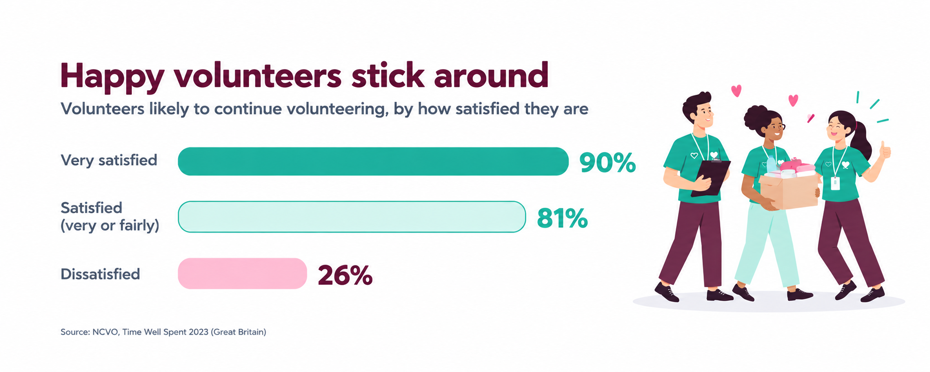
While most volunteers told NCVO they feel recognised enough, there's still big opportunity with younger volunteers:
- 49% of 18 to 24-year-old volunteers say recognition is important to them, but only 69% feel recognised enough
In other words, younger volunteers really value being thanked, so a little extra recognition could go a long way with that demographic.
It's also where there's most room to grow: 12% of people aged 25 to 34 volunteer regularly.
Where recognition makes a big difference
The good news is that when people do move on, it's most often because their circumstances have changed, such as a new job or caring responsibilities, rather than because of a bad experience.
What you can influence is their experience while they're with you. The top reasons volunteers give for staying are the organisation they help and the difference they're making (both 46%), and good recognition touches on both.
"Say thank you. Do this often, and make it specific."
What are the best volunteer recognition ideas?
The best volunteer recognition ideas are often the ones your volunteers aren't necessarily expecting. Here's a mix of old favourites, and a few you might not have tried yet.
| Idea | Effort | Works well for |
|---|---|---|
| A handwritten thank you note or card | Low | Anyone, any time |
| Milestone certificates (first shift, 100 hours, five years) | Low | Long-serving and regular volunteers |
| A thank-you get-together (tea, mince pies, a quiz) | Medium | Social volunteers and teams |
| A shout-out in your newsletter or on social media, with permission | Low | Volunteers happy in the spotlight |
| Nominating a volunteer group for the King's Award for Voluntary Service, or a volunteer for a local award | High | Groups and individuals with a standout story |
| Idea | Effort | Works well for |
|---|---|---|
| A short thank-you video from the people volunteers support (with consent) | Medium | Cause-driven volunteers |
| A LinkedIn recommendation or reference letter | Low | Students and career-builders |
| A behind-the-scenes session with your CEO or trustees | Medium | Committed volunteers curious about the bigger picture |
| Peer nominations or a "thanks wall" where volunteers recognise each other | Medium | Teams and group roles |
| Asking for their ideas on a new project, then telling them what happened | Low | Experienced volunteers with insight to share |
| A text the day after a shift, naming one thing that went well | Low | Remote and one-off volunteers |
A quick word on gifts
Small gifts can be a lovely touch, and NCVO's advice is to keep them modest and occasional. Valuable or regular gifts could suggest a contract and blur the line between volunteers and employees. Money, vouchers or gifts that could grow in value may also affect volunteers' benefits or tax. A certificate or a tin of biscuits for the team is plenty (and the biscuits are rarely wasted).
Making the most of volunteer recognition days
The UK has two natural volunteer recognition days a year, about six months apart: Volunteers' Week (1 to 7 June) and International Volunteer Day (5 December).
For 5 December, your winter volunteer recognition day, a few ideas that fit around a busy month:
- a short message from your CEO or chair, sent to volunteers personally rather than posted publicly
- a social post that names volunteers (who've said yes) and what they've achieved this year
- a "year in numbers" for each volunteer: hours given, events supported, people helped
- a thank-you hour where staff phone or message volunteers
St Luke's Hospice holds a Volunteer Thank You event during Volunteers' Week. Chris, who manages its, said:
"Assemble made it so easy to manage RSVPs and track attendance. It’s made event management a breeze and allowed us to increase participation at appreciation events.”
How do you tailor thanks to each volunteer?
The simplest way is to ask!
Ask early, note it down
You could even add "How do you like to be thanked?" to your volunteer sign-up form or first conversation. Keep the options simple:
- a private note or message
- a public shout-out
- a chance to learn something new or take on more responsibility
- a social get-together
- no fuss, please
Then record the answer somewhere your whole team can see it. If it lives in one person's head, it leaves when they do!
Think about personality
Personality plays a part, too. A confident extrovert might love being called up at the Christmas social, while a quieter volunteer would probably rather have a handwritten card. If you're not sure, start with something private until you know them better.
Team thanks can be just as powerful as individual praise, too. NCVO points out that singling people out can sometimes create a sense of "winners and losers", especially if some volunteers need more support than others, so celebrating the whole team is a great way to include everyone.
Match thanks to motivation
Why someone volunteers can be a good clue to the kind of thanks they'll like most.
| If they're mainly here for... | Thanks that tends to land |
|---|---|
| The cause | Stories and numbers showing what their time made possible |
| The people | Get-togethers, team shout-outs, peer recognition |
| Skills and experience | References, LinkedIn recommendations, new responsibilities, training |
| The organisation | Insider updates, time with leaders, a say in what happens next |
| Fitting something meaningful around a busy life | Flexibility, a quick personal message, no pressure to do more |
What makes a good thank you note for volunteers?
A good thank you note for volunteers is specific, personal and quick to arrive. "Thanks for all your help" is kind. "Thanks for staying late on Thursday so the last three families got their food parcels" is a step up.
Five things to include:
- Their name, spelled right, of course!
- One specific thing they did, not a general list
- What it made possible, for the people you support or for the team
- Good timing, ideally within a day or two
- No ask. A thank you that ends with "and could you do Saturday too?" stops being a thank you
Three sample notes to adapt
After a shift:
Hi Ada, thank you for Saturday. You kept the queue moving and somehow made everyone smile while doing it. Forty-two people left with a hot meal and a chat, and that's down to you. Sam
For a milestone:
Dear Mike, this week marks a year since your first befriending call with Joan. She told us your Tuesday calls are the part of the week she looks forward to most. Thank you for a year of showing up. Helen
For International Volunteer Day:
Hi Jo, today is International Volunteer Day, and we couldn't let it pass without saying thank you. This year you've given 86 hours to our helpline, and more than 200 callers have had someone to talk to because of it. That matters more than we can say. Tom, Volunteer Manager
Handwritten is lovely, if you have time. A personal email or text absolutely still works as a thank you note for volunteers though, as long as it reads like it was written for them.
How do you keep recognition going all year?
Think of it like your fundraising calendar: a few fixed dates, with everyday thanks in between. It makes it much easier to keep going when things get busy, and to make sure everyone gets their moment.
Make thanking everyone's job
The recognition of volunteers doesn't have to come from the volunteer manager alone. Encourage staff, trustees and the people volunteers support to say thank you too. A quick word from a frontline colleague can mean more than a formal certificate.
Check it's landing
Regular check-ins, even 15 minutes over a cuppa or a call, often tell you more than a survey! Ask whether they feel appreciated, what they're enjoying and what's getting in the way. It's also a lovely chance to spot anyone who might need a bit more support, nice and early. A recognition question in your annual volunteer survey will give you the bigger picture.
To see whether your recognition is making a difference, you can also track your volunteer retention rate before and after you try something new. Here's how to work it out:
- Count the volunteers you had at the start of the period who are still active at the end.
- Divide by the number of volunteers you had at the start.
- Multiply by 100.
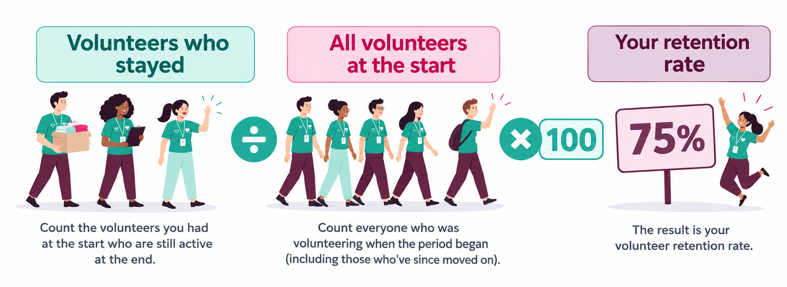
So if you had 120 volunteers on 1 January, and 90 of those same people are still active on 31 December, your retention rate is 75%.
Tip: only count people who were already volunteering at the start, so a busy recruitment drive doesn't flatter the result. Decide what "active" means for you too, such as volunteering at least once in the last three months, and stick with it.
Say thank you on the way out, too
When someone steps back, whether that's down to health, caring or a change in circumstances, how you mark it matters to them and to the volunteers who stay.
In 2026, the "Cessation of Volunteering" survey by Newcastle University found that 37% of organisations had held a leaving do for older volunteers who stepped back, and about a third (34%) kept up formal contact, like setting up an alumni club, afterwards. There's plenty of scope to try something new!
Simple ways to mark someone's departure:
- a card or thank you letter, ideally from someone senior
- a certificate of service or a small keepsake
- a mention in your volunteer newsletter, with their permission
- an open invitation to drop in for a cuppa, or to stay on your mailing list
Build a simple recognition calendar
Here's an example:
| When | Moment | A quick idea |
|---|---|---|
| Sign-up | Welcome | A personal welcome message and the "how do you like to be thanked?" question |
| After the first shift | First impressions | A text or call to say thanks and ask how it went |
| Three months in | Settling in | A check-in plus one specific thing they've done well |
| 1 to 7 June | Volunteers' Week | A team celebration or shout-out |
| Anniversaries and hour milestones | Personal milestones | A certificate, card or note from a senior leader |
| End of a project or season | Wrap-up | A short impact round-up |
| 5 December | International Volunteer Day | A personal thank you and their year in numbers |
| When someone steps back | Moving on | A card, a certificate of service and an open invitation to stay in touch |
How can volunteer management software help you remember to say thank you?
Milestones are much easier to celebrate when everything lives in one place, rather than across spreadsheets, inboxes and sticky notes!
Good volunteer management software can help you:
- keep each volunteer's details and history together, including how they like to be thanked
- log hours and activities as they happen, so a 100-hour milestone or a "year in numbers" is easy to pull together
- send a personal message or share team news in a few clicks
- run reports to spot anniversaries, milestones and anyone you haven't heard from in a while
For example, Access Assemble brings all of this together, so more of your time goes on the actual thanking itself.
Mencap, for example, uses the Assemble news feed and messaging to help volunteers across the country feel more connected, and has grown its volunteer numbers by 71% in a year since introducing it.
"Your volunteers will thank you for investing in Assemble"
So, is recognition of volunteers really a retention strategy?
Yes, and a refreshingly affordable one!
Satisfied volunteers are far more likely to stay, and feeling recognised is a big part of that satisfaction, especially for younger volunteers. What turns a kind gesture into a strategy is consistency: knowing how each person likes to be thanked, showing them the difference they make, marking the milestones in between, and saying a proper thank you when they move on.
International Volunteer Day on 5 December is a perfect place to start. Use it to thank your volunteers, then keep the momentum going into the new year.
A million thanks, one at a time.
Quick answers
Why is recognition of volunteers important?
Volunteers who feel satisfied are far more likely to keep volunteering.
NCVO found 81% of satisfied volunteers were likely to continue, compared with 26% of dissatisfied ones.
Recognition is a direct, low-cost way to shape that experience!
What should a thank you note for volunteers include?
As a minimum, their name, one specific thing they did, what it made possible, and your name.
Send it as soon as you can, and try not to make any additional requests at the same time.
How often should you thank volunteers?
Little and often, in an ideal world! Fixed moments like milestones and recognition days help, but quick, everyday thanks matter just as much.
Does volunteer recognition need a budget?
Not necessarily! Plenty of well-loved volunteer recognition ideas, like a personal note, a reference or sharing their impact, cost nothing but a bit of your time.
When is Volunteers' Week?
1 to 7 June in the UK. Together with International Volunteer Day, it gives you two recognition moments about six months apart.
What is International Volunteer Day?
A United Nations day celebrating volunteers worldwide, held on 5 December since 1985. Many UK charities use it as a winter volunteer recognition day!
