

 AU & NZ
 SG
SG
 MY
MY
 US
US
 IE
IE

KICKS COUNT
677%
increase in annual income
 Access Raise
Charity fundraising and marketing teams are doing more than they were five years ago. Anyone that's worked in those roles – which includes me – is well aware that challenges building reliable online income is rarely due to a lack of effort, or not enough ideas. In fact, the recent Charity Digital Skills Report 2026 found that 81% of charities made progress with digital in the last 12 months, which is amazing, and a big jump on the year before.
So how are charities building reliable income, especially when giving can so often be a response to a moment? We're talking the inspirational news story, or a well-timed social media post the right person happened to see.
This article looks at what charities are doing, and how the donation journey on your charity website is often a practical place to start ...

Written by Lisa Newhouse - Charity Software & Communications Specialist.
Posted 10/09/2026
It's worth a quick look at the backdrop, because it explains a lot about why online fundraising for charities has likely felt harder lately.
The Charities Aid Foundation's UK Giving Report put total giving at an estimated £14 billion in 2025, down from £15.4 billion the year before.
That means there are around six million fewer donors than a decade ago, and average monthly donations slipped from £72 to £65.
CAF also found that around two-thirds of all charitable giving is prompted by conversations, appeals, or being moved by personal experience rather than by a pre-existing commitment.
If you're forecasting income, it's a variable that refuses to sit still.
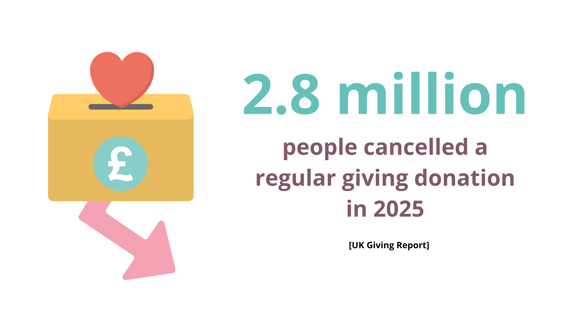 Some 2.8 million people cancelled a regular donation during 2025. So, committed income isn't a set-and-forget arrangement, but a decision supporters keep making. That's actually good news, because a decision can be influenced!
That same Charity Digital Skills Report, based on a record 807 responses, found only 28% of charities have a strategy in place for digital.
There's plenty of brilliant activity happening, but maybe without a written view of what it should earn. If that sounds familiar, you're in very good company.
The refreshed Code of Fundraising Practice and the Data Use and Access Bill have sharpened what's expected around consent, preferences and communication.
Here's another encouraging bit. Reliable gains can come from simply taking friction out of the gap between someone deciding to give and the gift actually completing.
Which means having an honest look at your donation journey:
That last one matters more than it looks. Every time a supporter leaves your website to give, you lose a bit of the relationship, and often the data that would let you continue it.
Kicks Count is a good example of what happens when a small team gets this right. The charity, which works to reduce stillbirth in the UK, moved donation pages primarily onto its own website, rather than always routing supporters through third-party platforms.
Supporters can set up their own fundraising pages, which the team approves with a single click, and Gift Aid claims are processed from a live income dashboard.
The feature CEO Elizabeth Hutton OBE singles out is the personalised In Memory donation pages, which let parents fundraise in their own baby's name rather than through a generic donation process:
"It's an easy way to help people make a difference in their baby's name."
Kicks Count has grown from an £18,000 charity to a £140,000 charity, with Access Raise and Charity Ad Grants both playing a part.
Get this right too, and you've earned the first slice of reliability: fewer moments lost somewhere between the decision to give and the donate button.
"Hand your donation form to someone who doesn't work in fundraising and watch them set up a monthly gift. And go easy on adding fields you'd love to have rather than fields you'll genuinely act on, because every extra question can cost you completions."
A reactive gift is a good thing. But, a reactive gift with nothing designed to follow it quickly becomes a missed opportunity for reliable income.
The charities "moving the needle" here treat the time after a first donation as a designed sequence, starting with:
The moment straight after someone gives is the highest-attention moment you will ever have with them, and it's usually spent confirming a transaction. One clear, specific invitation to make the gift monthly, or support in another way, belongs right there.
Show your donor what their gift did, and then invite them to make it ongoing. That order matters, because you're asking them to repeat something they've already seen work.
The Fundraising Effectiveness Project, run by the Association of Fundraising Professionals and GivingTuesday, named first-to-second-gift conversion as the sector's pain point in 2026, and pointed to locking in monthly commitments at the point of giving as part of the answer. US data, but the pattern will look familiar enough.
Your existing regular givers are the cheapest source of extra income you have, and the most frequently forgotten. An annual, personal, easy-to-decline invitation to increase a monthly gift tends to outperform acquisition activity taking the same effort. Bonus: it also feels nicer to do.
Most of that lives on your website rather than in your campaign calendar, which is why the platform question turns out to be a fundraising question.
Caring in Bristol is a useful example. The team can now build campaign landing pages and custom donation journeys themselves, without waiting on a developer. For their Bristol Cares Walk, participants set up sponsored pages, received automatic thank-yous, and tracked progress on visual totalisers. Helen McCartan, Head of Public Fundraising, on the difference it made:
"It's just so much more professional now. The new website has really helped us improve our supporter journey."
Worth noticing what's happening there. The supporter journey improved because the team could build and change it themselves, at the speed a campaign actually moves ...
For a sense of the potential prize, CAF puts the value of standing orders and direct debits to the UK charity sector at £2.89 billion, describing them as vital because they let charities plan more effectively. In any given month, 46% of donors give this way.
This could be the step that changes your year. A moment becomes income that turns up again in March, and again in June, with no campaign behind it.
Asking someone to commit monthly is a bigger ask than asking for a one-off gift, so it does rest on trust.
If a donation arrives without the supporter's details and preferences attached, you can't thank them properly, you can't honour what they asked for, and you run the risk of asking someone for a gift they already make every month. Few things undo a supporter relationship faster!
Which is why the connection between your website and your CRM has quietly become a stewardship win, rather than a technical one. When a donation and its communication preferences arrive together, automatically, your team can be as personal as they'd like to be, and gone are the days of working from a spreadsheet and a good memory.
Firstly, not reinvention, but better mechanics around the giving you're already generating.
And here's three places to start this quarter, none of which need budget:
So, while none of us have complete control over which moments resonate the most – the news story, or the supporter who tells everyone at work – what you can shape is what happens next. Whether the moment becomes a completed gift, or if the person behind it feels looked after enough to give again.
That's what building reliable income can come down to.
The genuinely good news? The most useful lever isn't the next campaign, or a bigger budget, but the journey you already own.
Access Raise bring your website, donation journey, recurring giving, Gift Aid and more together in one platform, with a CRM connection built in.

By Lisa Newhouse
Charity Software and Communications Specialist
Lisa is the voice behind much of Access Not For Profit's content. With over 12 years experience in marketing, including 7 years at a charity dedicated to reducing stillbirth, she brings a genuine, lived connection to the sector and a sharp understanding of purpose-driven communication. She's also a previous user of Access Raise and Donorfy! An avid reader and committed storyteller, Lisa describes writing as "the language she speaks best." At Access, she channels that passion into educating charities on what great technology can do, and telling the stories of organisations using it to amplify impact.


