

 AU & NZ
 SG
 MY
 US
 IE
 Access Charity Ad Grants
Are you in AI answers? How charities get found now, and get ready for what's next
Search has started answering back
Ask Google a question and the first thing you see is often an AI answer, not the usual list of websites. Those answers come from AI Overviews and, increasingly, AI Mode, which Google says passed 1 billion monthly users in May 2026.
For charities, that raises a few questions. Is your charity in those answers? What happens to the website visits you used to rely on? How do Google Ad Grants for charities fit into all of this?
This guide answers the main questions we're hearing from charity marketers and fundraisers about AI search. You'll notice it focuses on Google because, for charities, that's where you can get extra value with Google Ad Grants. But, of course, Google isn't the only place answering questions. Tools like ChatGPT, Microsoft Copilot and Perplexity do too, and the website tips in this guide can help your charity show up there when it matters, too.
Main takeaways:
- Google's AI answers are taking a share of clicks, mainly on searches for information.
- Searches where people want to act, like donating, volunteering or getting support, still lead to websites.
- Clear, well-structured web content gives your charity a better chance of being cited in AI answers today.
- Your Google Ad Grant can help you be seen when people are ready to act.
- Ads in AI answers are reaching more countries, so getting your account ready now puts you ahead when they arrive in the UK!

To start: a quick tip
You likely noticed the main takeaways just above this, and they're there for two reasons.
First, for you, the reader, who may not have time for the nuts and bolts and can find a quick overview there. But, you're not the only one looking for quick answers and overviews ... AI is, too.
Short, clear summaries are exactly what AI tools look for when they put an answer together. Adding main takeaways, sometimes known as a "too long; didn't read" section, is one of the simplest ways to give your charity's key pages a better chance of being cited.
“AI Overviews and tools like ChatGPT have fundamentally changed search behaviour, and our own data reflects that shift."
Why the fuss about AIO? What's actually changed?
First, what are AI Overviews and AI Mode?
AI Overviews are the AI-written summaries that appear at the top of some Google results, with links to the sources they draw on. AI Mode is a more conversational search, where people ask detailed questions and follow up, a bit like chatting to an assistant.
The way people search is changing with it. Google reported that questions in AI Mode were nearly three times longer than traditional searches. People are describing their situation, not just typing two or three keywords.
Is my charity's website traffic falling because of AI answers?
It's likely contributing, though AI is probably not the only reason.
In August 2026, Blood Cancer UK, Mind, the Mental Health Foundation, The Brain Tumour Charity and Save the Children all told Press Gazette their website traffic had fallen over the previous 12 months, following the rollout of AI Overviews.
The picture across the sector is gentler, though. Research by agency Tank across 800 organisations, summarised by Charity Times, found charities' average monthly organic traffic growth slowed from 15% to 12.5% after AI Overviews and AI Mode launched. That's a smaller dip than many other sectors saw.
Save the Children also made the point that search behaviour, algorithm updates and platform changes are all happening at once, so it's hard to pin any drop on AI alone.
Which searches are most affected, and which aren't?
Searches for information are the most affected.
If someone asks, "what are the early signs of a brain tumour?" or "how does Gift Aid work?", an AI answer can often satisfy them without them having to click on anything.
Searches where someone wants to do something are a slightly different story. AI can explain how to volunteer, but it can't sign someone up to your Saturday shift. It can also tell someone how to donate, but can't take the donation.
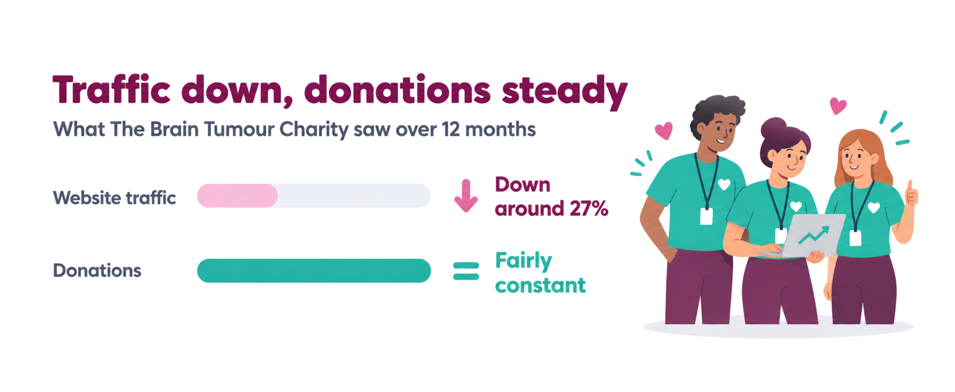
The Brain Tumour Charity saw traffic drop by around 27%, mostly on its support and information pages, yet its website officer said "donations have remained fairly constant".
How do I get my charity into AI overviews?
How does Google decide which websites to show?
There's no form to fill in, and Google hasn't published a quick-fix formula.
AI answers draw on pages Google can already find and read, and that clearly answer the question being asked.
That means the basics matter more than ever. For example, charity digital agency Platypus Digital found that research and impact reports hidden in PDFs, or content that only loads through JavaScript, are harder for AI tools to read.
Can a small charity realistically get cited?
Yes! AI answers pull from several sources, not just the biggest name.
Platypus Digital's report also found smaller organisations can feature by offering something distinctive, such as lived experience or expert analysis.
The same report flags a risk for charities with a very broad remit: if a website covers everything, AI can struggle to see what it's an authority on. Being clearly known for something helps.
How do I build the kind of authority AI answers draw on?
Google's own guidance on AI search features points to unique, genuinely useful content that's well organised and easy to use.
For charities, that looks like:
- Build in Q&A sections. Add short FAQs to key pages, answering one question at a time, in plain English.
- Go deep on what you're known for. Several connected pages on your core topics, linked to each other, show expertise better than one page on everything.
- Share what only you know. Your own research, service data, case studies and lived experience stories are hard for anyone else to copy.
- Show your experts. Name the people who write or review your content and say why they know their stuff. Health charities can also show recognised quality marks, such as the PIF TICK as a trust signal.
- Get talked about elsewhere. Mentions and links from partners, sector bodies and the press help confirm who you are and what you're known for. Describe your charity the same way everywhere.
- Make pages easy to scan. Short paragraphs, clear subheadings, lists and summaries help readers and AI tools alike.
- Don't switch yourself off. Search Console now lets website owners opt out of AI Overviews and AI Mode, and Google says sites that do won't get traffic or impressions from them. Check that setting before you start.
Does it matter if I'm cited in AI overviews, but nobody clicks?
It does! Being named in an AI answer builds recognition, even if somebody doesn't ultimately click on your website.
Save the Children told Press Gazette its presence in AI Overviews was up 303% on the previous year, making it the most-cited charity brand in AI search across the topics it tracks.
There's an upside to fewer clicks, too. Tank's research suggests the people who do reach your website through search are likely to be more interested than casual browsers. Fewer visits, but warmer ones.
Getting ready for ads in AI answers
Will my Google Ad Grant ads appear in AI answers?
Not inside them in the UK ... Yet. But, they're on the way!
Google publishes a list of countries where ads can appear inside AI Overviews, and the UK wasn't on it in early October 2026. Ads in AI Mode are being tested and are live in the US.
Other markets are moving fast. In Australia, for example, sponsored ads now sit directly beneath AI Overviews for some searches. 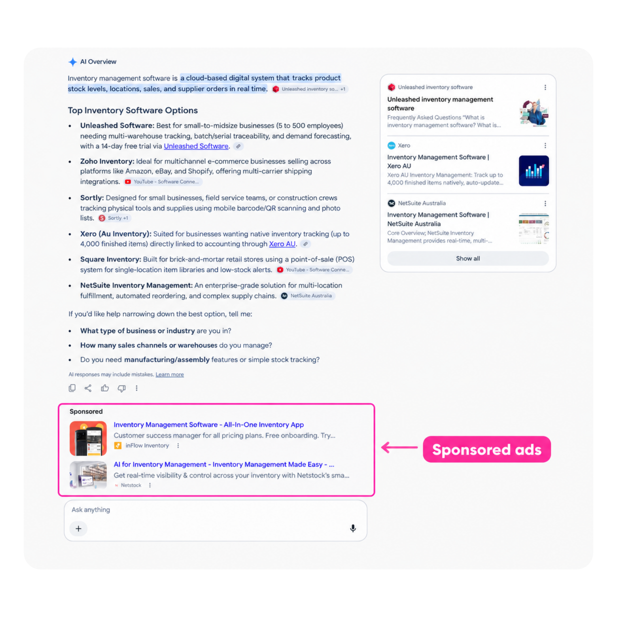 The vital takeaway from this? The charities whose Charity Ad Grant accounts are set up and ready for AI placements will be first in line when the UK follows.
If fewer people are clicking, is the grant still worth it?
Arguably more than ever! A Google Ad Grant gives eligible charities up to $10,000 a month in free Google Search ads.
When organic visits get harder to win, free visits from the grant count for more! If you'd like to check if your charity is eligible, here's somewhere you can quickly check.
Which searches should my grant focus on now?
The ones where people want to act.
Think "volunteer at a charity shop near me", "donate to dementia research" or "support for carers in Leeds."
AI can summarise information, but these searches need a website, a form or a person at the other end.
Information searches can still have a place in your grant, especially where they lead naturally to the next step. But, if AI is answering those questions on the results page, it's worth checking they're still earning their clicks.
What if sharing information is our mission?
For health charities and others whose mission is information, being found is the action.
If AI answers are pushing your expert content further down the page, grant ads can give it a route back to the top, so people searching for help find a trusted source, not just a summary.
It takes care. Information searches need strong, relevant ads to keep clicks healthy, and health topics come with extra advertising rules. But for many information-led charities, it's one of the most practical ways to stay visible while organic visibility shifts. Getting support from an expert managed Google Ad Grant service can really help here.
How do my website and my grant work together?
More closely than ever.
With AI Max for Search, Google can write ad text using your website, landing pages, existing ads and keywords, and can choose which page to send people to.
So, a clear, well-written page helps you get cited in AI answers and gives your ads better material to work with.
It works the other way too. The searches that trigger your grant ads show you the questions supporters are asking, which makes them a ready-made list of content to write.
What do I need to do to be ready?
Google has pointed advertisers towards AI Max for Search, broad match keywords and Performance Max as the routes into AI placements.
Before any of those, the foundations need to be solid: conversion tracking that records real actions, landing pages that explain clearly who you help, and a grant focused on searches that lead somewhere.
Keeping it all working
What should I measure now that clicks aren't the whole story?
Look past clicks to what people actually do.
Donations, volunteer sign-ups and support requests tell you more than visit numbers.
Google Search Console now helps too. Google says its new generative AI insights, including impressions and which of your pages appear in AI responses, had rolled out worldwide by 31 August 2026. It's free, and it's a good first look at whether you're in the answers.
One note of caution: if you change your grant settings, it's hard to tell whether a result came from AI placements or from the other changes. Tracking real outcomes keeps you honest.
How much time does this all take?
Honestly? More than it used to.
A healthy Google ad grant account needs regular attention to stay within Google's programme rules, and AI features add new settings, reports and landing pages to keep an eye on.
When does managed support make sense?
If your grant is underused, has been paused, or simply doesn't get the time it needs, expert support can make the difference.
Access Charity Ad Grants specialists manage grant accounts for charities, keeping them compliant and focused on the searches that matter, so your team can focus on the mission.
Dreams Come True are a great example. They're now turning free ads into measurable results.
“Charity Ad Grants gives us access to specialist knowledge we could never afford internally. They know exactly how to maximise our reach and make every click count.”
Are you ready? Five checks for your charity
Run through these on your own website and grant account, if you have one.
| The check | Why it matters |
|---|---|
| 1. Is conversion tracking recording real actions? | Donations, sign-ups and enquiries, not just page views. |
| 2. Do your landing pages say clearly who you help and what to do next? | They now shape your ads as well as your search visibility. |
| 3. Is your grant focused on searches where people want to act? | Volunteering, donating, crisis response and offering support. |
| 4. Is your account set up for the matching AI placements rely on? | Such as AI Max for Search or broad match. |
| 5. Are you checking Search Console's AI reporting? | It shows whether your pages appear in AI answers. |
Summary
So, are you in the AI answers? With clear content and a grant that's ready for what's next, your charity certainly can be.
AI search is moving quickly, and keeping a grant account compliant, focused and ready for what's next takes time most charity teams don't have spare.
That's where Access Charity Ad Grants can help. Specialists manage your grant for you, so your ads keep reaching the people searching for your help, now and when AI answers start showing ads in the UK.
Disclaimer: This blog is intended for informational purposes and reflects information accurate as of October 2026. This topic and what's possible are moving fast, so always check Google's latest documentation, or get in touch with any questions.
These handy Google factsheets were current at the time of publishing, and offer helpful, bitesize information:
