AU & NZ
 SG
SG
 MY
MY
 US
US
 IE
IE
 Access Charity Ad Grants
How to write Google Ads copy that converts: guide for charities
If the phrase "write a Google Ad" makes you want to close your laptop and go make a cup of tea, you're not alone. For many people working in charity marketing and fundraising, Google Ads can feel like a world designed for someone else, someone with a creative writing degree and more time on their hands.
But ... writing a Google Ad that converts isn't a technical skill, it's a communication one. And, if you work in the charity sector, chances are you're already pretty good at communication.
This guide walks you through everything you need to know about how to write Google Ads copy that gets clicks: no jargon, no fluff, just practical advice you can actually use.
A note from the author: I spent several years working in charity marketing myself. Like a lot of charity marketers, I wore a lot of hats. Google Ads was one of them, and it took me a while to get to grips with it. What you'll find in this guide is mostly the things I wish someone had told me!

First things first: what does a Google Ad actually look like?
When someone types a query into Google, the results fall into two camps: organic results (the ones Google serves up based on relevance) and paid results (the ads that appear at the top of the page).
Google Ads for Charities sit in the second camp, and with up to $10,000 of free advertising credit available every month, the stakes for getting your copy right are high.
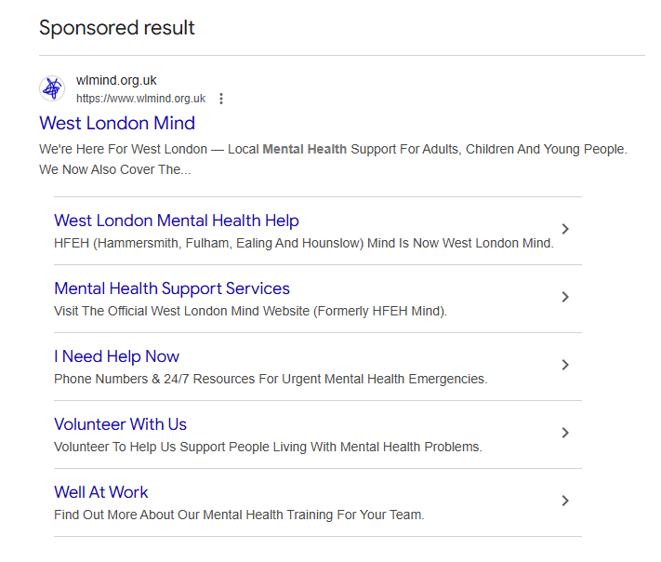
Each ad is made up of:
- Up to three headlines (the clickable text at the top, 30 characters each)
- Two descriptions (the supporting copy underneath, 90 characters each)
- A display URL (the web address shown in the ad)
- Optional extensions/assets (extras like phone numbers, site links, or a click-to-call button)
That's not a lot of space, below is a visual example. This tightness of space is exactly why every word needs to work hard ...
How to write Google Ads headlines that do the heavy lifting
Your headline is the first (and sometimes only) thing people read.
If it doesn't immediately signal relevance to what they're searching for, they'll scroll straight past.
Given that the average click-through rate for the advocacy and nonprofit sector sits at around 4.41% (Wordstream, 2023), there's real room to outperform the average – if your headlines are doing their job.
Mirror your audience's search intent
The best headlines reflect the language your audience is already using. If someone searches "free mental health support London," a headline like Free Mental Health Support in London will feel far more relevant than Welcome to [Charity Name].
This is called keyword alignment, and it's one of the simplest ways to improve your click-through rate.
Lead with value, not your name
Unless you're a household name, your charity's brand recognition probably isn't what will win the click. What will? Making it immediately clear what's in it for the reader. Find Free Grief Counselling Near You will almost always outperform [Charity Name] | Grief Support Services.
Use your three headlines as a conversation
When thinking about how to write headlines for Google Ads, it helps to treat them as a sequence: the first grabs attention, the second adds context or credibility, the third closes with a call to action. For example:
- Free Support for Carers
- Practical Help & Advice Available
- Find Out What's Near You
How to write Google Ads copy that converts: the descriptions
If your headlines are the hook, your descriptions are where you reel people in.
You've got two, each up to 90 characters, which is (just about) enough space to add some personality and give people a genuine reason to click.
Speak to the person, not the policy
This is copywriting 101: descriptions that use "you" and "your" tend to outperform those written as "we" and "our."
It's a small shift, but it makes a meaningful psychological difference ... your ad starts to feel like a conversation rather than a press release. Your reader might not care too much about your charity's history at this stage; they care about their need to be searching. Meet them there first.
Be specific
Vague copy gets vague results. For example, "we offer a range of services to people in need" tells your reader almost nothing. "Get free, confidential advice within 24 hours" tells them exactly what to expect and gives them a reason to act. Specificity builds trust (and trust drives clicks.)
Include a clear call to action
Never assume people know what you want them to do. Research consistently shows that specific, action-oriented CTAs outperform generic ones. More evocative, concrete language drives more clicks than vague placeholders
The same principle applies to charity ads: Check your eligibility, Apply today, Find out more; they all work harder than leaving people to figure it out for themselves.
Get your charity's message heard
A word on Google Ad Grants compliance, and why your copy really matters
If you're using the Ad Grants programme, there's one more reason to take your copy seriously: Google requires Ad Grant accounts to maintain a minimum 5% click-through rate.
Fall below that threshold for two consecutive months, and your account risks being deactivated.
In other words, well-written, well-targeted copy isn't just good practice, it's what keeps your (up to) $120,000 annual grant active and working for your cause.
The good news? Charities using the grant are already seeing extraordinary results when they get it right.
For example, Hammersmith, Fulham, Ealing & Hounslow Mind use the Access Charity Ad Grants service to manage their ads.
They saw a 53% increase in clicks and an 85% rise in impressions during a special double Ad Grants funding period. Nicholas Smith, their Head of Marketing & Communications, said:
"Ad Grants is an essential part of our marketing mix. The ROI is undeniable, and it has a direct impact on the lives of those we serve."
Further afield, Direct Relief raised $59,000 in online donations in a single month through Google Ads, exceeding their previous annual total (Whitehat SEO, 2026).
The golden rules: a quick cheat sheet
- Match your headline to the search term – relevance is everything
- Focus on the reader's needs, not your organisation's credentials
- Be specific – concrete details convert better than vague promises
- Always include a CTA – don't leave people guessing
- Keep it human – warm, direct copy will always outperform corporate-speak
- Test everything – run multiple versions and let the data guide you
What if you're doing all this, and it's still not working?
You've written strong headlines. Your descriptions are punchy. Your CTAs are clear. And yet, the conversions just aren't coming.
The truth is, even well-written ads can underperform, and the reasons why aren't always obvious. It might be your keyword strategy, your bid settings, your Quality Score, your landing page, or something else entirely.
We dig into exactly that in our next article: Why your Google Ad might not be converting.
If you're putting in the effort, and not seeing the results you'd expect, take a look.