AU & NZ
 SG
SG
 MY
MY
 US
US
 IE
IE

 Donorfy
Hospice fundraising: how are hospices sustaining income, teams and donor trust?
Hospices are operating in one of the most complex environments the sector has faced in years.
Costs are rising, donor behaviour is shifting, and expectations around transparency are higher than ever. For most hospices in 2026, the response isn't necessarily a dramatic overhaul, but getting clearer on what works, and protecting it.
This report explores how hospices are sustaining income, teams and donor trust through clarity, continuity and incremental change.

What you'll find in this report
Sector context: what's shaping UK hospices in 2026?
The hospice environment sits within wider changes across the UK charity sector, many of which reinforce the importance of trust, clarity and good stewardship.
Financial pressure remains challenging
According to the National Audit Office, independent hospices receive only around 29% of their funding from government sources.
The remaining 71% comes from charitable donations, fundraising and retail.
That dependency makes long-term planning hard, even for hospices with strong community roots and well-run fundraising programmes.
Digging deeper into data, Hospice UK research shows:
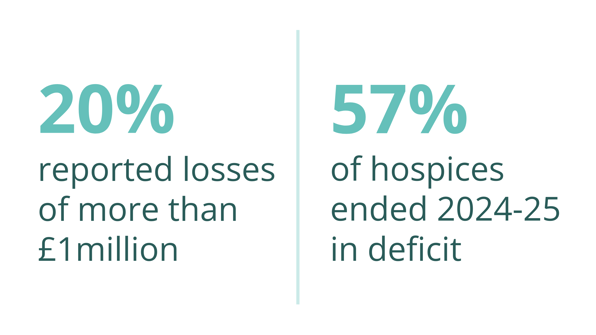 The proportion running at a deficit has climbed steadily, too – 43% in 2022–23, then 62% in 2023–24.
Toby Porter, CEO of Hospice UK, has been direct about what's at stake:
"We've been ringing the alarm on hospice funding for some time. Unless there is bold, long-term change to how hospices are funded by the NHS locally, hospice services will inevitably fall back even though demand for them is rising."
The regulatory picture has also been shifting:
- Updated Charity SORP puts more weight on narrative reporting and financial sustainability, so charities are expected to explain their finances, not just present them.
- The refreshed Code of Fundraising Practice reinforces respectful, transparent and consent-led fundraising.
- The Data Use and Access Bill has raised the bar on data use and communication preferences, with supporter experience at the centre.
For hospices, none of this is alien territory. Honesty, accountability and openness with supporters are values the sector already lives by.
The pressures hospices are facing
Income that's essential, but hard to predict
Legacy and in-memory giving sit at the heart of hospice income. These programmes are built on years of community trust, but they don't follow a tidy schedule.
With most hospices now running at a deficit, the focus in 2026 has shifted from growth to retention, forecasting and reducing surprises.
The Hospice Health Report 2024, which analysed over 21 million donations totalling £1.6 billion, found that hospices with growing revenue consistently achieve a 10% higher rate of donor retention than those in deficit or stagnation.
Experienced teams, stretched to capacity
Hospice fundraising teams tend to be experienced. Staff know their supporters well, understand the community and don't exactly need to be told what good looks like. The problem isn't knowledge, it's time.
Manual processes, legacy systems and accumulated workarounds eat into the day quietly. This is covered in more detail in this exploration of the quiet cost of manual work in hospice fundraising but, in short, it's rarely one big inefficiency that causes problems, but the pile-up of small ones.
Supporter relationships that don't have a neat ending
Hospice supporter relationships are unlike most in the charity sector. A single person might move through care, bereavement, in-memory giving, community events and long-term volunteering – sometimes over many years.
Holding those relationships with consistency and sensitivity is one of the sector's great strengths, but also one of its most demanding operational challenges.
How are hospices sustaining income?
The most effective hospice fundraising in 2026 is less focused on chasing new audiences, but deeper strategy for looking after the ones you already have.
Retention over reinvention
Rather than launching new campaigns, hospices are doubling down on the basics:
- Staying in touch with families after care ends
- Keeping relationships warm after community fundraising events
- Supporting in-memory donors without pressure or urgency
- Using automation and personalisation to build long-term donor value
Acorns Children's Hospice is a good example. By tailoring asks to donor warmth – requesting 50% of past giving from lapsed donors, while giving warmer givers the option to maintain or increase their level – their newsletter brought in 109% more income than projected.
"For warmer givers we gave the option to give at their current giving rate, plus the option to give a little more. It worked.”
Meeting supporters where they are, rather than pushing them to give more or faster, can protect income over time.
Visibility over volatility
Alongside retention, hospices are working to get a clearer picture of future income, not to eliminate uncertainty, but to manage it better.
That means:
- Understanding likely income over longer time horizons
- Giving trustees and leadership teams more accurate data to work with
- Reducing the number of surprises, even when income remains unpredictable
St Oswald's Hospice switched to Donorfy to move from reactive reporting to a more confident picture of income and supporter relationships.
Campaigns, events, volunteering, giving history, legacy intentions: all of it is in one place, accessible to anyone on the team. If a member of staff moves on or is unavailable, whoever picks up a supporter relationship has everything they need.
"It's that full joined-up journey of a donor. Having it so that anyone can step in and pick up where the last person left off is incredibly valuable."
In 2026, sustaining income is as much about confidence and planning as it is about growth.
How are hospices looking after their teams?
Asking already-stretched teams to do more isn't a strategy. The hospices managing this well are focused on removing friction — so their people can spend time on the things that actually matter.
Cutting out the drag
Manual processes drain capacity. The right tools (not the flashiest, but the ones built for the job) can help teams work without the constant overhead of workarounds and duplication.
Better systems are helping hospices:
- Cut down on duplicate data entry
- Automate repetitive tasks
- Simplify reporting and compliance
- Get off spreadsheets and manual processes
The cumulative impact of these small inefficiencies is easy to underestimate.
Knowing when to do less
I know, this sounds counter-intuitive! But, long-serving staff bring judgement, emotional intelligence and supporter knowledge that can't be replicated. The best systems are the ones that support that, reducing cognitive load and freeing up time for relationships, rather than adding to the noise.
This is the thinking behind CRM restraint. The most effective hospice CRM setups aren't necessarily the ones using every available feature – they're the ones doing the right things well, focused on what genuinely strengthens supporter relationships and long-term income.
As Duncan Hook, Senior Customer Success Manager at Donorfy, puts it:
"Your fundraising database can be the greatest tool in your arsenal. But only if you know what you're trying to achieve."
In a nutshell, looking after teams means protecting energy, not just headcount.
What about donor trust?
Trust remains the strongest asset hospices have. It isn't earned once; it's earned through every interaction, every communication, every decision about when to reach out and when to hold back.
Transparency as standard
Changes to fundraising standards and data expectations aren't new obligations for hospices, they reflect what good practice already looks like:
- Respecting supporter preferences
- Communicating with sensitivity, particularly around bereavement
- Building trust through care and consent, not volume
Supporters notice when they feel remembered rather than processed. Steady, personalised stewardship consistently outperforms high-frequency campaigning. The Hospice Health Report 2024 backs this up: hospices that prioritise retention and stewardship are the ones sustaining income over time.
This is why doing less, better matters so much in hospice fundraising. Fewer, more relevant communications, grounded in genuine knowledge of the supporter, protect the relationship far more effectively than sending more.
A sensible mix of human connection and well-configured automation is what works for most hospices: keeping communications personal without adding to the workload of already-stretched teams.
So, what is 2026 really asking of hospice leaders?
Simple: the challenge of 2026 isn't ambition, it's sustainability.
The hospices in the strongest position are those that:
- Protect what already works
- Make change deliberately, not reactively
- Use systems to support judgement, not bypass it
Hospices have always carried complexity with care – supporting people through the hardest moments, while keeping the services their communities depend on running.
In 2026, that means getting clear on priorities, protecting the time and energy of good people, and nurturing the relationships that sustain everything else.
Considering a CRM refresh to support retention?
You can start a free trial and see how Donorfy feels. No commitment, no jargon – just a clearer picture of what's possible.
Serve your supporters with Donorfy