AU & NZ
 SG
SG
 MY
MY
 US
US
 IE
IE

 Donorfy
Donor numbers are falling. Is your charity fundraising strategy ready to do more with less?
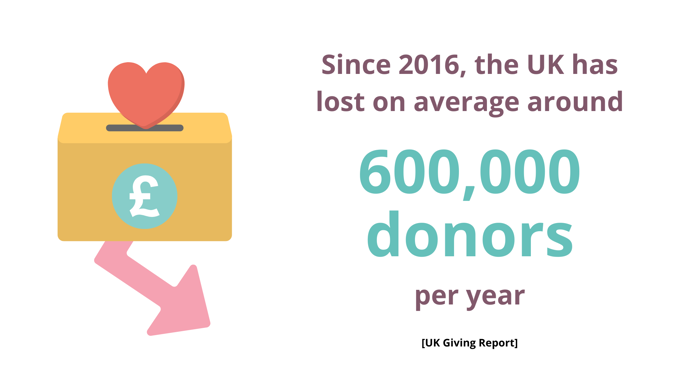
The first part of this "Reality of Giving" series named the challenge: six million donors lost in 10 years.
And for most fundraisers, the findings of the latest CAF Giving Report wouldn't come as a surprise, thought that probably doesn’t make it easier to read.
Once part of our nation’s DNA, charitable giving in the UK is changing.
Rather than wait for numbers to recover, the most resilient charities are getting ready to respond. And many are finding the solution isn’t always chasing new donors, but rethinking what growth, and what your charity fundraising strategy, should look like.

What is the CAF UK Giving Report is really telling us?
Donor numbers across the UK have been falling for a while. But, while the increased generosity of a committed giving community once cushioned the blow, this year, the downward trend has started to bite.
Rising living costs. A shrinking donor base. Lower average gifts. Together, they’ve created a perfect storm – one that seen the total amount given to UK charities fall for the first time in five years.
If you're a fundraising team already under pressure, it may feel like the ground is shifting you. But, before you double down on your acquisition strategy and launch a search for new donors, is the answer actually doing more with the relationships you already have?
Why donor acquisition strategies are under pressure
Donor recruitment is never easy. But in today’s climate, the market isn’t just saturated, it’s drying up. That means higher acquisition costs, tougher competition, returns that are harder to justify and predict and more fundraising challenges.
Increased financial pressures mean people have less to give. And when they do, they’re driven less by traditional acquisition strategies and more by personal connections, shared experiences, and trusted recommendations.
"Most donations are not the result of a charity prompt."
This doesn’t mean recruitment tactics don’t have their place. But it does raise an important question about the sustainability of your charity fundraising strategy.
Are you choosing cold recruitment because it’s the best choice, or because it’s a familiar one?
It might feel controversial, but the more you read the CAF Giving Report, the more this line of thought makes sense. Because long-term stability won’t come from donors you haven’t met. It has to be built over time, starting with the people who have already chosen to support you.
Experience is the new acquisition
The concept of relationship-based fundraising is not new. But when you’re managing competing priorities with a shrinking budget and busy team, it’s easy to leave your regular giving programme on autopilot and default to acquisition strategies.
That’s a potentially risky move.
Falling average gifts and the loss of 2.8 million regular donations in 2025 are clear signals that something needs to change.
Yes, the cost of living is forcing people to rethink what they can give. But giving isn’t just a financial decision, it’s an emotional one too. And with the UK giving culture starting to shift, now more than ever, your charity fundraising strategy must give people a reason to stay.
Turn donor data into insight
Rethinking your charity fundraising strategy
Building a charity fundraising strategy that puts value over volume doesn’t happen overnight. It’s the result of intentional steps to:
1. Deepen connections
Nobody gives “just because”. To build stronger relationships with your donors, you need to understand them – what matters to them, what motivates them, and what brought them to you in the first place.
From there, the focus shifts to making those relationships feel personal. That means creating space for feedback, encouraging conversations, and tailoring communications so they feel relevant and timely. It also means recognising the pressures donors are under, and ensuring your work reflects the issues and stories that resonate with them.
2. Build (and keep) people’s trust
Public trust in charities might have stabilised in recent years, but it isn’t a given. Being open about how your organisation works, where the money goes, and what it achieves, is critical.
Be careful not to divert into numbers and jargon. Take the time to explain the numbers and show impact through real, lived stories. And of course, you need to make sure that the basics (think thank you letters, receipts, and answers to queries) happen quickly and smoothly.
3. Create new opportunities to engage
When connection and trust are in place, opportunity follows.
A value-led charity fundraising strategy focuses on long-term growth over short-term wins – developing relationships over time, recognising when donors need flexibility, and creating clear pathways for those who are able to give more.
Remember: not every opportunity needs to be financial. Events, community fundraisers, and volunteer opportunities all help build the relationships that inspire people to stay with you.
Investing in the systems that make this possible
To make this work, you need the right foundations in place.
It might not be as glamorous as launching a donor recruitment campaign, but the charities seeing results are investing in the systems that make relationship-led fundraising possible.
As Georgina Bradley and the Songbird Survival team found, that often starts with data.
Before they moved to Donorfy, Georgina and the team relied on spreadsheets and an old, clunky CRM to manage their fundraising.
It worked. But only to a point.
Bringing their data into a single system meant they could finally see their donors clearly, track relationships over time, and understand the bigger picture. Routine admin could be automated, communications personalised, and the time saved used to build stronger donor connections.
“We can send an email newsletter to 13,000 people, and can often get replies saying ‘Hi George!’ They think I wrote it just for them, and that’s exactly what we want.”
The result?
Tailored journeys that make every supporter feel valued, and a 102% retention rate. A reminder that sustainable growth doesn’t always come from doing more. Often, it comes from doing the basics better, and making every donor count.
Looking ahead: building resilience today for stronger tomorrow
When it comes to UK giving, it would be lovely to say that falling donor numbers are nothing more than a glitch in the system, and a temporary loss that will soon be restored.
But the numbers suggest a deeper, more fundamental shift in how, why, and when people give.
To stay resilient, charities should look beyond traditional acquisition strategies and act now.
Because growth isn’t just about replacing lost donors. It’s about building a charity fundraising strategy that makes every donor count, and investing in the relationships and systems that help those connections grow.
Part of the Reality of Giving series: