AU & NZ
 SG
SG
 MY
MY
 US
US
 IE
IE
 Donorfy
How to claim Gift Aid for a charity in 2026 (and make sure you don’t leave money on the table)
You'll likely know by now, Gift Aid is one of the most powerful income boosters available to your charity.
No fundraising campaign, no match funding bid, no extra ask to your donors. Just money your charity has earned, waiting to be claimed.
Still, around £560 million goes unclaimed every year, and it's certainly not because charities don't want it. Not knowing Gift Aid rules is sometimes the culprit, along with incomplete declarations, messy data and ... time.
While it may not cost money to claim Gift Aid, it does add hours to your timesheet. With that in mind, let's explore how to claim Gift Aid for a charity easily, including how Gift Aid software can turn a time-consuming admin task into a few confident clicks.

Gift Aid in 2026 by the numbers: a sector snapshot
"An estimated £560m of Gift Aid relief goes unclaimed every year due to the complexities for charities and donors."
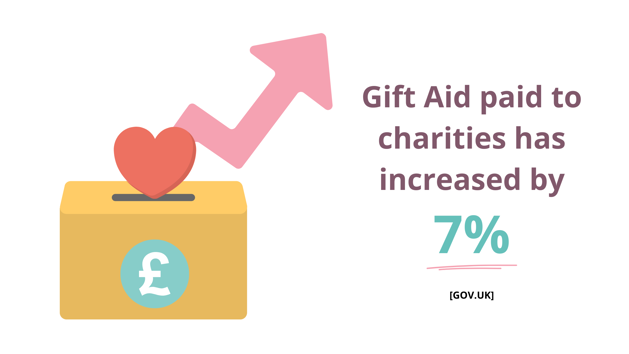
According to Gov.uk, UK charities received an estimated £1.7 billion in Gift Aid in the year to April 2025 - up about 7% on the previous tax year, showing the scheme’s continued importance to sector income.
But, around £560 million still goes unclaimed each year, often due to incomplete declarations, changing donation channels, or poor data hygiene - and that’s potential programme funding left behind.
Research from organisations like the Charities Aid Foundation (CAF) suggests a quarter of donors don’t always use Gift Aid, even when eligible, because “it’s too much effort” or the option isn’t presented clearly enough.
Taken together, those statistics make one thing clear: claiming Gift Aid is an opportunity maximised by some charities - and completely missed by others.
Why Gift Aid still slips away (and what you can do about it)
The complexity isn’t just anecdotal: despite its simplicity in principle - reclaiming 25% on qualifying gifts - the practical process requires clean data, valid declarations, and organisational grip. Without that, a significant slice of potential income evaporates.
Five practical steps to claim Gift Aid with confidence
Capture valid Gift Aid declarations at source
Everything starts here. A valid Gift Aid Declaration must be linked to your donor before you can make a claim, and if donors aren't prompted clearly at the moment they give, or if your data capture is inconsistent, claims will fail before they've started.
There are three types of declaration, so you can choose the one that best fits your situation.
- Gift Aid Declaration for single donations: covers one donation only; use when you won't have an ongoing relationship with the donor
- Gift Aid Declaration for multiple donations: covers all past and future donations; the most efficient option for regular supporters
- Gift Aid Declaration for sponsored events: designed for sponsorship forms, covering all donors giving for that event
Wherever possible, go for a multiple-use declaration. It covers past and future donations, not just the one at hand, which means you're building a compounding asset every time a donor signs up.

Standardised online forms and verbal declaration workflows (backed by good data capture software) can cut the friction dramatically.
Submit your claim (and know your route)
Once your declarations are in order, how you submit depends on your volume:
- Fewer than 1,000 claims?
You can complete a schedule spreadsheet and upload it directly to your HMRC Government Gateway account. It works, but it's manual - and manual is where errors creep in. - More than 1,000 claims, or want to save significant time?
You need specialist Gift Aid software. GOV.UK maintains a full list of approved suppliers, including Donorfy and Access Charity CRM. Both integrate directly with HMRC, keeping your data secure and making it quick and easy to claim in just a couple of clicks.
Use Gift Aid software built for charities
Manual records are where errors hide - I know this, I worked for a charity claiming manually! If you're managing declarations in spreadsheets, the risk isn't just admin time ... it's missed claims, failed submissions, and compliance gaps that are hard to spot until something goes wrong.
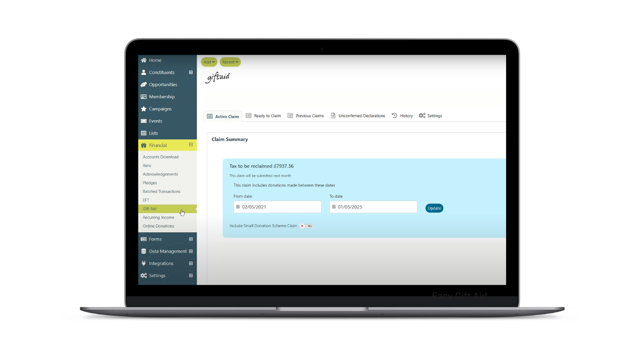
Good Gift Aid software for charities does the heavy lifting: it stores declarations securely, flags eligible donations automatically, integrates directly with HMRC, and prepares claim-ready submissions in clicks rather than hours. Your team spends less time wrestling with data exports and more time on the work that matters.
Think beyond one income stream
When people think about how to claim Gift Aid for a charity, they often picture a simple one-off donation. But Gift Aid eligibility stretches further than many charities fully optimise.
With the right processes and strong Gift Aid software for charities, you can confidently claim on:
- Recurring donations – ensuring declarations stay valid and linked over time.
- Charity shop sales (under the Retail Gift Aid Scheme where structured correctly).
- Online donations and micropayments – where clean data capture is essential.
- Sponsored events and peer-to-peer fundraising – capturing declarations from individual sponsors, not just participants.
- Gift Aid Small Donations Scheme (GASDS) – unlocking additional income from small cash or contactless gifts, even when donors haven’t completed a declaration.
Each income type has slightly different rules. If your systems do not reflect those nuances, claimable income can quietly slip away.
Run a backdated Gift Aid audit (there’s likely money waiting)
HMRC allows charities to claim Gift Aid on eligible donations made in the last four years. Four. Whole. Years.
Which means if your processes haven’t always been watertight, there may be a quiet pot of reclaimable income sitting in your historic data.
Backdated claims often surface when:
- donors ticked Gift Aid on one form but not another
- legacy spreadsheets weren’t merged properly
- shop or event income wasn’t linked correctly to supporter records
- declarations were valid but never connected to earlier donations
This is where good Gift Aid software for charities earns its keep.
Instead of manually combing through years of spreadsheets, a CRM allows you to:
- run reports on historic eligible donations
- match older gifts to valid declarations
- identify donors who gave previously but now have a valid declaration on file
- generate retrospective claim batches safely and compliantly
For some charities, a focused “Gift Aid sweep” has uncovered tens of thousands in missed income. It is not glamorous work. It is, however, incredibly satisfying.
Think of it less as admin and more as a mini fundraising appeal you forgot you ran!
Diversify your income with Donorfy
What role does your CRM play?
At its simplest: the right CRM becomes your Gift Aid HQ!
Donorfy, for example:
- automates the inclusion of eligible donations for Gift Aid.
- lets charities manage declarations and resolve issues quickly.
- provides reports that make unclaimed Gift Aid visible.
- integrates with HMRC to submit claims smoothly.
By turning manual toil into automated flows, you can spend time cultivating donors, and less fighting spreadsheets (yes, post code column, we're talking to you.)
Real-world shouts: charities using tech to boost claims
It’s one thing to talk theory, but charities are reporting practical wins:
Teams have reduced Gift Aid admin time significantly by switching from manual spreadsheets to CRM workflows, freeing up hours every claim period.
In fact, some organisations uncover tens of thousands in unclaimed Gift Aid simply by tightening donor data and running regular checks.
- Before Donorfy, the Youth Talk team hadn’t submitted a Gift Aid claim in over two years. Now, with income management features, they made a claim for £10,000 off the bat.
- Gift Aid claims are submitted monthly with greater confidence at the Roman Catholic Archdiocese of Southwark, thanks to the clarity of pre‑claim data checks.
-
Using Donorfy helped Brake reclaim £5,000 in backdated Gift Aid, a significant boost for the charity.
"Getting the Gift Aid sorted felt like a windfall. Donorfy’s made it possible to organise our claims, and with the integration we’re able to keep them up-to-date.”
- Amy Walker, Operations Manager, Brake
Claim Gift Aid with confidence in 2026
Gift Aid isn’t an add-on, it’s a core income lever for UK charities.
But with changing giving behaviours, new donation channels, and rising demand for resilience in the sector, the old adage applies: you can’t claim what you can’t see. That’s why:
- Getting declarations right at source matters.
- Clean data unlocks more claims.
- Software that understands charities turns potential into performance.
Put simply, understanding how to claim Gift Aid for a charity in 2026 means embedding it into your systems and workflows - with the right technology and the right processes - so you’re always capturing what you’re entitled to.
Where to next?

What and why
Understand Gift Aid rules
Get up-to-date on the latest Gift Aid rules for charities

How
Learn how to maximise and claim
Put the rules into practice with your step-by-step claiming guide.

Discover
Learn about Donorfy
See how Donorfy handles your Gift Aid