AU & NZ
 SG
SG
 MY
MY
 US
US
 IE
IE
 Donorfy
The quiet cost of manual work: how small inefficiencies add up in hospice fundraising
Hospice teams are often highly experienced. We’ve worked alongside hospices for many years, and roles tend to be long-held - you know your supporters, your communities and your income streams inside out.
The challenges are rarely about skill or commitment. More often, they’re about friction.
The quiet kind that builds up over time. Extra steps. Manual checks. Processes that work, but only because someone knows how to make them work. Each one feels manageable individually but, together, they quietly drain time, energy and headspace ...

When experience meets operational pressure
Across the sector, independent hospices generate more than £1.5 billion in income each year. That figure reflects extraordinary community support, strong relationships and sustained fundraising effort.
And yet, according to Hospice UK, many adult hospices in England have reported operating deficits in recent years, as rising costs have outpaced income growth. This tension sits at the heart of hospice fundraising today.
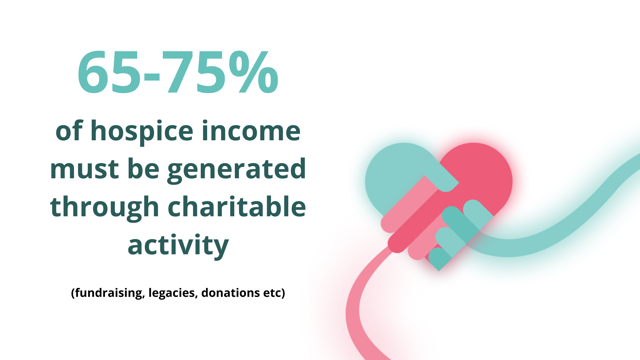
With government funding accounting for only around 30% of hospice income, the responsibility for generating the remaining majority sits with charitable giving, trading and community support. In practice, around 65–75% of hospice income is generated through charitable activity.
But - you know how to fundraise. Fundraisers in hospices often have sophisticated individual giving, event and legacy fundraising streams. The challenge is usually how to sustain what you do so well, without exhausting the people doing the work - and ensuring small inefficiencies don't become big ones.
The lesser-seen cost
Manual work rarely appears in financial reports, but its impact is felt every day.
It shows up as:
- Exhausted teams with high workloads
- Reports that take longer than they should
- Data held in multiple places “just in case”
- Lists that need checking and re-checking
- Knowledge concentrated in one or two people
Each of these might seem minor in isolation. But together, they chip away at the time and clarity teams need to plan ahead.
When most income depends on charitable activity, inefficiency isn’t just an admin issue. It becomes a sustainability one.
Save time with Donorfy
Why “digital transformation” misses the point
For many hospice teams, the phrase digital transformation feels heavy. It suggests disruption, retraining and change for its own sake.
In reality, what teams are often looking for is much simpler.
Relief.
Relief from:
- Duplication
- Unnecessary complexity
- Over-reliance on spreadsheets
- Processes that only work if the right person is in the room
Reducing manual work is about making everyday tasks easier and more reliable, so experienced people can use their judgement where it matters most.
Making space for better decisions
When friction is reduced, the impact generally goes beyond efficiency.
Teams gain:
- Clearer visibility of income and supporter behaviour
- More confidence in forecasting and reporting
- More time to focus on relationships, not just transactions
- Space to make deliberate decisions, rather than reactive ones
In a sector where so much depends on charitable income, that clarity matters. It helps teams protect what already works, even when conditions are tough.
From friction to marginal gains
When pressure is constant, it’s tempting to look for big fixes. New strategies. New ways of working.
But for many hospices - and many charities in general - the most meaningful improvements can come from small, cumulative efficiencies that make everyday work a little lighter.
This is the idea behind marginal gains. Not transformation. Not disruption. Just small improvements, applied consistently, that add up over time.
In practice, this might look like:
- Removing a duplicate step from a regular process
- Making reporting quicker and more reliable
- Reducing the number of places supporter data needs to live
- Improving how information flows between fundraising, finance and leadership
Over time, those marginal gains compound and protect team energy. They support steadier decision-making, and they make it easier to keep doing what already works.
In a sector where most income must be generated year after year through charitable effort, those small efficiencies aren’t cosmetic, they can directly support sustainability.

If you’re interested in exploring how small, practical improvements can add up, the Marginal Gains resource hub brings together ideas, examples and guidance designed specifically for charities.
CRM, quietly supporting the work that matters
You almost certainly already have a CRM - but is it genuinely helping you do less manual work?
Does the way you’re using it supports steadier income and stronger relationships with automation, or quietly add to the load of already stretched teams?
It's worth pausing to ask:
- Does your CRM help you see supporters as whole people, not isolated transactions?
- Does it support long-term relationships across giving, events and in-memory fundraising?
- Does it reduce admin, or create more of it?
- Does it give you confidence in reporting and income projection, without extra work?
When a CRM is working well, it shouldn't demand much attention. It supports continuity rather than change, helping experienced teams work with greater confidence and less strain.
That’s the philosophy behind Donorfy.
"We design Donorfy so it just quietly does its job in the background - so charities can stay focused on raising funds and doing great work."
-Rich Bee, Product Manager
Because the value isn’t usually in doing more.
It’s in doing what already works - with greater clarity, less friction, and more space for the work that really matters.
"We're a small team, so time is precious. Wherever we can save time is a bonus. At the end of the day, time is money."
- Fundraising Manager, Longfield Hospice