AU & NZ
 SG
SG
 MY
MY
 US
US
 IE
IE
 Donorfy
Data, consent & transparency: what does the latest Code of Fundraising Practice expect?
The Code of Fundraising Practice exists to protect supporters and strengthen public trust in the charity sector. The 2025 update sharpens that purpose. Its principles-based approach asks charities not only to follow rules, but to consider how their actions feel to supporters.
At the centre of this shift? Data, consent and transparency — the everyday foundations of ethical fundraising.
For charities already committed to treating people fairly, the updated Code simply provides clearer language, clearer expectations, and clearer guidance on what “good” looks like.
Let’s explore what that means in practice.

First, what drives public trust in 2025?
The latest Public Trust in Charities report shows that the public still want to trust charities - and, encouragingly, levels are rising.
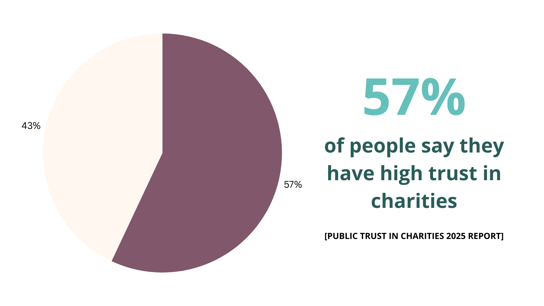 57% of people now say they have high trust in charities, placing the sector among the most trusted institutions in the UK.
More importantly, the research reveals why people trust charities:
- 53% of people say their trust increases when donations “reach the end cause.”
- 45% say it matters that the charity “makes a real difference” to people or communities.
- 39% say transparency about “how much is raised and how it is spent” is essential.
- 30% say acting “ethically” is a key factor in whether they trust a charity.
These findings reinforce what fundraisers know intuitively: trust is the currency that keeps the sector moving.
As Baroness Stowell, former Chair of the Charity Commission, once said:
“A charity’s most precious asset is its reputation for trustworthy behaviour.”
And trust is about to become even more valuable. Sector commentators predict that in the years ahead, “trust becomes the premium” — something donors actively seek out in a world of AI, automation and digital saturation. Real stories, transparent communication and authentic interactions may become more influential than ever.
The 2025 Fundraising Code doesn’t just react to these expectations, it anticipates them.
Where does secure data handling come into this?
Most supporters rarely think about data protection - but they trust that you do.
While they may never see the CRM systems or processes you use to safeguard their data, donors may well notice when something feels off.
The Code positions responsible data handling as a cornerstone of ethical fundraising, stating:
“You must act reasonably and carefully in all matters relating to fundraising… including making sure your fundraising activities keep to data-protection requirements.” - 2.1.1
And on inappropriate data sharing:
“You must not sell personal data to, or share it with, any other organisation unless you have the information owner’s consent.” - 2.1.5
Strengthening trust isn’t only technology — it’s about culture. Charities can embed respectful data behaviours by:
- Setting clear rules about who has access to supporter information and why
- Keeping data accurate and correcting errors promptly
- Only collecting what is genuinely needed
- Training everyone — not just data teams — on what good practice looks like
With regulatory pressure expected to grow, particularly around AI, accountability and safeguarding, strong data practice now will serve charities well in the future.
As Shaf Mansour, Head of Product (Charity) at Access Not for Profit, notes:
"As systems become more integrated and data quality improves, fundraisers will be able to use AI in ways that really make a difference. Improving your data use and quality is a great starting point for charities."
Transparency: are your supporters getting the full picture?
Trust doesn’t grow in the dark. The Public Trust report shows donors care deeply about understanding the impact of their giving, and about charities being honest when things change.
The Code reinforces this plainly:
“Your fundraising must not mislead… including by leaving out information or giving inaccurate or unclear information.” - 1.2.1
And when fundraising for a specific purpose:
“You must provide information about what will happen if you raise more than or less than the target amount.” - 1.2.2
Research from Dr Beth Breeze, Centre for Philanthropy, echoes this:
“People give because they think their gift will make a difference."
Supporters value transparency when charities:
- Are open about costs and overheads
- Communicate honestly about how donations are used
- Give realistic, not inflated, projections of impact
- Provide honest updates when circumstances shift
Younger donors, particularly Millennials and Gen Z, increasingly prefer shared excitement, collective meaning and clear purpose over guilt or pressure. Transparency isn’t just ethical; it’s a competitive advantage.
Nurture your supporters with Donorfy
Why are consent and choice so important?
Consent is no longer a compliance formality — it’s a relationship signal. Supporters want to feel known, not processed, and they want to stay in control of how they are contacted. The Code is clear:
"You must not use “unreasonably persistent approaches.” - 1.1.2
And:
“You must take all reasonable steps to treat existing or potential donors fairly, so that they can make an informed decision.” - 1.2.6
Supporters feel respected when charities:
- Make opting out simple and shame-free
- Offer clear choices at sign-up
- Don’t bombard or chase excessively
- Recognise when someone may be vulnerable
- Honour preferences across every platform, not just one
These aren’t just good habits, they’re relationship-building behaviours. They signal that the supporter’s comfort, boundaries and preferences matter.
Looking ahead

Many analysts predict that most charities will adopt an AI-first communication model, with human contact becoming a more premium, personalised experience for the likes of major donors, corporate partners and those who value a phone call or personal note.
This approach makes sense - there are only a certain amount of hours in the working day - but that shift works better when consent and preference management is already solid.
If AI handles day-to-day communication, knowing when a supporter wants a person instead becomes crucial. As Rich Bee, Donorfy Product Manager, puts it:
"It’s not about jumping on the latest AI bandwagon though. It’s about getting your foundations right."

Good data makes AI safer, more accurate and more supporter-friendly. Read more: AI for Fundraising: Building the Data Foundations
Are you storytelling with integrity?
Stories remain the heartbeat of fundraising, but the way you tell them matters more than ever. The Code sets the tone:
“Your fundraising must be legal, open, honest and respectful.” - 1.1.1
And cautions against misleading representation:
“You must not mislead… including by exaggerating details.” - 1.2.1
Fair, dignified storytelling includes:
- Using images that uplift rather than diminish
- Avoiding oversimplified “saviour” narratives
- Being transparent about the context behind a story
- Ensuring beneficiaries fully understand and consent to how their story will be used
Fundraising expert Giles Pegram CBE encapsulates it:
“Emotion is part of fundraising. Exploitation is not.”
With the rise of AI-generated content, authentic, consented, lived-experience storytelling will become even more important. Supporters want to know the stories they hear are true, and ethically obtained.
The Code prepares charities for exactly that shift.
How does charity technology support supporter care?
Up to this point, we’ve talked about values: transparency, dignity, fairness, respect. Living those values consistently across every appeal, campaign and colleague needs one thing: structure.
A well-run charity isn’t powered by great-intention alone, it’s powered by consistency.
While technology isn’t the heart of supporter care - people are - reliable charity CRM systems make it far easier to:
- Log and honour consent across channels
- Track restricted and unrestricted income transparently
- Capture changes quickly, like communication preferences
- Store storytelling consents and restrictions
- Maintain audit trails for accountability
- Handle data lawfully, safely and respectfully
For example, the Preference Centre in Donorfy lets supporters easily manage how they want to hear from you, putting choice and transparency directly into their hands.
It keeps all communication permissions centralised and automatically respected across your emails and campaigns. You can use it for legitimate interest as well as consent - which is great for the Data Use and Access Bill - more on that here.

Beyond supporting Code compliance, charity-specific software give you other advantages:
- Better reporting and insight
Structured data reports helps teams understand supporter behaviour, identify trends and make informed decisions.
- Significant time savings
Automation reduces administrative load, freeing staff to focus on creativity, relationship-building and stewarding supporters.
- Stronger collaboration
Shared information across teams reduces duplication and enables unified supporter journeys.
- Faster, more agile delivery
As predicted, charities can now build faster, cheaper and better than ever before. Rapid testing, content creation and reporting empower smaller teams to do bigger things.
- A smoother, more personalised supporter experience
Accurate records lead to more relevant messages, timely thank-yous and communication that feels human.
"We’re not just storing data with Donorfy, we’re using it to work smarter."
- Carisa Coley, CRM and Compliance Manager, Acorns Children's Hospice
In other words: Technology isn't just a data compliance tool, it’s an enabler of better fundraising, better supporter experiences and better use of precious time.
Final thoughts
The 2025 Fundraising Code of Practice distils what supporters are already telling us and what future trends are making clear: they want fundraising that is open, honest, ethical and respectful.
The Code puts it simply:
Fundraising must be carried out in a way that is legal, open, honest and respectful. - 1.1.1
Get those fundamentals right, supported by thoughtful processes, respectful storytelling and reliable systems, and compliance becomes more than an obligation. It becomes a story your supporters can believe in.