AU & NZ
 SG
SG
 MY
MY
 US
US
 IE
IE
 Donorfy
What is grant management software? A plain-English guide for charities
If you've typed "what is grant management software?" into a search engine, there's a decent chance you're already living the problem it solves.
Maybe you're chasing a deadline and you're not sure who last updated the application. Maybe your funding is growing, and the system that worked for two grants is starting to creak under the weight of twelve. Maybe your end-of-year report requires digging through three spreadsheets and a folder called "FINAL_v2_USE THIS ONE". This last one has absolutely been me, more than once!
Whatever brought you here, this guide aims to give you a straight answer.

What is grant management software?
Grant management software is a tool that helps charities and nonprofits manage the full journey of a grant: from identifying opportunities and submitting applications, through to tracking decisions, managing restricted income, and meeting reporting requirements.
It's sometimes called a grant management system, and it often forms part of a broader fundraising CRM – but we'll come back to why that distinction matters.
At a functional level, here's what it typically covers:
Before the application
- Researching and logging funding opportunities
- Tracking eligibility criteria and deadlines
- Recording funder preferences and relationship history
During the application
- Managing draft submissions and internal sign-off
- Logging amounts requested and key contacts
- Tracking application status in a shared pipeline
After the decision
- Recording outcomes (successful, unsuccessful, deferred)
- Managing grant conditions and restricted fund requirements
- Scheduling and tracking reporting deadlines
- Storing impact data and evidence for future applications
That's the mechanics. But the reason organisations actually reach for this kind of software is usually something more specific.
The real reason charities use it
Here's what tends to happen without a dedicated system ...
Your trust fundraiser keeps a spreadsheet. It's good – colour-coded, carefully maintained, probably their life's work. But when they're on leave and your Director needs to know the status of a £40k application that's due for a decision this week, nobody else can find the answer quickly.
Or: you've successfully grown your grant income from three funders to fifteen over the past two years. Amazing! But your reporting deadlines now span the whole calendar year, each funder wants something slightly different, and the mental load of keeping it all straight has quietly become enormous.
Or: you're preparing your annual report and you need to show restricted fund expenditure against grant conditions, and you're realising you never consistently recorded that information in one place.
Grant management software solves these problems not by being clever, but by being consistent. One place where applications live. One place where deadlines are tracked. One shared view of what's in the pipeline, what's been awarded, and what needs to happen next.
What makes a good grant management system?
Not all grant management tools are created equal, and the difference between a useful one and an expensive shelfware situation usually comes down to a few things. When you're talking to suppliers, keep the following in mind:
It should live where your fundraising lives.
The biggest practical mistake charities make is treating grant management as a separate process from the rest of their fundraising. Grants don't exist in isolation, they're part of your income picture alongside major donors, individual giving, and corporate partnerships. When grant data sits in a separate spreadsheet or standalone tool, you lose the ability to see how it all connects.
This is why many charities manage their grants through a fundraising CRM like Donorfy, rather than a standalone system.
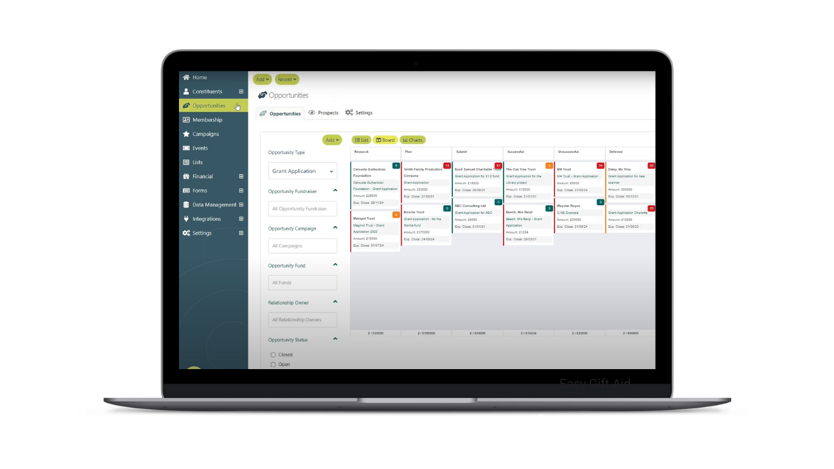
Donorfy's Opportunities feature lets you manage grant applications through a visual pipeline, tracking each stage from submission to outcome, logging amounts applied for and received, and keeping everything attached to the funder's constituent record. Because it's all in the same system as the rest of your fundraising, you can see your full income pipeline in one view. Here's a quick video overview.
It should make reporting easier, not just possible.
One of the most time-consuming parts of grant management isn't the application, but the reporting. A good system captures the right data at the right point in the process, so that when a reporting deadline comes around, you're pulling from clean records rather than reconstructing a narrative from memory and email threads.
It should be something your team will actually use.
This sounds obvious, but it's where a lot of implementations quietly fail. If it requires training to do basic tasks, adoption drops. The best grant management systems are the ones that make it slightly easier to log something than to not log it.
It should give you visibility, not just storage.
There's a difference between a system that holds information and one that surfaces it. What's in the pipeline right now? What decisions are expected this quarter? What's your success rate with this funder? A useful grant management system answers these questions without requiring you to build a report from scratch each time.
See everything Donorfy can do
Does it have to be grant management software for nonprofits?
All software you use should, ideally, be specifically designed to meet the needs of the work you do. Commercial and retrofitted CRMs often miss the mark, and don't give you the functionality you need easily.
For example, restricted funding is the big one. Grants frequently come with conditions attached – money that can only be spent on specific activities, within specific timeframes, with specific evidence requirements. Your system needs to be able to reflect that, so restricted income doesn't get muddled with unrestricted funds and your auditors (and funders) stay happy.
Relationship history matters more than it might in other contexts, too.
Many trusts and foundations prefer not to receive unsolicited applications, they want to build relationships over time. A good system keeps a clear record of every interaction, every application, every conversation, so that each approach is informed by everything that's come before.
And then there's the team reality. Most charity fundraising teams are small. Grant management systems that work well for nonprofits are built with that in mind.
English Touring Opera is a good example of this in practice. By adopting a more structured approach, and using Donorfy's Opportunities feature specifically for grant and trust applications, they were able to build a clear, trackable process from scratch.
As Development Manager Olivia Collins put it:
"The opportunities feature is particularly useful for monitoring the different stages of our applications once they're in the pipeline, from submission to outcome."
That's not a small shift. For a lean fundraising team, having that pipeline visible and shared changes the day-to-day significantly.
Do you actually need grant management software?
Honest answer: not always – and not necessarily as a standalone product.
If you're managing fewer than five or six active grants, a well-maintained spreadsheet might genuinely be fine. The warning signs that you've outgrown it tend to look like this:
- You can't answer "what grants do we have in progress right now?" without opening multiple documents
- More than one person needs access to grant information, and keeping it in sync is becoming a job in itself
- You've missed a reporting deadline, or come close
- Your restricted fund reporting at year-end requires detective work
- You're trying to grow your grant income but you don't have a clear picture of your pipeline
At that point, the question isn't really whether you need a better system. It's whether you want a standalone grant management tool, or whether it makes more sense to manage grants as part of your wider fundraising CRM.
For most charities, the latter is the stronger choice, because your grants don't exist separately from your relationships, your campaigns, or your income forecasting. Keeping them connected gives you a clearer picture of everything.
The short version
Grant management software helps charities track and manage grants from first contact with a funder to final report. A good system brings consistency, visibility, and shared access, so the whole team is working from the same picture, reporting is less painful, and nothing slips through the gaps.
For most charities, the best approach is managing grants through a fundraising CRM like Donorfy, where grant applications sit alongside the rest of your income activity rather than off to one side.
If you're at the point where your current approach is starting to cost you time and confidence, it's probably worth a look.