AU & NZ
 SG
SG
 MY
MY
 US
US
 IE
IE

 Donorfy
Fundraising challenges: what six million fewer donors means for UK charities
A guide for UK Fundraising Managers
This guide is for fundraising managers trying to make sense of the current landscape – not just the headline numbers, but what's structurally shifted and the new reality of giving.
It walks you through the key findings from the UK Giving Report 2026, what's driving the fundraising challenges charities are facing right now, and why the difficulty most teams are experiencing isn't a failure of execution, it's a change in the environment.

You've felt it before you could name it
Campaigns that used to perform predictably, don't. Regular givers are quietly dropping off. Acquisition feels harder – not catastrophically, just steadily, like the tide going out.
And somewhere in your planning meetings, a question hangs in the air that nobody quite wants to say out loud:
Is it us, or is it something bigger?
Recent research suggests the latter, and the whole sector is feeling it.
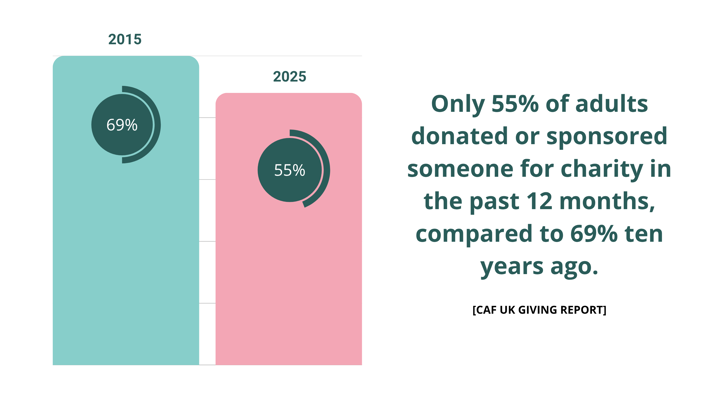
The Charities Aid Foundation's UK Giving Report 2026 puts a number on it: six million fewer donors than a decade ago. The British public gave an estimated £14 billion to charity in 2025, down from £15.4 billion the year before, the first fall in total giving since 2021. One in five people said they simply can't afford to give to charity.
The fundraising challenges charities face
The instinct when you see a figure like six million fewer donors is to think: fewer people giving. That's true, but it's only part of the picture, and arguably not necessarily the most important part.
Here's what makes the current situation more complex:
The donors who remain are, in many cases, giving more.
Average monthly donations have risen over the decade, and giving has broadly kept pace with inflation. Total giving only fell for the first time in five years because a shrinking group of committed donors kept propping it up – and now even that buffer is showing strain.
What this tells you is that the fundraising challenges UK charities are navigating aren't simply about scale, but also structure.
The sector has been quietly reorganising itself around a smaller, more committed core, and the strategies many teams are still running were built for a giving landscape that no longer exists.
Three structural reasons donations are falling in UK charities
"Individual giving in the UK is undergoing a structural shift, not a short-term dip."
- UK Giving Report
The six million figure is a symptom, but what are the potential causes?
Giving has become a considered decision, not a default behaviour.
The most important thing to understand about the current decline is that people haven't stopped caring. What's changed is the assumption underneath the act of giving. Where charitable donation was once habitual – something people did without much deliberation – it has become conditional and selective.
Today's donors weigh causes against each other.
They evaluate impact. They give to fewer organisations with more intention. The UK Giving Report describes this clearly: the shift is not a loss of compassion, but a fundamental change in the baseline assumptions people bring to the decision.
In practice, this means you're no longer competing for a share of a generous reflex, you're competing for a considered decision. That's a different problem, and needs a different response.
Loyalty is no longer the natural outcome of a good donor relationship.
For a long time, the logic of regular giving was relatively straightforward. Acquire someone well, steward them reasonably, and they'd stay. The direct debit was the destination, and once you had it, you could broadly rely on it.
That logic has broken down. Around 2.8 million people cancelled a regular donation in 2025 alone. The broader picture makes clear that two-thirds of all giving is now essentially unplanned, triggered by moments, campaigns, and emotional prompts rather than ongoing commitment.
This is the fundraising challenge most teams feel most acutely, because it changes the shape of the income problem entirely.
Retention is no longer a passive outcome of a relationship maintained. It's an active, ongoing decision your donors are making, month by month, whether or not you're helping them make it consciously.
The moment of giving now matters as much as the message
Perhaps the most practically significant finding in the UK Giving Report 2026 is this: a recommendation from a friend or family member is around five times more likely to prompt a donation than an email from a charity.
That gap tells you something important about how giving actually happens now. Donors give when they're emotionally engaged, when friction is low, and when the prompt arrives at the right moment — not when a charity has scheduled its next campaign.
The infrastructure of giving – how easy it is, how natural it feels, how well it meets people where they already are – has become as consequential as the message itself.
Reach alone matters less. Relevance, timing, and ease matter more.
Turn donor data into insight
Why these fundraising challenges don't feel like a landscape problem
There's a reason this section exists. Because one of the most disorienting things about a structural shift is that it can feel, from the inside, like you're doing something wrong.
I've been there myself. Your campaigns perform inconsistently. The regular giving base erodes, slowly, at the edges. Acquisition costs more and returns less. Forecasting income has become genuinely difficult in a way that feels new. And underneath all of this is pressure – to explain the numbers, to find the fix, to run harder in order to stand still.
The instinct is to blame execution: the wrong message, the wrong channel, the wrong timing. Sometimes that's true. But often, what looks like a performance problem is an orientation problem.
The fundraising challenges UK charities face right now are structural, and the strategy might've been built for conditions that have shifted.
Understanding this doesn't necessarily make the numbers easier, but it does change the question you need to be asking, which is less what went wrong and more what does good look like now?
Why this goes beyond your fundraising team
The downstream effects of a shrinking, shifting donor base don't stay on the fundraising floor, they move through the organisation.
When income becomes harder to forecast, planning horizons shorten. Short-term thinking starts crowding out longer-term investment, and in systems, in people, in the kind of relationship-building that creates durable income over time.
Risk appetite drops. Teams feel pressure to show results fast, which often works against the slower, more compounding work of building genuine donor loyalty. Sound familiar?
There's a further structural risk embedded in the current picture. Charities have increasingly come to rely on a smaller group of highly committed donors who give more. That's not inherently problematic, but it creates concentration risk. Any disruption to that core group's behaviour, as we're now beginning to see, has outsized consequences.
What presents as a fundraising challenge is, at its root, an organisational resilience challenge. The two aren't separable.
The quiet opportunity inside the difficulty
None of this is intended to leave you staring into the middle distance, because there's something worth holding alongside the difficulty.
The donors who are still giving – the 31 million adults who donated or sponsored in 2025 – are, in important ways, a higher-quality base than a decade ago. They're giving more per person. They've made a considered choice to support causes they care about. The relationship, when it's working, is built on something more durable than habit.
The UK Giving Report 2026 also shows that more than half of donors are motivated by a desire to be part of something bigger than themselves. They want to feel connected to a cause, to a community, to a sense of shared purpose.
That's not a problem to solve. That's the raw material of a genuinely strong donor relationship.
Smaller, more intentional donor bases can support stronger relationships, better long-term value, and clearer feedback on what's resonating.
The fundraising challenges are real, but so is the foundation underneath them.
What this points toward
A few honest implications ... not instructions, but things worth sitting with as you think about what comes next.
Growth may no longer come primarily from volume.
Acquiring more donors at scale is harder and more expensive than it was. The approaches that worked when giving was habitual are less effective when it's selective. Where growth comes from – deeper relationships, higher lifetime value, reactivation of lapsed donors – deserves serious attention.
The donor experience has become a fundraising lever.
When giving is considered rather than automatic, how donors feel about their relationship with your organisation directly influences whether they stay and whether they give more. Stewardship isn't a nice-to-have alongside fundraising. It is fundraising.
Visibility needs to align with intent.
Being present at the moment someone is emotionally ready to give, and not just broadly visible, but specifically relevant at the right time, is worth more than wide but poorly-timed reach.
And the systems underneath all of this matter more than they used to. If your infrastructure can't tell you who's at risk of lapsing, where unplanned giving is coming from, or which donors are most engaged, those gaps have become increasingly costly.
It probably goes without saying that a CRM, like Donorfy, won't just store your donor data, but give you the insights you need.
What comes next?
Understanding the fundraising challenges charities are navigating is the foundation. The more useful question – how do you actually respond, and what's working in practice – is where this goes next.
In the coming weeks, we'll be moving from diagnosis to response: the strategies, decisions, and approaches that are helping fundraising teams navigate a changed landscape. Not a list of tactics, but a grounded look at what effective fundraising looks like when the old assumptions no longer hold.
If this guide has helped you name something you'd already sensed, that's exactly its purpose. The next part is what to do with that clarity ...