AU & NZ
 SG
SG
 MY
MY
 US
US
 IE
IE
 Access Raise
Nonprofit website best practices: 6 tips for charities
Riddle me this. It holds no books, yet is full of pages. It receives many visitors, but never leaves its own address ... it’s a website.
As for getting lots of visitors, well, that’s something we all hope, even though it’s not guaranteed. The good news? There’s usually more we can do to turn up the traffic and boost end results.
If you work for a charity, establishing a strong online presence is, needless to say, a must. In this article, we’ll be looking at nonprofit website best practices. And while once that might have focused mainly on ‘prettier pages’, these days it’s often exploring performance and making sure your site maximises fundraising, awareness and impact.

The aim? make your website a revenue and relationship engine
A charity’s online home is a critical platform to showcase your work, and the ethos that acts as its foundation.
“Your website is an essential shopfront to the world and the first port of call for many people who come across your organisation. When beginning the design [or redesign] process, your starting point should always be to define who those people are and what their motivations are for visiting, approaching your website as if you’re the outsider and putting yourself in their shoes.”
And they're wise words. A modern charity website is more than a digital brochure – it’s a fundraising and engagement engine, where success can be partly measured by its ability to drive revenue and strengthen relationships.
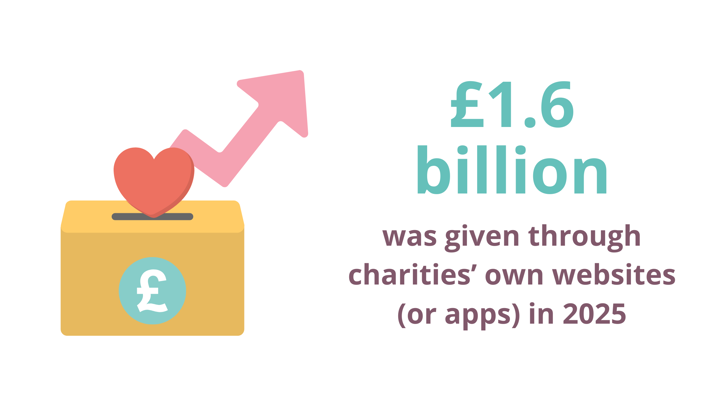
There's an important reason to get your website donation journey right, too. While we all know that charitable giving has been squeezed in recent years, the UK Giving 2026 Report from Charities Aid Foundation still found that some £1.6 billion was given through charities’ own websites (or apps) in 2025.
OK, how do I build that engine?
Good question. Firstly, most charities don’t have a website problem. They have a conversion problem. Or a connection problem. Or even a data problem.
From speaking to hundreds of charities over the years, an effective solution is often a good quality charity website builder that brings your systems and needs together – linking and strengthening communications, campaigns, databases, event planning and more besides, especially with new tools like AI in the frame.
We’ll look at that idea more shortly, but first, let’s cover six nonprofit website best practices and design truths that will always be valid when your engine is being built.
- Make your design simple and accessible: if your website is complicated to use, hard to navigate, looks messy on mobiles, or isn't accessible to everyone, users will bounce, and usually fast.
- Use clear messaging and branding: your charity is unique, so make sure you articulate that well with a consistent visual ID, strong voice and prominent content about your mission and passions.
- Optimise for fundraising: donation, donation, donation! Fundraising is your bedrock, so make those buttons eye-catching, offer multiple payment options, big up Gift Aid and make giving super-simple.
- Go beyond donations: it’s about more than money, so consider selling event tickets or memberships, including an online shop and providing insightful resources.
- Step up your storytelling: bring your work to life with great stories, meaningful statistics, news and campaign updates, all told via blogs, videos, mailshots, social media platforms and even event calendars.
- Use the latest tools to expand reach: SEO considerations still count, but the new kid on the block is GEO. Get up to speed on how to optimise your website to be found by the likes of ChatGPT, and don't forget to choose a CMS with AI tools built in!
From fragmentation to free-flowing online experiences
In the section above, we covered some of the foundational principles your website should address. But, looking around in today’s world of stressed economies and rapid AI and tech developments, nonprofit website best practices should also reflect what cuts through in the here and now. That is to say:
- Friction is a no-no: we’ve touched on accessibility, but these days digital-savvy people expect seamless and instantaneous experiences, so avoid buffering, glitches and looking sus on data protection.
- Take trust further: speaking of which, showing security measures, e.g. via HTTPS hosting, acts as a trust signal, just as a strong and steady tone of voice, and smooth user journeys do; in short, credibility is key.
- Capture that intent: tap into a fully managed Google Ad Grants service, to bring more high-intent traffic to appeal pages and turn visits into measureable income.
- See sense with a CRM: it’s a key component in all of this, really, a ‘one-stop-nonprofit-shop’ that will manage data from your website, events and engagement, as part of a single digital solution.
Don’t let nonprofit website best practices puzzle you
The right choices in a digital world can be a brain twister at times, but we hope this article has helped to provide you with a starting point/quick wins.
If you’d like a deeper dig into your website specifically, the Access Raise team offers services like smart strategy, best practices and charity UX design, so you - and your website - can hit the ground running.
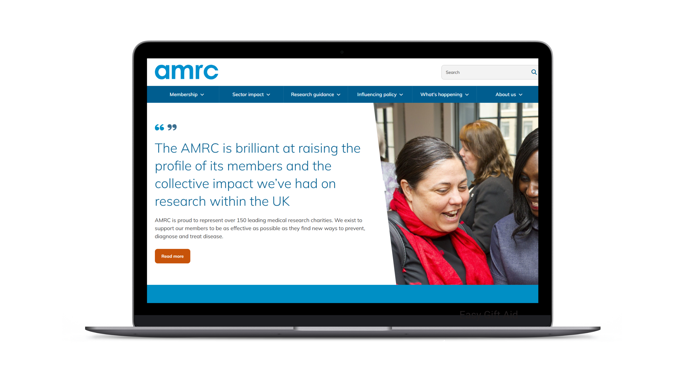
The Association of Medical Research Charities recently took part in structured discovery workshops, and here's what they thought:
“That first workshop opened our minds to opportunities we hadn’t thought of. It helped us step back and look at the website with fresh eyes.”
If you could benefit from the same service, get in touch!
Less complexity, more clarity