

 AU & NZ
 SG
SG
 MY
MY
 US
US
 IE
IE
Beyond Predictions: Co-Creating Value in 2026
Two months into a new year and, I'm guessing your inbox looks a lot like mine. Packed full of trends and predictions, each one urging us to pay attention to the latest ideas deemed essential for L&D to remain relevant and valuable in the year ahead.
Personalised learning. AI transformation. Learning ecosystems. Agile L&D. The latest ‘new’ trends all clamour for our attention. Each urgent, each essential, each adding to an already impossible day job.
We read and agree with researchers and experts, look at our current workload, bookmark the insights, and hope to come back to them.
But here's what two decades of researching how high performing learning teams deliver results has taught me: hopes and intentions don’t convert to business impact. The trouble is this. The way most of us react to these trends keeps us stuck in the patterns that limit our impact rather than improve it. And increasing our value to the business is one of the biggest trends we saw over the last 12 months.

The pattern we fall into
When we're overwhelmed, we retreat to familiar territory. Does someone need personalised learning? Let’s find easy ways to offer them more to choose from. Are we getting demands for new skills from across the business? Let’s design programmes to order. AI knocks at our door? Let’s offer awareness training. Agility matters? Let’s do all of this but faster!
We spend our time in corporate L&D working FOR people. We take requests, analyse needs, design solutions, and deliver interventions. We measure what we can control: completion rates, engagement scores, satisfaction surveys.
The trouble is that this approach keeps us operating at the learning value end of the L&D value spectrum.
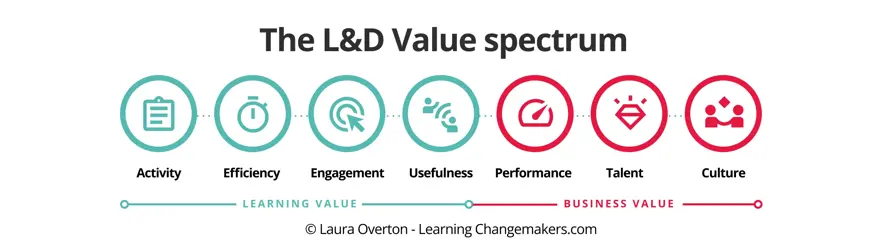
Activity, efficiency, engagement are good indicators of how our interventions are perceived by our stakeholders, but they mostly signal L&D as a cost centre. These value metrics rarely tell us whether we've made a difference to business value – the goals that matter to the business.
What high performers do differently to get results?
For over 20 years, the Learning Performance Benchmark has tracked what separates high-performing L&D teams from everyone else. Through the change and disruption of 9/11, the 2007 global recession, the COVID pandemic, and now AI, one pattern has still been remarkably consistent.
High performing L&D professionals do not work FOR the business. They roll their sleeves up to co-create value WITH the business.
When we work FOR people, we provide learning interventions in response to requests. Output-oriented, we deliver programmes, content, experiences.
When we co-create WITH our stakeholders, we operate in the interwoven world of the organisation's politics, process, and people. But we bring our professional insight to a shared business goal or problem. In this business model of L&D, we are outcome oriented. Here we operate in the messy space where business value is created, and we work, with others, to measure shared business outcomes.
Here's what the data shows. Over the past two decades, high-performing teams have consistently reported average improvements of 14% in productivity, 21% in customer satisfaction, and 28% in the speed of implementing new initiativesi. Not because they had bigger budgets or better technology, but because they found smart ways of co-creating value with others rather than just delivering interventions.


Four ways to co-create value
This year's trends are telling us WHAT we need to focus on to drive better value in 2026. But shifting our perspectives from working for the business to co-creating value with the business helps us work on HOW to turn trend talk into impactful action. Let me show you four essential shifts.


Co-creating value with individuals
Trend to respond to: Personalised Learning
Personalised learning dominates L&D conversations right now. Every major platform is launching AI-powered personalisation features. Organisations are investing heavily in recommendation engines, adaptive technologies, and smart curation tools. The message from those vendors is clear: personalise or lose your talent to competitors who will.
But there's a critical gap between what technology can deliver and utilising this effectively to drive business value. The question isn't whether to personalise, it's whether you're personalising for what you think people want, or co-creating with them to focus on what they really need.
The personalised learning trend promises tailored pathways, adaptive content, and individualised experiences. But here's what we often miss: people are already learning, with or without our help.
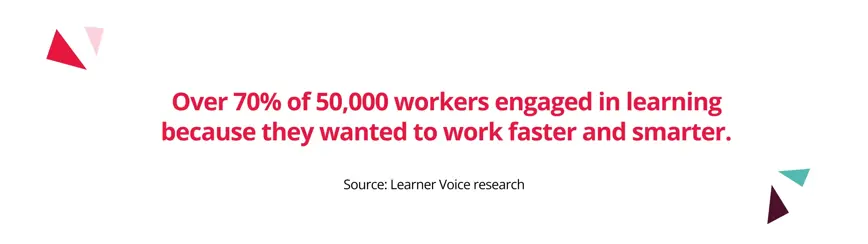
Over the years, my own Learner voice research revealed something crucial. Over 70% of the 50,000 workers, we studied engaged in learning because they wanted to work faster and smarter. They were already using mobile devices and social networks to learn from each other, even in organisations where these were officially off-limits.
When you co-create value with individuals, you're not designing FOR them. You're working WITH them to equip them to do their job better and faster and ensure they are ready to adapt to what’s next.
Daniel Pink in his book Drive, reiterated that autonomy drives motivation. Acknowledging that learning is an individual choice change everything. Today’s workers are increasingly aware of the need to be ready for the next job and are looking for organisations that invest in their career and not just their performance. Working with individuals, we move from "here's your predetermined personalised pathway" to "here's what's possible, here's where you are, you decide what's next."
The Learning Performance benchmark data proves this approach works. High-performing teams have always been twice as likely to offer access to non-job-related content. They proactively support career progression using technology. They create conditions where autonomy flourishes rather than trying to control the learning experience. This isn’t a trend – it’s a pattern repeated over the last 20 years! (Overton & Ockers 2025 p 54)
Self-directed learning isn't about building better recommendation engines. It's about connecting with individuals and co-creating the conditions where people can direct their own development towards goals that matter to both them and the business.

Co-creating value across the enterprise
Trend to respond to: Learning ecosystems
The vision of connected learning ecosystems is becoming reality. Integrated platforms now link learning with HR systems, performance tools, and the flow of work itself. Technology helps us get closer to seamless experiences where learning happens everywhere.
The technology makes it possible—but technology alone doesn't determine success. The real impact comes from working with stakeholders across the business to understand shared goals and solve problems together. When you combine connected systems with collaborative partnerships, that's when ecosystems deliver genuine business value.
The learning ecosystem trend talks about breaking down silos, integrating systems, and connecting learning to the broader employee experience. But you can't build an ecosystem alone.
When Damien Woods at National Australia Bank wanted to improve contact centre training, he didn't start by designing a programme. He spent time on the floor, listening to customer calls, watching how people juggled multiple systems, understanding where they struggled. Then he approached the business manager with a shared goal: reducing time to proficiency whilst improving retention. (Overton & Ockers 2025 p 16)
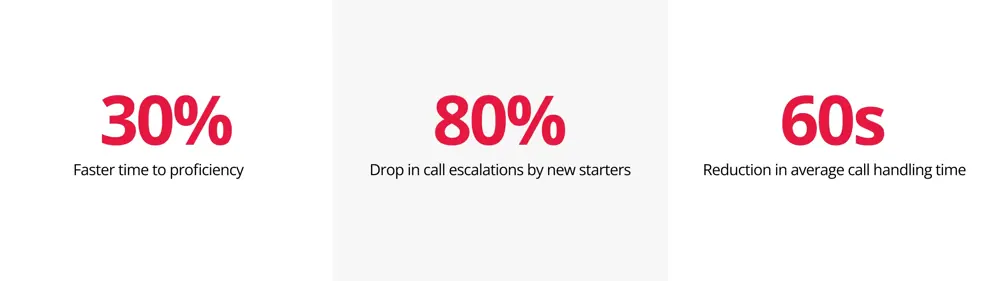
Together, they replaced a 17-day face-to-face induction with a four-day blended approach. Employees reached proficiency 30% faster, call escalations by new starters dropped by 80%, and average call handling times fell by over 60 seconds.
That's co-creating value across the enterprise. Not L&D implementing a solution, but L&D working WITH operations to solve a business problem together.
High-performing teams don't wait for formal structures to change. The Learning Performance benchmark shows they're twice as likely to explore how digital learning integrates into onboarding, and they ensure succession planning connects to development. They recognise that their high-impact work happens at the intersections with other functions.
Working across silos means understanding that you don't control the ecosystem. You're part of it. You bring your professional insight to shared goals, and you measure success through business outcomes that matter to everyone involved.
Co-creating value with AI
Trend to respond to: AI transformation
AI is transforming what's possible in L&D. Automated content creation, intelligent coaching, predictive analytics, and real-time performance support are opening up opportunities for connecting the learning dots. The technology is powerful, and organisations continue to explore AI-enhanced learning experiences.
The potential is enormous—but realising it requires more than great deployment of the latest tech stack. The critical success factor is working with AI as a partner to enable performance in entirely new ways. When you combine AI's pattern recognition and real-time insights with human judgement and stakeholder collaboration, you unlock transformation that neither could achieve alone.
The AI trend fills our inboxes with promises of automated content creation, intelligent coaching, and predictive analytics. But here's the critical question: are we using AI for improving what we do now, or co-creating better learning opportunities WITH AI?
James Swift at Leyton faced a challenge when the company shifted to hybrid work. Client retention was falling, and managers could no longer observe the critical interactions that drove engagement. Rather than guessing at solutions, he used AI to help identify eight specific behaviours that consistently appeared in successful client calls. (Overton & Ockers 2025 p 106)
But he didn't replace human coaching with algorithms. He gave coaches better insights so they could have more effective conversations. The AI monitored calls continuously, and when certain behaviours didn't improve, he adjusted the coaching with focused practice scenarios.
Within eight months, those critical behaviours showed up in 80% of client calls, and client retention significantly improved.
That's human judgment plus AI pattern recognition. That's co-creating value WITH AI, not just deploying content faster and hoping people use it.
Research shows that 75% of employees don't feel confident using AI, business leaders are passionate about the opportunity but nervous about implementation. Without trust and partnership, AI-powered solutions won't deliver the transformation everyone's predicting. Co-creation means involving people in exploring how AI can help, experimenting together in low-stakes ways, and building systems where humans and AI each contribute what they do best.
AI isn't about automating content creation. It's about enabling performance in ways that were previously out of reach, offering real-time insights, and helping us sense patterns we'd miss on our own. But only when we co-create the approach rather than implement solutions in isolation.

Co-creating value dynamically
Trend to respond to: Agile L&D
Adaptability, speed and flexibility are now essential. Business priorities shift rapidly, and modern learning technology enables L&D to respond in ways that weren't possible before. Agile methodologies and digital tools make it possible to iterate quickly, experiment continuously, and adapt without lengthy delays. The capability to be truly agile is finally within reach.
But the tools and methodologies are only part of the equation. Real agility happens when you use these capabilities to sense, respond, and adapt with your stakeholders in real time. When technology-enabled flexibility meets collaborative partnership, you move from simply delivering faster to continuously discovering what creates the most value.
The agile L&D trend urges us to iterate faster, respond to change, and embrace experimentation. But being agile isn't something you do TO your processes. It's something you practice WITH your stakeholders.
Marie Daniels at a global eye-care company didn't pursue perfect metrics. She became curious about what 'good' looked like to the business. By tuning in to what mattered to stakeholders, she created connections that led to collaboration. She linked to existing business metrics rather than creating L&D-specific measures disconnected from business realities. (Overton & Ockers 2025 p 92)
Like a navigator who agrees on the destination and then constantly adjusts course based on changing conditions, effective L&D creates feedback loops that drive ongoing adaptation. In complex environments, success comes not from perfectly executing a predetermined plan, but from continuously sensing, responding, and refining your approach WITH those around you.
High-performing teams don't follow rigid processes. They engage in continuous improvement practices, embracing uncertainty and developing the ability to shift course when needed. The benchmark data shows they're far more likely to have a safe environment to work out loud and an organisation that understands the value of learning from mistakes.
Co-creating value dynamically means sensing together, experimenting together, and adapting together. It means sharing progress in business terms that stakeholders understand and inviting them into decisions about where to adjust course.

The question that changes everything
I've watched L&D teams transform their impact by shifting one fundamental question.
Instead of asking stakeholders, "What training do you need?" they ask "What is the goal we trying to achieve together?"
That shift changes the relationship. We move from service provider to strategic partner. From order-taker to co-creator. From someone who delivers interventions to someone who helps solve business problems.
And here's what surprised me most after 20 years of studying high-performing teams: this shift doesn't require a massive transformation. It starts with how you frame your next conversation.
The trends will keep coming. Technology will keep evolving. Business priorities will keep shifting. But the fundamental principle remains constant: real impact happens when we bring our learning expertise to co-create value with the business enabling individuals’ teams and organisations to achieve their goals rather than expecting them to achieve ours.
So, as you look at that overwhelming list of trends, ask yourself: am I working FOR my organisation, or am I co-creating value WITH them?
Because how you answer that question will determine whether you spend 2026 hoping things stick or building the kind of partnerships that create lasting business value.
The opportunity is right in front of us and over the coming week’s we’ll be digging deeper into the strategies of high performing teams that can help us all turn trends into tactics that deliver impact in 2026.
