AU & NZ
 SG
SG
 MY
MY
 US
US
 IE
IE

 Donorfy
Corporate fundraising: navigating social value, confidence and winning proposals
Corporate fundraising has a habit of sitting in an awkward middle ground.
It’s rarely completely new to charities, but it’s often not fully embedded either. Most organisations recognise its potential, yet many feel unsure how to approach it in a way that’s realistic, repeatable and right for their size.
This leaves corporate fundraising living in the “important, but slightly intimidating” category.
Not because charities lack good projects, strong impact or compelling stories. But because translating that value into something businesses understand, and can confidently buy into, isn’t always straightforward.
That’s what this piece is about.

The UK landscape - ripe for impact?
According to the Charities Aid Foundation, only around 25% of UK businesses supported charities through time, cash or goods last year.
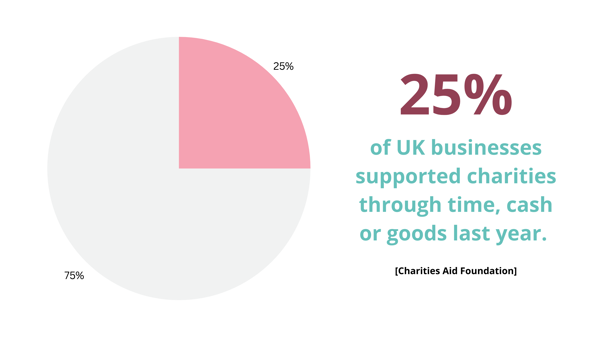
Those that did gave an estimated £4.2 billion. In other words, three quarters of UK companies are not currently engaging with corporate giving.
This is often interpreted as a bleak picture, but it can be read differently ...
Rather than a saturated marketplace dominated by a handful of large charities, corporate fundraising in the UK is uneven and fragmented. There's significant untapped potential, particularly for organisations that can articulate their purpose clearly and demonstrate how business support translates into real-world impact.
For charities thinking seriously about income diversification and long-term fundraising management, this matters. Corporate fundraising isn't a crowded channel. It's an emerging one for many organisations, and that creates space for those who approach it with clarity and structure. Success usually comes from positioning well.
"Businesses want to support culture, but they also want opportunities that strengthen their profile, engage their staff, and demonstrate social value. Organisations that can clearly articulate not just what they need, but also what they can offer, are far more likely to succeed."
Getting confident about corporate fundraising
A large proportion of discomfort around corporate fundraising stems from how it's mentally framed.
If it feels like persuading businesses to part with money, it will likely feel uncomfortable. If, instead, it's understood as offering businesses a credible route to create social value through your work, the dynamic changes.
You're no longer asking for a favour, you're presenting an opportunity.
Confidence also tends to grow when corporate fundraising is grounded in tangible projects rather than abstract partnership concepts. Many charities jump straight to imagining large, multi-year strategic partnerships, when in reality most successful relationships start with something much simpler.
A well-defined project with a clear outcome is far easier to talk about, cost, visualise and manage within your existing fundraising management processes than a broad request for “support”.
It gives both you and the business something concrete to engage with, and it provides a natural starting point for a longer relationship.
Starting smaller isn't a lack of ambition, it's often what's most realistic, and a strategy for building momentum.
A standout example: shifting behaviour, not just bank balances
Not all charity corporate partnerships are about cheques. Some of the most powerful ones focus on awareness and behaviour change.
A great UK example is the partnership between Kicks Count and maternity clothing brand Natal Active.
Kicks Count works to reduce stillbirth by raising awareness of the importance of monitoring baby movements during pregnancy. Natal Active supports this by embedding Kicks Count’s messaging directly into its maternity leggings through a discreet “life-saving label” reminding wearers to check their baby’s movements. The brand also sells wristbands linked to the campaign.
It’s a simple idea with big reach.
- Natal Active uses its product as a channel for impact.
- Kicks Count gains repeated, real-world visibility with the people who most need the message.
No complex sponsorship package. No heavy assets. Just a smart alignment between product, audience and purpose.
For charities, it’s a powerful reminder that corporate fundraising isn’t only about money. Sometimes, the most valuable partnerships are the ones that place your message exactly where it can change behaviour.
Diversify your income with Donorfy
How about navigating social value?
Charities already understand their impact deeply. The challenge is rarely substance, It's translation.
Charity language often focuses on activities and services. Business language tends to focus on outcomes and change.
Bridging that gap doesn't mean reinventing your mission, it just means reframing it.
- Providing counselling becomes improving mental wellbeing and resilience.
- Running community sessions becomes reducing isolation and strengthening local connection.
- Supporting families in crisis becomes helping families stabilise, reducing pressure on statutory services.
Nothing about the work itself changes. The lens changes.
A useful reference point here is The Access Foundation. The Foundation focuses on funding measurable, project-based initiatives that improve people’s lives, including tackling the digital divide through access to technology and digital skills. Its model centres on clearly defined projects, tangible outcomes and demonstrable benefit.
That structure mirrors what increasingly resonates in corporate fundraising more broadly. Businesses want to understand what will change, who will benefit and how success will be evidenced. When charities present their work in those terms, social value becomes easier to see and easier to support.
“Our top tip would be to do your research and choose potential partners who have the same values as your charity. Provide a dedicated Relationship Manager who can develop a mutually beneficial relationship e.g. by helping grow their brand, providing volunteering opportunities and helping meet their Corporate and Social responsibilities.”
How does tech contribute to successful corporate fundraising?
As corporate fundraising activity increases, complexity follows.
- More conversations.
- More relationships.
- More projects.
- More reporting.
Without a reliable way to manage this, corporate fundraising quickly becomes difficult to sustain.
This is where a charity CRM - like Donorfy - quietly earns it's keep.
Having one place to hold relationships, log interactions, track corporate prospects, link them to projects, and view corporate fundraising alongside individual giving, events and other income streams changes the experience from reactive to controlled.
Fundraising management tools are designed to support this joined-up approach, helping charities manage donors, campaigns, segmentation and reporting from a single system.
Not to make corporate fundraising flashy - but to make it workable!
When information is organised and accessible, corporate fundraising stops living in people’s heads and starts living in the organisation.
Writing winning proposals
Strong corporate fundraising proposals are rarely memorable because they're clever- they're memorable because they're clear.
At their core, most effective proposals answer a small number of fundamental questions.
- What problem exists.
- What will change.
- Who will benefit.
- How success will be measured.
- What the business makes possible.
When those elements are present and easy to follow, the proposal is doing its job.
Where proposals often fall down? Not structure, but relevance. Small signals that show a proposal has been shaped with a specific business in mind can make a disproportionate difference. A brief reference to the company’s sector, location or previous community involvement, or maybe a short explanation of why this particular project aligns with them.
From a fundraising management perspective, this is where good data and history matter. Knowing what a business has engaged with before, what conversations have happened, and what interests have been expressed allows proposals to feel considered rather than generic.
Equally important is realism. Over-promising may feel tempting, but credibility is built through honest scope, achievable outcomes and consistent delivery. Businesses are far more likely to continue a relationship with a charity that does what it says it will do, than with one that promises the world and struggles to evidence it.
Where this all leads
Corporate fundraising isn't about becoming more corporate.
It's about becoming more clear.
Clear about what you do. Clear about what changes. Clear about what support enables.
Get that clarity in place, supported by solid fundraising management, and corporate partnerships begin to feel less intimidating and far more workable.
Which, in fundraising terms, is exactly where you want to be.