AU & NZ
 SG
SG
 MY
MY
 US
US
 IE
IE


What does HR System scalability actually mean?
Scalability in HR software is often reduced to a single dimension: user volume. But a system that handles 5,000 employee records without issue could still fail when asked to manage multiple pay frequencies, complex compliance requirements, or a new learning management tool added to the tech stack.
A genuinely scalable HR system supports growth across four distinct dimensions:
- Headcount – from hundreds to thousands of employees, without a platform migration
- Organisational complexity – multiple entities, cost centres, and reporting structures
- Regulatory change – adapting to new employment law, payroll legislation, and reporting requirements
- Technology integration – connecting with new tools as the business grows
Many vendors will confirm their platform is 'scalable'. It's worth understanding which of these dimensions they mean.
6 Signs your HR system is already at its limits
Scalability problems rarely announce themselves. More often, they appear as small frustrations that become normalised over time. If any of the following sound familiar, your system may already be struggling to keep pace:
- 1. Workarounds have become standard practice – teams are using spreadsheets alongside the system, not instead of it
- 2. Routine changes require IT involvement – updating a reporting line or adding a new cost centre takes a ticket and a waiting queue
- 3. Reports take hours or days to compile – data sits in different modules or systems and has to be manually consolidated before it's usable
- 4. Every new tool requires a bespoke integration – connecting a new ATS or learning platform means a development project, not a configuration
- 5. Onboarding new employees is a manual process – the system doesn't flex to accommodate different contract types, locations, or working patterns without significant admin
- 6. Your vendor's response to compliance changes is slow – you're finding out about legislative updates from external sources, not your platform
The longer these workarounds persist, the more embedded they become, and the harder it is to separate the system's limitations from your team’s processes.

The scalability gaps organisations often miss
1. User volume isn't the same as operational complexity
Headline employee numbers are the most visible measure of scale. But a system may handle ten thousand records while struggling to manage multiple pay groups, shift patterns, or different employment contract types within the same organisation. When evaluating scalability, it's worth looking beyond the numbers vendors lead with.
2. Integrations can become a bottleneck
As an organisation grows, so does its tech stack. A system that connects cleanly with three tools today may struggle when a new ATS, a learning platform, and a workforce management tool are added. For some organisations, the answer is a best-in-breed approach with a strong API architecture – but for many, the more sustainable solution is a single, unified platform that brings HR, payroll, talent, learning, and workforce management together from the outset, removing the integration challenge entirely.
And the shape of your HR tech stack has implications for how you’ll be able to leverage AI. According to Fosway's AI Market Assessment for Cloud HR 2025, 89% of HR teams struggle with AI and automation across fragmented systems – and with only 8% of providers offering live AI features in their HR systems, few platforms are addressing this challenge. That’s because AI works best with clean, connected data
This is already playing out for many HR teams. As stacks grow more complex, the effort required just to keep systems talking to each other can start to outweigh the value they were meant to deliver. As Oli Quayle, The Access Group’s AI Evangelist, puts it:
“I’m spending too much time on the tech, not enough time with my people. Frankenstack was a great intention. It was the right thing to do to get the depth. But you’re not leveraging that depth if you’re spending all your time servicing the integration. You think, ‘I’ll take product A and product B and integrate them and of course this will flow from here to here.’ The promise didn’t quite live up.”
Mastering the Employee Lifecycle webinar | Do the Best Work of Your Life Ep. 1
3. Heavy customisation can limit future flexibility
Organisations with legacy systems often replicate their existing processes exactly when moving to a new platform. This is understandable but can lock teams into yesterday's workflows. Each bespoke configuration adds complexity that compounds over time, making upgrades harder, implementations longer, and the system more difficult to adapt as the business evolves.
Scalable platforms tend to be configurable rather than customisable: flexible enough to adapt without custom code for every change.
How a scalable HR System should adapt as your business grows
Navigating a merger or acquisition
M&A activity places HR systems under significant pressure. A scalable platform enables you to onboard a newly acquired workforce – with different pay structures, benefit schemes, and working patterns – without requiring a full system replacement. It's worth asking vendors specifically how their platform has been used in M&A scenarios, and speaking to customers who have been through it. Our HR due diligence checklist covers the HR systems, data and risks typically reviewed during mergers and acquisitions.
Norse Group, Britain's largest local authority trading company, faced exactly this kind of complexity, not through a single merger but through years of TUPE transfers and contract acquisitions that left HR managing inherited systems, inconsistent processes, and over 1,000 uncontrolled job titles. Using Access PeopleXD Evo, they consolidated that complexity into a single platform and delivered £1.1m in net annual savings.
“The platform has given us a scalable operating model that supports growth while continuing to deliver real financial and service value.” – Justin Gallford, Chief Executive, Norse Group
Adopting new HR technologies
The HR technology landscape is evolving quickly and new tools are emerging faster than most organisations can evaluate them, let alone implement. A truly scalable HR system evolves as the technology landscape changes – adding genuine capability over time rather than requiring replacement every time the market moves. Yet, most vendors currently market AI capability that remains on the roadmap rather than available to customers (Fosway Group) which means organisations risk building their strategy around features that don't yet exist. When evaluating any platform, it's worth asking not just what AI can do, but what it's doing today, for live customers.
Responding to organisational change
Businesses restructure regularly – creating new cost centres, changing reporting lines, or shifting entity models. A scalable HR system will reflect these changes quickly and accurately, with minimal manual intervention. If an organisational change takes weeks to implement in a system, that's a sign the platform isn’t built for the pace of your business.
Is your HR System truly scalable? A practical checklist
Use the following checklist to evaluate your current HR system, or any platform you're considering. For each question, it's worth understanding whether the answer is 'yes, natively', 'yes, but at additional cost or effort', or 'not yet'.
Headcount and organisational structure
- Can the system support your projected headcount in three to five years without a platform migration?
- Does it support multiple legal entities, cost centres, and organisational hierarchies?
- Can it manage different employment types - permanent, fixed-term, zero-hours, and contractor - within the same system?
Technology and integration
- Does the system have an open API that allows connection to third-party tools?
- Are integrations live with real customers today, or are they on the roadmap?
- Can new integrations be configured without significant bespoke development?
Compliance and regulation
- Is the system updated when UK employment legislation changes?
- How quickly do compliance updates reach customers after legislation changes?
Configuration and flexibility
- Can the system be configured to your workflows without custom code?
- Will configurations survive version upgrades without needing to be rebuilt?
- Is there a self-service configuration layer that doesn't require IT involvement for routine changes?
Vendor track record
- Does the vendor have a proven record of supporting organisations through rapid growth?
- Can they provide references from organisations that have scaled significantly on their platform?
6 Questions worth asking your HR Software vendor
Vendor conversations about scalability are often high-level; these questions can help you get more specific answers:
- What is the largest organisation currently using your platform, and what is the most complex use case they manage?
- How have you supported a client through a merger or significant headcount growth in the last two years?
- How much of your HR, payroll, workforce management, and talent capability sits on a single platform – and where do third-party integrations fill the gaps?
- How do you handle UK compliance updates – are they automatic, or do they require manual configuration?
- What happens to our configurations when you release a major platform update?
- What does your product roadmap look like for the next 18 months, and what is live with customers today versus in development?
For a more in-depth look at conducting conversations with vendors, read our guide on the impactful questions large businesses need to ask HR vendors.
What a scalable HR System looks like in practice
What separates an HR platform that grows with you from one that holds you back? A few characteristics come up consistently:
A unified platform architecture
Systems built on a single, unified platform (rather than multiple acquired products integrated after the fact) tend to scale more reliably. Data flows consistently across modules, reporting is accurate, and there are no hidden integration gaps between HR software, payroll management software, and workforce management.
This consistency is also the foundation for effective AI: models are only as good as the data they can see, and a fragmented stack puts most of that data out of reach. Access Evo embeds intelligence directly into workflows, decisions and experiences, so insights are drawn from the full workforce picture rather than isolated datasets.
Continuous compliance investment
UK employment legislation changes constantly, and the pace of change is accelerating – the Employment Rights Act alone introduces 28 phased reforms affecting pay, contracts, and workforce data. The risk for organisations is not just falling behind on a single update, but finding their platform structurally unable to keep pace with change as it compounds.
A transparent, living roadmap
Vendors who share their product roadmap openly – and who make a clear distinction between what's live today, what's in preview, and what's further out – give you significantly more useful information than a polished feature list.
A partnership model, not just a product
Scalability isn't only about the technology. It's about the vendor's ability to support your organisation through growth. Customers who consistently get the most from their HR platforms tend to have a dedicated account management relationship, proactive engagement with new features, and an implementation model that doesn't rely on external consultants to get things done.
The cost of getting it wrong
Replacing an HR system can be disruptive and costly. However, the data suggests the cost of staying put is often higher than the cost of change.
Our research with YouGov found that 46% of mid-to-large HR teams still need hours to pull a basic workforce report, and for 1,000+ employee organisations, 17% need days to consolidate data from multiple systems.
For a 1,000-person organisation, the transformational impact of connected technology is clear: 77 hours/week admin time reclaimed for the HR team and an estimated net annual benefit of £474,202.
The organisations that avoid the replacement cycle tend to share a common approach: they evaluate scalability before they commit, ask the right questions earlier in the process, and choose a vendor whose product and partnership model can genuinely grow with them.
For more guidance on choosing the right platform, our ‘10 Mistakes to Avoid When Choosing an HRIS Software Vendor’ blog is a useful companion to this guide.
See how Access PeopleXD Evo scales with you
Access PeopleXD Evo is a unified HCM platform trusted by more than 1,700 HR teams across the UK and Ireland. Built for the complexity of mid-to-large organisations, it brings together HR, payroll, talent, learning, workforce management, and employee benefits in one intelligent system – with AI that's live today, a transparent Living Roadmap, and a partnership model that stays with you beyond go-live.
With the navigator screen in Access Evo, work comes to the user. Managers and employees see what matters, take action faster and get clear answers in plain language, driving real adoption from day one.
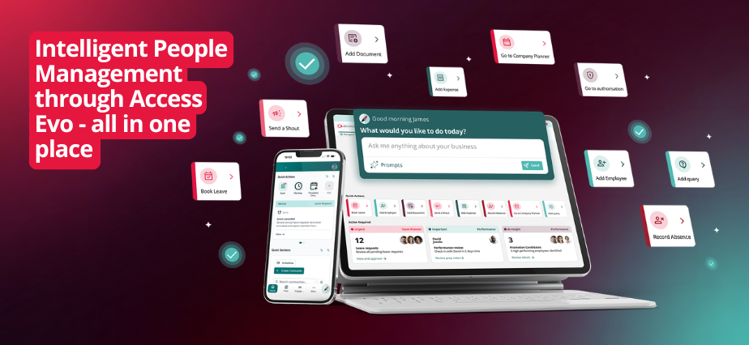
A transparent Living Roadmap provides confidence in what’s live today and visibility into what’s coming next, so organisations can plan, adopt and influence the future without disruption.
The result is enterprise‑grade capability made simple: less admin, lower risk, faster decisions and an HR platform that scales as your organisation evolves.
Whether you're building the foundations for growth, navigating structural change, or scaling headcount rapidly, Access PeopleXD Evo is designed to grow at your pace.