AU & NZ
 SG
SG
 MY
MY
 US
US
 IE
IE


ADR in hotels increased by 1.35% year on year, with dynamic pricing strategies playing a direct role in driving that growth. Hotels leaning into this approach saw the strongest returns during high-demand spikes like bank holiday weekends and peak travel seasons, where moving prices quickly contributed directly to profits. Knight Frank's UK Hotel Trading Performance Review points to the same results, identifying real-time pricing as one of the key reasons the hotel sector held its performance well, alongside the recovery in international visitor numbers.
Hotels that moved quickly during high-demand periods like bank holiday weekends, peak travel seasons and local events captured stronger returns not just on rooms, but across food and beverage, spa and ancillary spend too. Those that didn't are widening their profit gaps and leaving revenue behind. Dynamic pricing isn't just a rooms strategy, but it's how you make the most of every corner of your hotel when demand spikes.
This article will guide you through what hotel dynamic pricing is and how to approach it practically with the right technology tools to increase your revenue. By helping you to understand how dynamic pricing can work for your hotel, you will get a clearer picture of where your pricing strategy sits currently and where to strengthen it.
What is dynamic pricing in hotels and how does it work
Dynamic pricing is the way you adjust rates across your hotel automatically or with as little manual input as possible. It’s based on real-time insights surrounding demand, availability or competitor rates as well as local events or peak holidays. This strategy helps you respond to what is happening in the market and align your hotel rates to capture the best opportunities across all departments.
Fixed rates are safe but dynamic rates create flexibility and profits
When working with fixed rates, it gives you the safety of certainty but flexibility comes at a cost. Using a dynamic pricing approach means prices may differ on a Tuesday than a Friday to accurately target the demand at that given moment.
Most hotels now operate in an unpredictable market where changes like events, bank holidays, school breaks and corporate travellers boost last-minute booking volumes that creates a shift. This means the pricing picture is constantly changing but also requires you to have the strategy in place to keep up with sudden demand.
The indicators that move your room rates
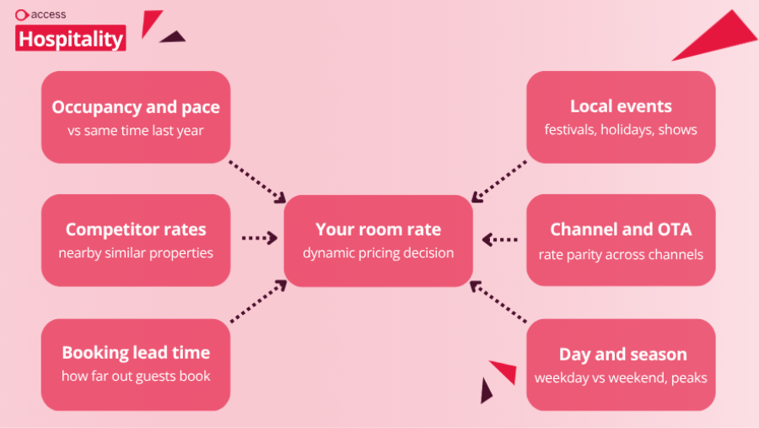
What makes hotel dynamic pricing effective comes from reading the right trends and responding quickly to them. You might expect a certain weekend to be quiet, but a surge in last-minute bookings or last-minute events mean you’ll be busier than usual. Here are some of the key indicators to look out for that influence your room rates significantly.
- Current occupancy and booking pace compared to the same period last year.
- Local events, festivals and public holidays.
- Comp-set rate changes in your location.
- Lead time and booking window trends.
- Day of the week and seasonal patterns.
Reading these indicators together and responding quickly is where the profit opportunities lie. When a group of competitors drop their prices or a sudden local event takes place nearby, these all feed into your pricing strategy. Hoteliers capturing the most profits are the ones who always have a clear picture, and sudden spikes in hotel demand can be harder to spot if your systems are not talking to each other.
Slow pricing is costing you more than you think
The hotel market has been hit with rising labour costs, bills and business rate changes meaning there is less room for mistakes leading to lost revenue such as inaccurate pricing decisions. Pricing right is no longer about extracting the most revenue each year, but about staying stable when costs and demand keep shifting.
Without dynamic pricing you're either leaving rooms empty or money behind
A quiet midweek, a fully booked weekend or package experiences that had lower rates are both areas where revenue is slipping away. Unlike other issues that might be costly such as maintenance work or tech upgrades, this one is a straightforward fix.
Automated dynamic pricing can produce measurable revenue gains of up to 30%, according to Hotel Tech Report, showing that smarter pricing has a direct impact on your returns. A quiet midweek, a fully booked weekend or package experiences are areas where pricing might not be working as hard as it could be. Unlike other issues that might be costly such as maintenance work or tech upgrades, this one isn’t a costly fix, it’s about using smarter pricing strategies.
Local events are a profit booster, but is your hotel pricing strategy ready?
Hotels in Cardiff achieved ADR of £340 during the first Oasis shows of 2025, which was up sharply year on year in a relatively small market. That kind of revenue performance doesn’t happen by chance, but it reflects how their pricing strategy worked at the right time to capture that additional revenue.
When Taylor Swift performed across the UK in 2024, hotel occupancy in hosting cities regularly hit 95% or above. However, hotels close to these major venues that were not monitoring demand or pricing trends would have missed those opportunities entirely. Dynamic pricing in this instance is an important process to have so you can spot these moments and act on them quickly.
And it isn’t just major concerts that trigger these surges, as Simonstone Hall in Yorkshire saw demand rise by 142% in a single week after the hotel hosted the cast and crew of the acclaimed film Wuthering Heights. That kind of demand spike is almost impossible to anticipate without real-time visibility of what is driving search and booking behaviour, but with a strong pricing plan to act quickly in the moment, it was a welcome revenue opportunity.
3 easy ways to start dynamic pricing in your hotel
You don’t need a full revenue management team to start dynamically pricing as most hotels already have the structures in place, it’s just about using them strategically. The question is whether these processes are connected in a way that results in quick and confident decisions.
1. Your booking data shows you what’s trending, so use it to your advantage
You need to think about the main questions about your guest behaviour to know what might be ahead. Look at the booking patterns and see how far ahead most of your guests book, which room types go first and what your position was the previous year. Around 65% of hotel bookings are made by domestic guests, and as we know they are only for 1 or 2 nights, so this trend is a very tight window to work with. Tracking your booking pace and keeping prices adjusted consistently is a practical starting point that you can assess without any additional costs.
2. Know what the local competition around you are charging
You don’t need to follow your local competitors closely, but it helps to know what they are doing and why. For example, if 3 properties closest to yours have all put their prices up for a particular weekend, staying at a fixed rate means you are leaving money on the table that potential guests are clearly willing to pay. Browse their prices online or look at incentives and discount offers for dining experiences or spa packages and see how you can match or offer more so guests choose you instead.
3. Set rate tiers so you can choose the right price at the right time
Rather than adjusting your fixed rates constantly, some hoteliers find it easier to set a small number of rate tiers and allocate them to a specific demand or trend. For example, set a standard midweek rate, a higher weekend rate and a peak event rate, each with clear occupancy or lead-time influences that will ensure they are set at the right time. This helps you recognise the demand shift and quickly respond to it with the right price every time.
How the right technology takes the manual work out of pricing
Checking your rates manually can work, but it isn’t a long-term solution to keep up with demand and changing booking trends. Using integrated systems means that instead of checking competitor rates and adjusting your own manually, your systems will monitor the trends and suggest or apply automatically the correct rates based on the rules you set.
What a good pricing tool actually does for you
A good pricing tool shows you how full you are, how busy each department is, how fast you are filling and what the hotels around you are charging at the same time. From there, you can set rules that adjust your rates automatically when certain conditions are set without you having to log in and do it yourself.
Once your RMS is integrated with your operational ecosystem like your hotel PMS, channel manager and hotel booking engine, it should update rates across all departments. So, when rates are set, they will be automatically propagated across all your distribution channels, whether this is your own booking engine or OTA's.
Connected systems give you the full view of your pricing performance
For a lot of independent and portfolio hotels, the challenge isn’t understanding dynamic pricing but having the time to act on it. When your systems are reporting separately, pulling together the clarity you need to make a confident rate decision takes longer than necessary. Our recent AI report shows that around 322 hours per year are wasted switching between systems to get tasks done, so this is where connected technology saves you time.
The Lewis Partnership found that after bringing everything together, one person could manage rates and availability across all three properties in real time. Their Moat House saw ARR grow by 11% over three years, the Swan by 13%, alongside a 22% year-on-year increase in direct bookings. When your systems talk to each other, it not only makes admin tasks easier to manage, but also ensures the right data is being applied at the right time to close the revenue gaps
Top 3 questions hoteliers ask about dynamic pricing
Will guests notice price adjustments, and does it matter if they do?
Some hoteliers worry that consistently changing rates might break trust or put guests off. In reality, guests already expect prices to vary just like trains, flights and event tickets all working the same way. What matters is that your rates are transparent and that your direct channel stays competitive with the OTAs.
Do you need a revenue management team to make this work?
Not necessarily, as many independent and portfolio hotels manage their dynamic pricing with smaller teams who review rates a few times a week using the data their hotel RMS provides. The key is having the right tools working together and a clear process that puts prices out at the right time.
How often should you be reviewing and changing rates?
There is no right or wrong timeline, but most hotels that price well are checking in at least a few times a week rather than once a month. The key times to watch are short stays within a 30-day window, weekends and any period where a local event or school holiday could shift demand. It also may vary for the size of your hotel, for example for independent properties, it’s best to review rates when demand shifts, and for larger chains review rates on a daily basis across the portfolio. Either way, having real-time data that helps you match rates to shifting patterns makes your pricing decisions much quicker.
The best time to look at your hotel pricing strategy is now
Dynamic pricing for your hotel doesn’t need to be complicated or expensive, it needs to be strategic. The data you already have is enough to start pricing more responsively, and getting a clearer picture of your booking pace or what is happening locally will help you set the pricing foundations for your rooms, F&B areas and upselling packages.
Hotels gaining the most from dynamic pricing right now are not always the bigger chains, but are the ones paying attention to what their market is showing and ensuring their systems are doing the work behind the scenes. Identifying demand spikes earlier or making confident rate decisions brings more profit to the surface than staying with fixed rates that don’t respond to demand.
Most independent hotels already have the data they need to price more responsively. The gap is usually the time to act on it, and systems that aren't connected make that gap wider. Access Hospitality provides a platform for your hotel RMS, PMS, channel manager and booking engine to work together so your rates update automatically when demand shifts. No daily logins, no front-desk surprises. If you're still reviewing rates once a month, it's worth seeing what a connected RMS setup could do for your profit margins.