AU & NZ
 SG
SG
 MY
MY
 US
US
 IE
IE


A hotel marketing strategy is what tells you who to target, where they are, how much to spend and which tools you need to run without adding to your workload. Competition in the hotel industry is high, with corporate chains and OTAs using big budgets to get the top spot. And the reliance on OTAs will cost you more over time as they charge commissions of around 15 to 25% per reservation, meaning every direct booking you lose cuts straight into your revenue.
The main challenge to get there is to receive guests directly to you in the first place, and that starts with good hotel marketing strategies. This enables you to hold a strong position in an already crowded market, but you need to think about what suits your needs, your guests and your budget.
By the end of this article, you'll have a clear framework to separate your guests by value, set a realistic budget around how your hotel actually trades and choose a channel option that matches who you're trying to reach without adding to your team's workload.
What is the difference between a hotel marketing strategy and a channel plan?
A hotel marketing strategy maps out how you’re going to attract guests, through which channels and with a sustainable budget behind it. For smaller hotels, the main aim is for the plan to do more than target direct bookings and instead get the right bookings from the right guests.
The difference between a strategy and a channel plan is that a strategy starts with your data, and a channel plan takes this and drives it into the best channel to get revenue results. A marketing strategy shows who your highest-value guests are such as weekend couples who book 3 weeks out, but adding a channel plan takes it further by thinking about where to reach them and what to measure. One is a list of activities and the other is a framework that tells you what's working and what to change when it isn't.
Great hotel marketing starts with knowing exactly who your guests are
Finding the best guests to target when building your marketing strategy starts with understanding who your returning guests are and what made them want to choose you every time. When you know what motivates your guests to choose you, you can target them with the right message through the right channel.
Who are your returning guests and what this tells you about your hotel marketing?
A mixture of guests is likely to step through your hotel doors like business travellers, large families or couples on a relaxing staycation. They have a different booking experience and respond to your marketing campaigns well if they align to their needs.
Start with your hotel PMS booking data from the last 12 months and pull records across 4 areas for every guest type you serve.
- Average spend per stay including F&B and extras beyond the room rate.
- Average length of stay and booking lead time.
- Return rate within a 12-month window.
- Booking source, whether direct, OTA, phone or walk-in.
Once you know your top 2 or 3 guest areas, build a short profile for each covering where guests are based, how they search, what they value most and what would move them to book direct. Those profiles are what your channel choices and content briefs should be built on as without the differentiation done first, channel decisions aren’t accurate.
Let your PMS do the work and show you exactly who your most valuable guests are
A well-integrated hotel PMS captures guest booking data and return history while showing you which guests are worth the effort and the channels you should use to target them. Using smart discovery and intelligent booking platforms makes this data immediately actionable and instantly available in real-time. Knowing where your highest value guests and their booking journey habits will be the strategic foundation for a successful marketing plan.
Choosing the right hotel marketing channels for your guests and your budget
Not every channel will work for every hotel, so choosing the right option depends on who your guests are, how they search and what your budget can realistically be spent on. Picking channels based on what feels popular or what a competitor is doing may see you spending too much and expecting results that are hard to measure.
Start with your guest profiles instead and let those drive the decisions, for example couples who are looking for a leisurely stay will be best targeted on Instagram, rather than business travellers who will be more responsive to email campaigns and direct booking incentives to return.
How to decide which channels to fund first
Running on a limited budget means you can’t target every channel in the same way. Here's our 5-step plan to help you decide which channels to put investment in first and help them grow.
1. Your website and booking engine first
Most channels send guests here so if your website is slow or hard to navigate, then your future paid ads and social posts are going to be wasted. Before spending any budget on different channels, make sure your website is ready to convert.
2. Email before paid media
Email marketing is one of the simplest and cost-effective tools that will drive direct revenue into your pocket. On average, emails deliver a return of around £36 for every £1 spent across the hospitality industry, showing that communication is key with your guest address book.
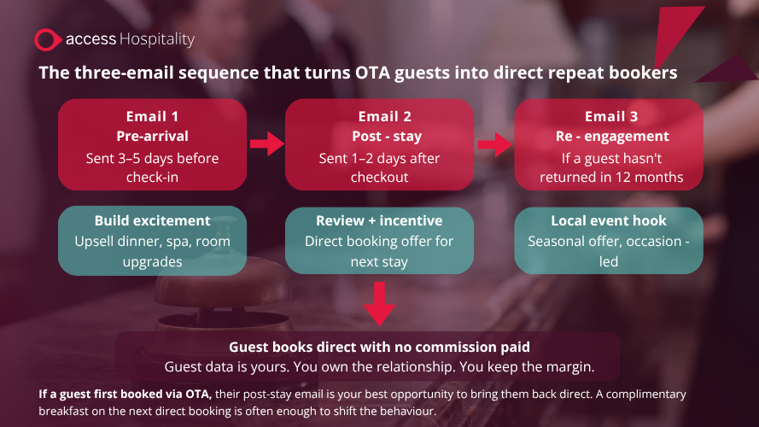
Emails target guests who already chose you which makes it a cost-effective channel for getting them to come back. It also gives you a direct connection to past guests while you’re building organic visibility without paying for extra clicks.
3. Local SEO before broader paid search
Guest searching for a hotel stay often want to find something specific like location or a type of service. When your website is optimised to target those searches, you’ll build your hotel value online. Paid search does fill gaps, but local SEO is what helps to close those gaps over time.
4. Paid search and metasearch once local SEO is working
Paid channels are most effective when your website converts well, and your direct rates are starting to become competitive. Spending budget on Google Hotel Ads while your booking engine isn’t capturing guests means you’re paying for traffic that doesn't actually convert. Paid search and metasearch take the assets that are already working, like your website or competitive rates, and then use these to speed up the results, helping you to reduce OTA reliance and your cost per direct booking at the right time.
5. Use social media as a long-term channel
Travellers are more likely to stay in areas with local events or seasonal highlights, so this type of content is perfect to drive those social engagements into direct bookings. Keep audiences updated with current special offers and discounts, with exclusive codes only available through social channels. Competitions and giveaways are a great way to build engagement and grow your following without any additional cost to your hotel.
Hotel marketing on a tight budget works when you know where to spend
If budget is tight, your website and email campaigns should come before any paid media spend. Once these are converting consistently, local SEO is the next step as paid advertising fills the gaps for last-minute rooms and sudden demand spikes. Set up simple reporting that connects spend to bookings like cost per direct booking by channel, total revenue from direct versus OTA bookings each month and email open rates against bookings generated. If your PMS is integrated with your hotel booking engine and CRM, most of this data is already there.
Where to start with your budget size and marketing position
A strong hotel marketing strategy doesn’t need to be expensive when you know where to invest. Before deciding where to spend your budget, think about what stage your hotel's marketing is at as if your direct bookings are low, then you need to see where you can improve your website and email campaign rather than thinking about spending on paid media channels. If your website is already converting, paid search and metasearch might be a channel to explore as you already have the foundations in place.
Whatever your budget size is, you need to consider what's working for your hotel now and what can help for the future. 2 channels funded consistently will always outperform 5 channels running without much consideration. Only add channels when the ones you're already running have started to show consistent results and let your booking data tell you the full story.
Hotel marketing technology that helps you stop guessing
In some cases, hotel digital marketing strategies failing isn't the channels that are set up, it's the data. If your hotel PMS, booking engine and CRM aren't sharing information, you can't tell which campaigns are filling rooms and which are just spending budget. That's not a marketing problem but a disconnected system problem that effects your marketing results.
A connected hotel PMS, CRM and booking engine gives you the real-time insights of your guests without the extra admin cost. Your PMS holds booking history, stay data and source attribution, telling you who your guests are and where they came from. Your CRM holds guest profiles and communication history, making personalised email campaigns possible even at a large scale. Your booking engine connects your website to live availability and rates, converting strategy into revenue.
When these three systems share data in real time, data flows between them so your marketing plan runs smoothly without any interruptions. This means your website generates more clicks and in turn, more direct booking results. In our recent AI report, hotels are using on average 5 separate systems to run their operations, so if systems are disconnected, it conceals the data that is influential for your hotel marketing strategy to work.
Your hotel marketing strategy starts here
Creating a strong hotel marketing strategy is through your data, not a gut feeling. So, when you’re planning your email campaigns or social media posts, have a clear direction of where you can show up the strongest. Local events, seasonal peaks and attractions is what steers guests directly to your site and having the right tools behind it makes all the difference.
Our hotel PMS, CRM and booking engine keeps guest data flowing into your marketing strategy so your hotel is always optimised to reach the right audiences. Spend less time on admin and OTA commission, and more time investing in a hotel marketing strategy that is data led and designed to deliver.
- Before investing in any marketing channel, consider these questions.
- Do you know which guest type generates the most revenue per stay?
- Do you know your current cost per direct booking compared to OTA commission on the same rooms?
- Do you have a 12-month view of your booking peaks and lead times?
- Are your PMS, CRM and booking engine sharing data in real time?
If you can't answer these confidently, your marketing strategy needs a concrete foundation before it needs additional channels. Getting these answers from your booking data first is what turns a marketing plan into something that consistently fills rooms.
Ready to reduce your reliance on OTAs with a strategy built on your own data? For the practical how-to detail on each channel, visit our hotel digital marketing guide, which covers website optimisation, SEO, email, paid advertising and social media in plain, actionable steps.