

 AU & NZ
 SG
SG
 MY
MY
 US
US
 IE
IE

 Access Attract Evo
What your CFO wants to see from Marketing
For a 10-person UK recruitment agency, annual job board spend alone typically runs to £30k–£50k, yet most have no clean way to prove what it's delivering. This guide covers exactly which recruiting marketing metrics your finance director wants to see, why standard tools fall short, and how to build a ROI report that ends the budget debate.

Table of contents
- “Which of this spend actually led to placements?”
- What does a CFO want from recruitment marketing reporting?
- Why do standard analytics tools fail to show recruitment marketing ROI?
- How do you build a recruitment marketing ROI case that survives CFO scrutiny?
- What does good recruitment marketing reporting look like in practice?
- What is Conversion Intelligence, and how does it solve the attribution problem?
- Strategic shift: From reporting to decision-making
- Stop defending your budget with gut feel
- See your own channel attribution in 30 seconds
- FAQs
“Which of this spend actually led to placements?”
Every quarter, the same scene plays out: the marketing manager presents impressions, click-through rates, and cost-per-click across LinkedIn, Indeed, and Google Ads. The CFO asks the one question it can't answer.
“Which of this spend actually led to placements?”
Nobody can answer it, not because the team isn't working hard, but because the tools weren't built to connect a marketing channel to a placement. This is the structural problem underneath most recruitment marketing ROI conversations. Research from the Digital Marketing Institute indicates that companies without proper attribution models misallocate up to 30% of their marketing budget, pouring money into underperforming channels while starving high-performers.
This guide covers the metrics your CFO needs to see, why standard dashboards tell the wrong story, and how to build a measurement framework that gets marketing treated as an investment, not a cost centre.

What does a CFO want from recruitment marketing reporting?
Finance leaders don’t object to marketing spend on principle. They object to spend they cannot evaluate.
Broadly, a CFO reviewing a recruitment marketing budget wants four things:
- Cost-per-placement by channel: Not cost-per-click, not impressions.
- Channel efficiency: Is spend being actively optimised?
- Reallocation decisions: Evidence that budget follows performance.
- Revenue impact: More placements = what in fee revenue?
These are reasonable asks. The problem is that standard analytics tools - Google Analytics, individual job board dashboards, LinkedIn Campaign Manager - were not built to answer these questions for a recruitment business. They show traffic and engagement. They do not show placements.
Marketing in recruitment has to earn its seat at the table the same way every other function does - by connecting its activity to revenue. That’s not a cultural shift, it’s a data problem. Once you solve the attribution chain, the ROI conversation becomes straightforward.
- Matt Donnelly, Head of Product Marketing, Access Recruitment
Why do standard analytics tools fail to show recruitment marketing ROI?
That gap between traffic data and placement data is where recruitment marketing ROI conversations collapse. According to the Demand Gen Report's Marketing Measurement & Attribution Survey, 63% of marketers struggle to measure and track activity between funnel stages. In recruitment, the problem runs deeper still, because the data sits in fundamentally incompatible systems:
- Job boards report clicks and applications, not placements
- Google Analytics reports traffic, but can't distinguish intent or outcome
- CRM systems record placements, but rarely link back to the originating channel
Only 7% of marketers report their tools are fully integrated. Without a chain that runs from traffic source to application to hire, you're reporting activity, not outcomes.

How do you build a recruitment marketing ROI case that survives CFO scrutiny?
The most effective frameworks start with the business outcome - a placement, a contract fulfilled, a headcount target met - and work backwards to show how marketing contributed to it. Not the other way around.
Step 1: Establish your placement value baseline
What is the average gross margin contribution of a placement in your key disciplines? This is your anchor number. Every recruitment marketing metric should be evaluated against its contribution to generating more of these. Without this figure, ROI conversations are relative rather than absolute.
Step 2: Get clean channel attribution through UTM tracking
UTM parameters (Urchin Tracking Modules - the tracking tags added to URLs in campaign links) allow you to trace which job board, campaign, or piece of content generated each candidate. Without consistent UTM tracking across every paid and organic channel, attribution is impossible. This is the technical foundation everything else depends on.
Step 3: Connect your career site to your CRM
The attribution chain only works when your career site, application tracking, and recruitment CRM share data. When these systems are siloed, the candidate who applies via a LinkedIn ad, engages with an email nurture, and is placed three weeks later shows up as a mystery. You need the full journey, not just the last click.
Step 4: Benchmark against the industry, not just your own history
Internal benchmarks tell you whether you’re improving. Industry benchmarks tell you whether you’re competitive. A cost-per-application of £80 might feel like progress internally - but if the sector average for that channel is £41, you still have a performance gap worth addressing.
Step 5: Simulate the revenue impact before committing to changes
The most compelling thing you can take to a CFO is not what happened last quarter - it’s what will happen next quarter if you make specific changes. If reallocating £2,000 per month from an underperforming job board to SEO projects £14,400 in annual savings and a measurable increase in placements, that is a decision, not a discussion.
The agencies that win the internal budget conversation are the ones who come in with a reallocation recommendation and a revenue projection, not just a retrospective report. That shift - from descriptive to prescriptive - is what changes how finance views marketing.
- Rachael Kindleysides, Divisional Marketing Manager, Access Recruitment
What does good recruitment marketing reporting look like in practice?
A report that lands with a CFO doesn’t need to be long. It needs to be outcome-focused and consistent. The format that works best covers four areas:
Channel efficiency snapshot: cost-per-application and cost-per-placement by source, benchmarked against the previous period and the industry. Red/amber/green at a glance.
Quality indicators: application-to-interview conversion rate and application-to-placement rate by channel. Identifies where volume is hiding poor candidate quality.
Budget reallocation recommendation: a specific, data-backed proposal for where to shift spend, including projected impact on cost-per-placement. Not a suggestion - a decision with the numbers behind it.
Revenue impact projection: what the recommended changes are projected to deliver in additional placement revenue, based on your own placement fee data. This converts a budget defence into a budget request.
The goal is a report a finance director can read in under three minutes and walk away from understanding whether marketing is working, whether the budget is correctly allocated, and what the next move should be.

What is Conversion Intelligence, and how does it solve the attribution problem?
Conversion Intelligence is a feature within Access Attract Evo (the recruitment marketing platform that automates the attribution chain described above. It is the first AI-powered recruitment site analysis tool specifically designed to show agencies which traffic sources drive quality candidates and which are wasting their budget.
Unlike generic web analytics tools, Conversion Intelligence was built for the specific data structure of recruitment: career sites, job board traffic, application flows, and placement outcomes. That context is what makes it meaningful rather than just informative.
How Conversion Intelligence works
Input your monthly marketing spend by channel once. Conversion Intelligence then:
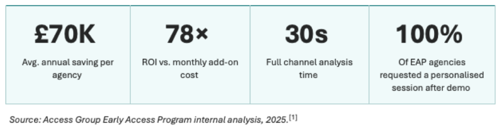
- Analyses your site in 30 seconds by pulling live traffic and application data via UTM parameters - no manual data entry or integrations to configure
- Calculates cost-per-application for every channel and rates each one as Excellent / Good / Poor / Underperforming, benchmarked against 140 million real recruitment applications
- Generates 3 specific, prioritised recommendations in plain English with full audit trails. Example: "Stop LinkedIn (£133/app), invest in SEO (£41/app), save £14,400/year"
- Projects the revenue impact of each change via A/B testing simulation, configurable with your own placement fee data - so you see potential placement uplift and fee revenue before committing
It is the only recruitment-specific platform that automatically connects traffic source → job application → cost per hire - the attribution chain your CFO has been asking for.
In practice, this typically translates to £2,000–£5,000 in recovered monthly budget for agencies that act on the recommendations - without reducing application volume.
Why the 140M benchmark matters and why no competitor has it
Every channel rating in Conversion Intelligence is benchmarked against 140 million real application events collected from recruitment agency career sites across the UK and ANZ.
Generic analytics platforms benchmark against all website types. Job board platforms only benchmark against their own traffic. Conversion Intelligence benchmarks specifically against recruitment agency application behaviour - which is what makes the channel ratings meaningful rather than directional.
This is data no competitor can replicate without the same career site platform footprint. It is the analytical foundation that makes prescriptive recommendations possible rather than just descriptive ones.
Source: Access Attract Evo internal benchmark dataset, 2025.

Stop defending your budget with gut feel
The question your CFO is really asking is not “what did marketing do?” - it’s “what did we get for this money that we couldn’t have gotten without it?”
Answering it clearly requires connecting your recruitment marketing metrics to placement outcomes, building attribution that survives scrutiny, and presenting performance in the language of commercial results rather than channel activity.
When you do that, recruitment marketing stops being a cost to justify and starts being a lever to optimise. That is a fundamentally different conversation - and one you are far more likely to walk away from with what you need.
See your own channel attribution in 30 seconds
Access Attract Evo’s Conversion Intelligence analyses your recruitment site, benchmarks your channels against 140 million real applications, and gives you 3 specific actions to take - with a projected revenue impact before you make any changes.
See Access Attract Evo in action
FAQs
What is recruitment marketing ROI and how is it calculated?
Recruitment marketing ROI (return on investment) measures the commercial return generated by spend on candidate attraction - job board advertising, paid social, content, SEO, and employer brand. It is calculated by comparing the revenue contribution of placements sourced through marketing channels against the total cost of generating those placements.
The core metric is cost-per-placement by channel: the total channel spend divided by the number of placements that can be attributed to that channel.
Which recruitment marketing metrics should I report to my CFO?
The four metrics that resonate most strongly with finance leaders are:
- cost-per-application by channel
- application-to-placement conversion rate by source
- cost-per-placement by channel
- the ratio of proactive (pipeline) placements to reactive (ad-response) placements.
Together these form a complete picture of marketing efficiency, candidate quality, and commercial return.
Why can’t I use Google Analytics to measure recruitment marketing ROI?
Google Analytics reports website traffic and user behaviour, but it does not connect visitor data to application outcomes or placement records. It treats all visitors and all sources equally, without the context of whether an application was submitted, progressed, and resulted in a placement.
Measuring recruitment marketing ROI requires source attribution that runs through the full funnel from first click to hired candidate - which requires a tool built specifically for the recruitment data model.
What is a good cost-per-application benchmark for recruitment marketing?
Benchmarks vary significantly by channel, discipline, and geography. Based on Access Attract Evo’s benchmark dataset of 140 million recruitment applications, there is substantial variation between channels within the same agency.
The more meaningful question is not whether your cost-per-application is above or below an industry average, but whether the channels with the lowest cost-per-application also have the highest placement conversion rates. High volume at low cost that doesn’t convert to placements is not efficient - it is an overhead.
How long does it take to build a proper recruitment marketing attribution model?
With consistent UTM tracking and an integrated career site and CRM, meaningful channel attribution can typically be established within four to six weeks. The initial setup involves tagging all campaign links with UTM parameters, connecting your career site to your recruitment CRM, and defining your placement value baseline. Once in place, the attribution model builds continuously and improves in accuracy over time.
Tools like Conversion Intelligence within Access Attract Evo automate the technical components of this process, reducing setup to approximately five minutes.
What does Access Attract Evo’s Conversion Intelligence feature do?
Conversion Intelligence is an AI-powered recruitment site analysis tool within the Access Attract Evo platform. It automatically calculates cost-per-application by marketing channel using UTM tracking, benchmarks performance against 140 million application events from recruitment agency career sites, rates each channel as Excellent / Good / Poor / Underperforming, generates three prioritised recommendations in plain English (with full audit trails), and projects the revenue impact of implementing each change before any budget is committed. The full analysis runs in 30 seconds.