Virtual Ward Software for Neighbourhood Health

The NHS 10 Year Health Plan places virtual wards at the centre of the shift from hospital to community care. Under the Neighbourhood Health Guidelines 2025/26, systems are asked to embed, standardise and scale virtual ward capacity aligned to local demand. That means the right technology infrastructure matters more than ever.

We work with NHS trusts and integrated care systems to join up the software that makes virtual wards function: remote monitoring, patient flow, rostering, care coordination and electronic records, all connected across health and social care.

Worth a Read

Joining Up Care Across the Virtual Ward

Few suppliers can connect care across primary and secondary healthcare, social care and the wider care sector. Access does by giving your teams the joined-up view that a virtual ward depends on.

Our solutions give your staff the visibility they need to provide safe, acute-level care outside of a hospital setting. Stepping down care to free up beds, or providing anticipatory care to avoid admission altogether — our software supports rostering, care provisioning, remote monitoring, patient communication and real-time health status tracking, all in one connected view.

Data flows to your existing systems from across the care pathway. Staff get clear, navigable dashboards. Clinicians get the confidence to treat patients in a virtual ward safely.

Learn how virtual wards can create better outcomes for patients and healthcare providers!

What are virtual wards?

With hospital capacity under sustained pressure, keeping patients in a bed longer than clinically necessary is a problem no system can afford. Virtual wards give healthcare professionals the tools to deliver safe, effective care at home, without compromising on clinical oversight.

Supported by remote monitoring and communication tools, clinicians can manage patients in a comfortable, familiar setting. The evidence shows that patients recover more quickly at home, with lower rates of infection and readmission.

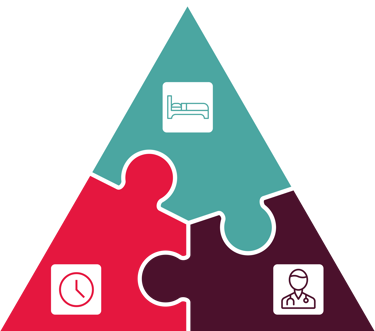
The Three Key Pillars of a Virtual Ward

Patient Flow and Bed Management - Enables clinicians to view patient RPM data alongside other health data within a clinician workflow, giving visibility of bed capacity and patients across both physical and virtual wards. 

Transfer and Discharge Management - Ability to quickly source all elements of the required care package and track progress of care provision to allow faster transfers and/or discharges of patients. 

Remote Person Support - Provides real-time data and alerts combining remote clinical observations with activities of daily living. 

Virtual Wards at NELFT

Hear our interview with David Pike, Clinical Safety Officer at North East London NHS Foundation Trust (NELFT) about their virtual wards project, how they're looking at it differently to make it work for their staff and the people they support.

Listen to Umesh Gadhvi, Chief Clinical Information Officer at North East London Foundation Trust (NELFT) talk about the virtual wards implemented in partnership with The Access Group.

He discusses the different approach NELFT have taken and how it's providing benefits for their patients and staff. He also looks forward to what's next for their virtual wards and the Trust as a whole.

Virtual Wards and the NHS 10 Year Health Plan

Virtual wards are no longer a pilot programme or a pandemic response. They are a core part of how the NHS plans to deliver care over the next decade.

The NHS 10 Year Health Plan, published in July 2025, commits to a national procurement for a new platform for proactive, planned care, with expanded remote monitoring capabilities available to all NHS provider organisations. Virtual wards will be supported by wearables and biosensors feeding real-time data into the NHS App and the Single Patient Record.

The 2025/26 Neighbourhood Health Guidelines ask all systems to embed, standardise and scale virtual ward capacity, ensuring services are aligned to local demand for both children and adults. There is no longer a single national population target: expansion is driven at a local level, which means the quality and connectivity of your technology infrastructure is what determines how far and how fast you can go.

By March 2025, 12,825 virtual ward beds were open across England. The 10 Year Health Plan sets an ambition to double that capacity to 40 beds per 100,000 GP-registered patients.

How virtual wards help offer better healthcare

£bn

Potential saving every year

%

of patients cared for at home felt more confident about being able to manage their condition

%

reduction in re-admission rate

%

reduction in the average length of hospital stay

Making Virtual Wards a Reality with Seamlessly Integrated Product Insights

Electronic Patient Record (EPR) System:

Central record to hold patient information for healthcare professionals

Electronic patient records

Social Care Case Management:

Central record to hold patient information for social care professionals

Social care case management

Care Planning:

Central record to hold patient information for care professionals

Care Planning

Patient Flow Manager:  

Dashboards that show an overview of patients and their needs in each virtual ward

Patient flow management

Monitoring Solution:

To show how patients at home are doing

Digital Telecare

Care Commissioning:  

To ensure everything needed for the care plan is in place

Commissioning software

Rostering Software:

To ensure the right people are in the right place at the right time

PeoplePlanner

Social Prescribing Software:

To help solve social issues that can lead to hospital admission  


Social prescribing

An Integrated Care Approach to Virtual Wards 

Integration between systems, people and places is what makes virtual wards work. Our interoperable solutions connect workflows across acute, community, voluntary and social care to support home-based care, giving every team involved a clear, consistent view of the patient.

Why Virtual Wards? 

Common core components to enable a consistent user experience 

Flexibility to adapt to various clinical pathways 

Builds on existing capabilities to enable clinician adoption and efficiency

Integration of health and social care systems 

Common standards, integrations and data model 

Benefits of Virtual Wards for:

Virtual Wards FAQs

What are virtual wards?

Virtual wards enable patients to recover within the familiarity of their homes instead of a traditional hospital setting. Using remote monitoring systems and data-powered technologies, patients can receive hospital-level, short-term care without needing a healthcare professional physically present.  

How do virtual wards work?

Virtual wards rely on wearables and environmental tracking devices to remotely manage an individual's health. These devices continuously monitor a person's vital signs, behaviour, and environment, feeding this data back to healthcare providers in real time and enabling them to manage the patient's care requirements.

If the technology detects that the patient is at danger of falling, having a seizure, or experiencing anything else that would require medical attention, it alerts the clinician to check in or intervene as necessary.

Who are virtual wards suitable for?

Virtual wards are suitable for people who suffer from certain medical conditions such as frailty, heart failure and acute respiratory infections. They are primarily designed for those who require ongoing monitoring and short-term care but who do not necessarily need to be hospitalised.

What are the benefits of virtual wards?

Virtual wards offer a wealth of advantages for patients, their families and healthcare providers. Some of the key benefits include improved patient outcomes, reduced hospital admissions and readmissions, reduced burden and workload on healthcare staff, increased patient satisfaction and quality of life, and better use of healthcare resources, to name a few.

How can the impact of virtual wards be measured?

The impact of virtual wards can be assessed using various metrics, including but not limited to:

  • Number of reductions in hospital admissions and readmissions
  • Length of stay in hospitals
  • Patient satisfaction surveys
  • Health outcomes such as mortality rates, complication rates, and disease management indicators
  • Healthcare resource utilisation, including cost savings
  • Patient-reported outcomes and quality of life assessments

Book a call with our Virtual Ward specialist