AU & NZ
 SG
SG
 MY
MY
 US
US
 IE
IE


In this article, we’ll take a close look at what labour demand forecasting is, how it works alongside automated scheduling, and the benefits it can bring to your business.
What is demand forecasting in hospitality?
In the context of rota planning, hospitality demand forecasting means using past data – and the more you have, the better - to make accurate, forward-looking decisions. It draws on patterns in your historical sales and staffing levels to anticipate how busy each day, and even each hour, is likely to be.
Behind the scenes, it’s the algorithms (often powered by AI or machine learning) that spot trends and relationships in your data, like how weather impacts footfall, or how mid-month weekends perform versus payday ones.
How do hospitality businesses typically build rotas?
the technology they want to use to support them. And that’s why there is spectrum of approaches to choose from, each with its own trade-offs:
Hospitality manual scheduling
Managers build rotas from scratch each week, or more commonly, copy a previous rota that looks similar and tweak it from there. It's the most widely used approach, and it's easy to see why: it's quick to get started, gives full control, and draws on the manager's knowledge of their team. But it has real limitations. It relies on memory and gut instinct rather than data, which means patterns get repeated even when demand has shifted, and over- or under-staffing can quietly become the norm.
Hospitality auto-scheduling
Managers set shift rules, staffing levels and requirements once and then let the tech auto-generate compliant rotas in seconds. Utilising templates that can be reused and adjusted as needed; this approach speeds things up but doesn't always account for demand variation – without AI demand forecasting, a busy bank holiday weekend looks the same on paper as a quiet mid-January Tuesday.
AI-powered demand forecasting for hospitality
The most advanced approach and the one where hospitality labour demand forecasting really comes into its own.
Scheduling software analyses your historical sales and labour data, alongside a much wider set of inputs: trading trends, weather forecasts, upcoming events, reservation data, and more, to build an accurate picture of how busy each hour of each day is likely to be.
When paired with auto-scheduling, it goes a step further: rather than just surfacing predictions for a manager to act on, the system uses those forecasts to automatically generate an optimised rota, factoring in staff availability, contracted hours, and labour rules.
The result is the most accurate and efficient approach available - rotas built on real data, in a fraction of the time.
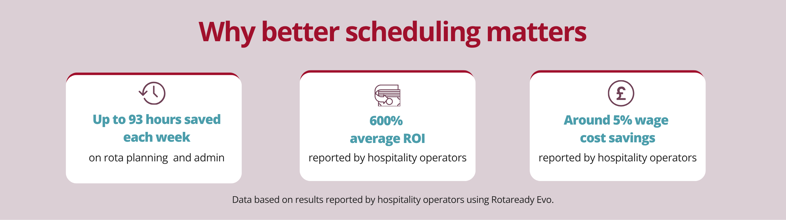
What are the benefits of labour demand forecasting in hospitality?
1. Improved planning accuracy
By using real data instead of gut instinct, AI driven rota suggestions help you make better decisions.
As it accounts for past sales trends, events and external factors (such as site-specific events like the Six Nations in Cardiff, for example), it helps ensure your rotas are built on a solid, data-driven foundation.
This in itself leads to additional benefits and clear wins: reduced labour costs and increased ROI, as you end up only having the staff you need without paying for hours you don’t. A perfectly optimised shift in terms of the number of staff not only makes the service run smoothly and as it should be, but it also helps keep your people on shift stress free.
2. Faster rota creation
With predicted sales and staffing forecasts built in, you (or your managers) spend far less time manually building the rota.
Even in smaller operations with just a few team members, it’s easy to rely on familiar patterns or recent memories when scheduling. But smart scheduling solutions can bring in data that managers might not typically factor in, like local events, trading patterns or weather shifts, and translates that into practical staffing suggestions, which doesn’t just speed up the process but makes each decision quicker and more confident, freeing up valuable time each week that can be spent elsewhere.
3. More balanced workloads
Forecasting demand for labour in hospitality isn’t just about getting the numbers right; it’s about creating fairer, more manageable shifts for your team and less headaches for the managers.
By anticipating peaks and troughs more accurately, you’re avoiding extremes – overstaffed shifts where people feel underused and idle, and overstretched ones that lead to stress and burnout. Since the industry already faces high pressure, with hospitality managers experiencing the worst mental health across all UK industries – in 2024, more than three-quarters (76%) of hospitality workers reported mental health issues in their careers, every little bit that contributes to a healthier, less stressful workplace, matters.
4. Longer-term visibility
Rather than reacting week by week, forecasting demand for labour gives teams a clear view of upcoming weeks, letting you publish rotas sooner, share plans earlier, and provide staff with more certainty.
Hospitality is known for crossing many boundaries, with last-minute work requests and late-night shifts making it hard for staff to plan their personal lives, get proper rest, or fully switch off after work. It's also worth noting that the Employment Rights Act now places greater obligations on employers around advance notice of shift changes, making forward scheduling not just good practice, but increasingly a legal requirement.
By improving forward visibility, smart scheduling solutions help reduce the reliance on short-notice changes, making rotas more respectful of people’s time and creating a healthier work-life balance.
5. Staff buy-in for AI-led tools
In our latest Hospitality People Survey, 52% of hospitality employees said they now see AI as a helpful tool - up from 41% the previous year - with 91% saying technology has helped them better manage the boundary between work and personal life.
That’s a clear signal that tools like demand forecasting aren’t just operationally useful, but they’re also welcomed by teams. When staff see that the rota reflects actual demand, improves fairness and cuts down on stressful shifts, they’re more likely to trust the process, stay engaged and remain at the company they can count on.
What do you need to get the most out of hospitality demand forecasting?
While more data leads to better, more tailored insights, many hospitality businesses can begin using basic forecasting tools from day one and build up from there over time.
Here’s what typically helps improve the accuracy and effectiveness of predictive scheduling:
-
Sales history -The foundation of any demand forecast is reliable sales history. Most platforms will perform best with at least one to two years of data to detect patterns and seasonality.
-
Shift and attendance records – Shift data, meaning when staff were scheduled vs. when they actually worked, helps build more accurate labour predictions over time. Even a few months of clean data can improve short-term forecasting.
-
Event planning – Adding key events (e.g. sports fixtures, holidays, local festivals) that affect trading helps forecasting models adjust for likely changes in footfall.
-
Staff availability – Accurate, up-to-date availability helps align predicted staffing needs with who’s actually able to work.
-
External factors – Weather and location data (such as tourist traffic or nearby venue activity) can also be factored in by some systems, although this is often automated in the background.
How does hospitality labour demand work in Rotaready Evo
Our Hospitality People Suite offers a Forecasting booster – the smart scheduling enhancement to our HR & workforce management module. Powered by AI, the booster gives data-driven scheduling recommendations based on your historical sales and labour data, helping you make quicker, more informed decisions, but ultimately letting you decide.
And it delivers real results.
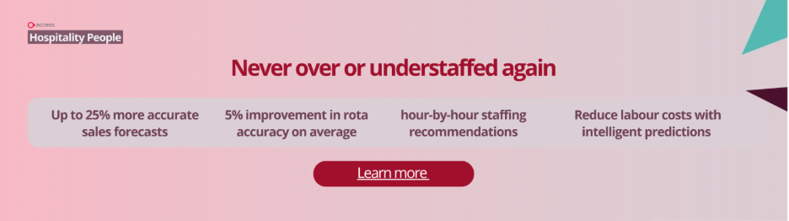
Customers using AI Forecasting see a 5% improvement in rota accuracy on average, and up to a 25% improvement in the accuracy of their sales predictions; resulting in significant labour cost reductions.
In hospitality, where margins are tight, those numbers add up quickly.
What do you need to use Forecasting?
The more data, the better. Ideally, we’re looking for at least one year of sales data and six months of shift data to get the best results.
-
Sales predictions work best with around a year of EPOS data, but the forecasting model can begin producing insights with less. If you have a live EPOS integration in place, we can also work with you to import historical sales data, helping to build a richer forecasting model from the start.
-
Labour predictions are most effective with three months of rota and attendance data.
– And for new customers, this feature can be introduced later once enough data is available.
-
Labour deployment can be used from day one, even before shift history is in place.
-
Events planner – try to plan 3-6 months ahead, and log events at organisation or site level depending on their relevance.
-
Weather data is built in by default, so there’s no setup needed here.
As you continue to use our smart scheduling & forecasting solutions, the predictions will adapt and improve with minimal manual input.
Ready to start your journey with hospitality demand forecasting?
In this article, we looked at how demand forecasting can help hospitality operators move away from guesswork and towards data-led decision-making, all to create an optimised and well-balanced rota that’ll work for everyone.
At Access Hospitality our AI forecasting tools are designed to support operators in building smarter rotas, without losing the flexibility that makes hospitality work, saving time, reducing labour costs and improving team wellbeing.
If you have questions about the features covered in this article or think it might be the right time to explore staff scheduling software, get in touch or book a demo.