AU & NZ
 SG
SG
 MY
MY
 US
US
 IE
IE
Technology in Care Homes
Technology is taking on a greater role in modernising care homes and improving the quality of life for their residents.
Within the social care sector, technology evolves according to care needs and demands, with more complex and targeted solutions, all centred around the individual’s needs, preferences and values. It aims to not only help deliver more responsive care, but to preserve the person’s social integrity and comfort.
It encompasses everything from personalised care planning software to remote monitoring systems, or assistive technological innovations like virtual communication tools and smart home automation. These tools and platforms enhance health and safety outcomes, promote better communication, but also help to promote social connection between residents.
As a care home operator you might sometimes feel a bit overwhelmed at all the different options. It can be tough to figure out which piece of technology will help you with that challenge, what kind of impact that technology will make, and how big that impact will be.
In this article, we are going to dive into these technological innovations and how they continue to contribute to the care sector.

Benefits of Technology in Health and Social Care
Technology is gradually transforming the care home landscape, improving resident safety through real-time monitoring and reducing isolation by enabling meaningful social connections. It can take different forms, from care planning and rostering software to wearables that help detect falls, and devices that offer cognitive support for dementia sufferers.
Though these are only some recent examples, technology was introduced to the social care sector decades ago. It has continuously evolved since then, particularly in the case of basic tools like mobility aids and emergency call systems. Over time, these innovations paved the way for the development of telecare and support for individuals in their homes, followed by the digitisation of documents and records and other digital devices.
Today, technology continues to advance with the introduction of smart devices, AI-powered tools and diagnostics and a range of personalised care platforms, all with the same goal— enhancing the quality of care.
Below we are going to have a look at how technology can help achieve this goal by boosting efficiency, safety, and what it can do to help with decisions, proactive interventions, and lighten the administrative burden on carers and managers.
Enhanced Resident Safety
Safeguarding residents is a top priority in all care homes. A variety of tools and systems are used to protect residents and support staff in their everyday tasks. With the help of fall detection alert systems and devices that track vital signs and sleep patterns, care staff can be immediately notified when unusual activity or other incidents happen, leading to less injuries and much faster response times. Door alarms and GPS tracking systems help protect individuals under the risk of wandering outside their room or even leave the care home.
Many systems offer features that keep families informed, through mobile updates, video calling, or giving them access to care logs. A combination between care and technology can better equip care homes to meet residents’ needs whilst reassuring family and friends that their loved one is safe and looked after.
Streamlined Administration
Automating time-draining paperwork allows staff to focus more on spending meaningful time with residents and focus on their wellbeing rather than manual paperwork. With digital systems, information comes up quicker and is more accurate and more accessible across teams.
For example, scheduling and rostering tools help with assigning and tracking shifts and optimise staff deployment according to real-time needs and situations, reducing the likelihood of burnout in the process. Digital care planning software and Electronic Care Records enable continuity of care by allowing for up-to-date resident information on medication administration and compliance tracking from mobile devices, improving reactiveness and reducing the risk of omissions and errors.
Improved Wellbeing and Social Connections
Generally, interactive technologies have been developed to reduce loneliness and foster a sense of connection between people, but this can be applied in care homes as well, particularly among residents who may face isolation from family and friends. Dedicated communication apps help residents stay in touch with loved ones no matter the distance, preserving their sense of identity and belonging.
Resident Independence and Comfort
One transformative role of technology is its ability to contribute to residents’ emotional health, their independence and dignity even when they are heavily reliant on constant assistance.
For example, smart home technologies allow people to voice control different settings in their space, like lighting or heating without needing someone else’s help, or medication reminder tracker apps or dispensers enable residents to live self-sufficiently and improve outcomes.
These technologies, however, are not solely focused on health, but on general wellbeing and entertainment.
Occupational therapy (or ergotherapy) is a treatment that helps a person overcome challenges, physical or social, by engaging them in meaningful activities with the goal of maintaining cognitive function.
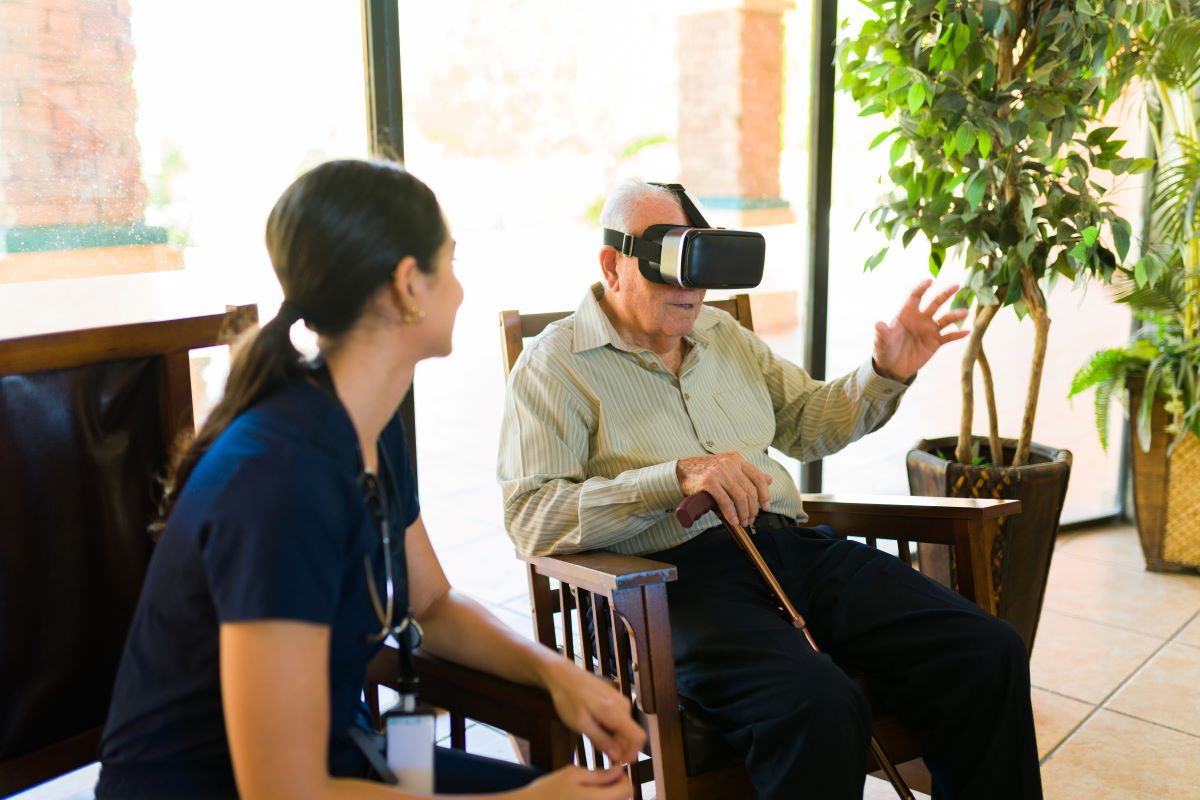
Telerehabilitation tools such as exercise programs, VR (virtual reality) are used in occupational therapy with the purpose of regaining confidence, quality of life and cognitive health, especially after an injury or illness.
There is not an established body of evidence showing VR provides a significant boost to reminiscence therapy, but where it is appropriately used it does have a positive impact, as Dr. Caroline Pooter of the Oxford Institute of Population Ageing writes:
“Conversations ensued (with encouragement from project team members) about residents’ experiences of the virtual worlds, which sparked reminiscence for some about places where they’d lived or visited. The most enthusiastic residents encouraged others to try VR, with a few even taking over the tablet to select the content for their friends.”
“Social engagement continued when the movement element was introduced, with residents encouraged to describe what they saw as they ‘walked’ (sliding their feet on a portable mat from a seated position) in the virtual environment. Feedback on the distance covered was motivating for some residents, who pushed themselves to ‘walk’ further than last time or further than their peers.”
“Care home staff fed back that the level of engagement was exceptionally high for some residents, although on any given day the numbers varied, with quite a few declining to participate or observing only. Residents with physical impairments seemed to especially enjoy and benefit from the virtual walking experience, as their ability to go on real-world walks was very limited. For them the VR technology did seem to provide ‘the world at your feet’, as promoted by the technology developers.”
The technology used was a VR Oculus headset. One app lets you go anywhere in the world and puts you in that location. The possibilities are endless with the headset; they can attend concerts – front seats of course! There is so much they can do. Family and relatives can give us information of childhood addresses, schools, holidays etc

Reach out to find out more about our care home software to support your organisation
Assistive Technology in Health and Social Care
Assistive technology (AT) is a term used to describe systems or devices that help the elderly and people with disabilities perform day-to-day tasks that they may be struggling with, improving their quality of life and giving them the confidence to live life on their own terms, in a care setting or in their own homes.
Assistive tools have a long history, dating back centuries ago. The earliest innovations were limited, taking the form of prosthetic limbs made out of metal or wood ear trumpets for amplifying sound. With the rapid evolvement of technology, they evolved into much more complex forms, encompassing a range of digital or mechanical solutions targeting very specific needs, evolving into mobility scooters, stair lifts, adapted computer screens, and more.
Circadian Lighting
Improved lighting can help reduce hazards in a care home, but studies have shown that light which mimics people’s natural circadian rhythms (or more accurately mimics our natural exposure to sunlight) can have a big impact on everything from mood and behaviour to how frequently people fall. This is especially true in people who have dementia or Alzheimers.
Circadian lighting, or ‘bioadaptive lighting’ mimics the body’s natural circadian rhythms by changing the intensity and forms (the wavelength and ‘colour’) of light that are used at different times of the day. These can have a substantial impact on everyone’s mental and physical health, but is proving especially effective in care homes and nursing homes.
One study in the Journal of the American Medical Directors Association recorded that lighting which changed intensity throughout the day reduced falls by 41%. Another study found negative behavioural episodes reduced by 41%. While a PhD project from Katherine Schledermann in Denmark, also found reductions in nighttime restlessness:
The night watch staff report a positive reduction in the occurrence of night walking among residents.
"Among other things, this can be explained by an improved sleep rhythm, but also by the significant signalling effect provided by the circadian lighting at night, where the light is amber-coloured."
"The circadian lighting’s night light is without blue tones, also referred to as biological darkness, as the brain perceives it as night and it therefore does not disturb the circadian rhythm and sleep."
We have saved so much time, so we can spend more time with staff and clients in the services we are auditing.”
It keeps all our audit information in one place, and we can tailor the audits specifically to the services we provide. The audit library on the system has everything we need, and some that we didn’t know we needed until now.
Telecare and Telehealth
Telecare is a service built to monitor residents’ interfaces and alert caregivers in case of an emergency. It can be used by any individual who suffers from an illness, recovering from a serious injury, or is in danger of losing their agency and independence. Certain systems can detect if the person is conscious or not, alerting family, neighbours or emergency services.
These systems are different depending according to need, like bed or door sensors that can activate when a resident hasn’t returned after a prolonged period of time, when they are prone to falling or wandering outside a designated area.
While Telecare refers more to technologies that support people in their daily lives, Telehealth focuses on monitoring and managing a person’s health condition. This includes devices that measure blood pressure, glucose and oxygen levels, and heart rate.
Telecare and telehealth are two distinct but complementary systems, and together, they create a foundation for person-centred care, through proactively managing both medical needs and daily welfare.
If you would like to read more about Telecare, and how it merges with Telehealth, click here.

Cognitive and Memory Support
These technologies are designed particularly for individuals living with dementia, Alzheimer's disease or other cognitive impairments. They aim to enhance memory, reduce confusion and overall foster a higher standard of living.
One example is reminiscence therapy technology.
Reminiscence therapy refers to a number of techniques used to stimulate mental activity, evoke memories or past events. Technologies used for this approach involve touchscreens or tablets where storybooks, old photos, videos or music are stored. They are meant to stimulate long-term memory and encourage meaningful conversations between residents and their caregivers.
Some care homes also use digital (or physical) memory boxes, containing familiar pictures, items to help residents recognise their own space and remind them of past experiences.
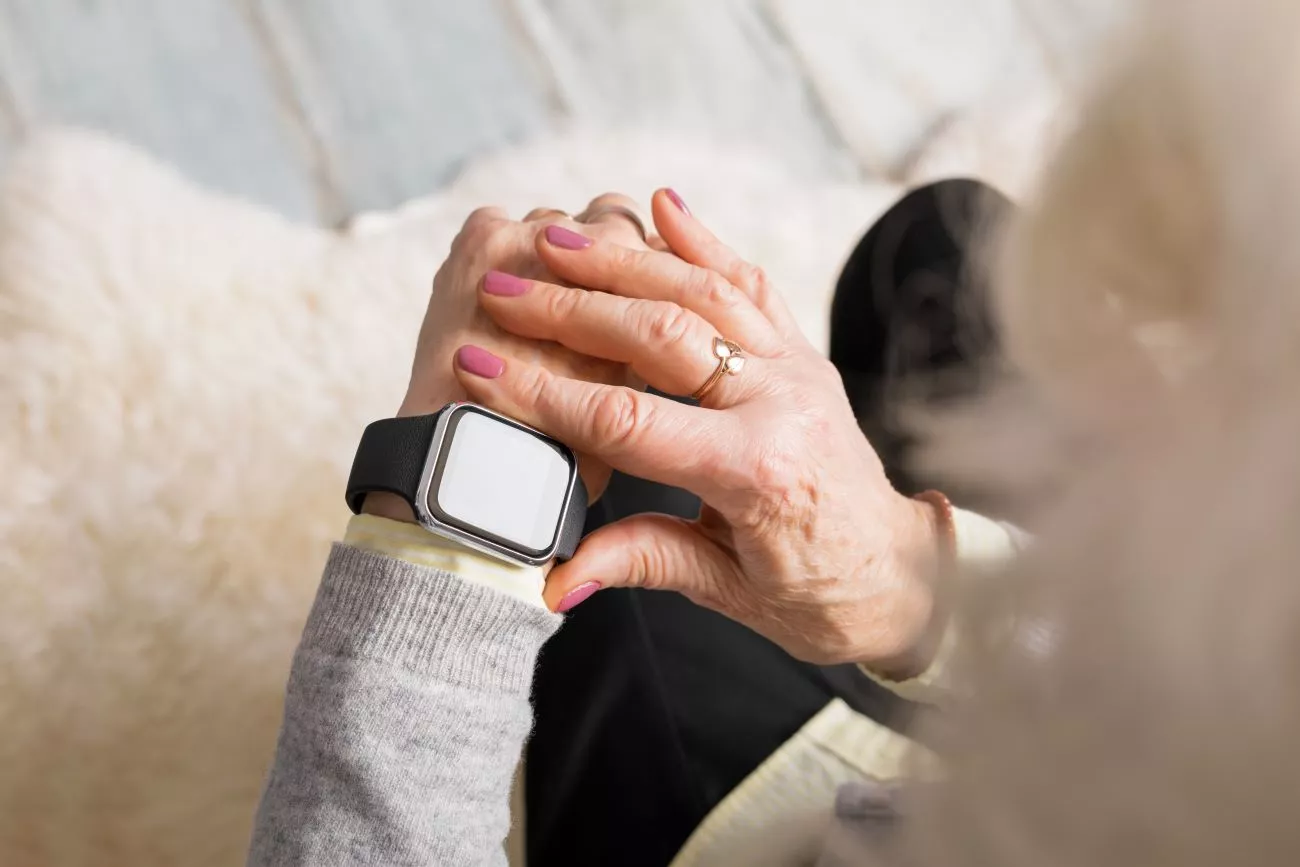
Other key support tools include talking clocks, calendars, or watches with clear and bold displays and integrated voice reminders, designed to aid those suffering from memory loss. These help them both keep track of their time and reduce disorientation.
Augmentative and Alternative Communication (AC)
This term refers to different communication methods used to support speech for individuals who are having difficulties communicating verbally. In care homes, AAC is particularly important for residents with conditions like Parkinson’s, dementia, stroke or other disabilities that impedes someone’s understanding of language.
Low-tech options for AAC include sign language, communication boards or books with symbols and bold letters that the person can point to. In short, they are communication tools that are not powered by batteries and electricity, are more accessible and ideal for residents with limited technological experience.
On the other hand, types of high-tech AAC are custom devices, like eye-tracking and speech-generating devices, or tablet-based communication applications that can convert text or symbols into speech. This type of AAC, though more engaging and customisable, requires a setup, maintenance and staff training.
Advanced Technologies, Artificial Intelligence and Machine Learning
Artificial intelligence (AI) is supporting the care sector by enabling a more responsive, holistic care, through tools that help care workers streamline administrative tasks and monitor health in real-time.
Generative AI analyses vast amounts of care and health data and uses it to identify patterns, predict outcomes and tailor care strategies in order to meet the individual’s needs more effectively and accurately.
The health and social care sector is increasingly embedding the use of artificial intelligence to deliver more proactive, personalised services and enhance resident safety. Within the NHS, AI guidance helps with speeding up the diagnoses of diseases and managing different conditions through predictive tools and virtual wards.
The integration of AI is changing the process of monitoring, analysing, and care planning within the health and social care sector, enhancing the way healthcare professionals assess and support their clients. Here’s how it works:
An AI model will analyse a person’s social data in order to identify their needs and preferences. From here it will draw patterns in the individual’s medical history, daily routines and other conditions, and help build a more bespoke care plan that adapts to the individual’s health changes. This also helps support care workers by flagging potential issues and concerns early, such as an increased risk of falls, ensuring care plans are not only customised, but also proactive and responsive. For example, it can customise care plans by recommending lifestyle changes or support services, adjust the care plan as soon as new data becomes available, or suggest specific medication plans or specific interventions depending on individual risk factors.
The NHS has been piloting AI in care homes, where a device is placed in residents’ rooms (with their consent of course) to monitor normal patterns of movement and noise at night, and alerting staff via a smartphone/tablet app if any abnormalities are detected.
AI is also being used to identify signs of pain in people who are unable to tell others they are in pain, or to do so reliably. Systems like PainChek use a smartphone’s camera to analyse people’s faces and identify signs of pain from facial muscle movements. These are then coupled with the person’s self-reported levels of pain to produce an overall pain score.
These scores can then be tracked over time to assist those writing or review care, or clinicians with pain management.

Robots
Despite the enormous funding and interest, only 10% of social care providers had introduced any form of robotics into their care services. Reasons cited by care providers and experts in the field include robots actually creating new labour and overall more work for care workers, rather than freeing them from tasks. Practical limitations, for example in robots that assist with lifting residents being uncomfortable.
Ironically, when the creator of ‘Robear’ (a discontinued robot designed to help lift care home residents) was asked if robots were a solution to Japan’s challenges in social care, he said that migrant labour was a better answer. Numerous experts have commented that paying care staff more would also help.
So for now it seems robotics is yet to find its place in care homes, perhaps in the future it may, but any successful use would have to recognize the distinctiveness of health and social care.
Deploying robots on assembly lines makes sense, they can do simple, manual tasks faster, constructing inanimate, duplicated objects. In is of course, the exact opposite of care, where everyone is unique and really, there is very little that a machine counterpart to a care worker could do better than a care worker (if that care worker has the necessary time, equipment, training and so on).

Medication Management
Medication management software for care homes has come on leaps and bounds in recent years. Initially, at the end of the 1990’s, care home and nursing homes started transitioning from MAR charts to eMAR (simple, electronic MAR charts).
Since then these systems have been further developed and now help manage the entirety of medicines processes in care homes and nursing homes, including: Automation of processes such as medicine ordering
- Inventory functionality; stock control and counts, alerts on low stock etc.
- Integration with pharmacist’s systems for seamless ordering
- Reporting and analytics
- Remote monitoring of medication rounds
- Barcode scanning
- Medication review management
Of course each specific system may have different functionality. Some systems will also be better than others and this will impact the benefits you can expect from them.
The main reasons providers implement digital medicine management systems is to simultaneously improve safety and make it easier, more efficient and more reliable to manage medicines processes.
Managing medicines using paper, or regular computer software that is not specifically designed for the job, leaves room for lots of risk. These could be risks caused by incorrect information, gaps in information, or parts of processes not being carried out or carried out properly.
Managing medicines properly also creates a lot of admin time when using paper or normal office software, to audit, manage stock, records and so on.
Medicine management software ties up loose ends, uses automated alerts and process management and lots of other useful features to make medicines safer in your care service and reduce, or completely eliminate medicine errors.
There are around three or four leading software suppliers of medicine management software. The Access Group’s eMAR and medicine management software among them, but you should do some online searching and look at what the market has to offer.
But, regardless of whether you decide to use our software or another, ensure the supplier also has an integrated care planning component too. It is essential your medicine management software integrates with your care planning system as this example highlighted by NHSX/Digital Social Care shows:
One massive requirement for us was that any electronic records system and medicine management system needed to dovetail together. They needed that seamless integration. Access Group was able to provide us with this integrated system.
It was our carers and managers who were most adamant about this, and when you think about the additional duplication of data entry and the potential for errors that using two separate systems create, they were and are absolutely correct to insist on an integrated system.
Our staff were saying they didn’t want to have to put residents’ details in half a dozen different places, we want to put it in once. That was our number one requirement and that came directly from our care staff.
Digital Innovation and Technology in Care Homes – What’s Next?
In this article, we have provided an outlook on how technology is shaping the present and future of care homes, but also how it impacts and supports the social care sector. All technologies - from digital care plans to AI-powered tools - are built to improve the quality and safety of care delivery whilst also promoting autonomy in residents’ lives and enabling a more person-centred support.
Particularly for residents with sensory, cognitive or mobility difficulties, these innovations are there to offer greater control over how they make their everyday decisions. When remote monitoring and live updates are set up, families gain reassurance and a deeper sense of connection knowing that their loved ones are cared for.
With thoughtful planning and inclusive implementation, technology can become a trusted partner in a dignified and person-centred care setting that enhances the lives of residents.
The Access Group’s goal is to support you as we are moving into a new chapter of innovation in care home technology.
Our leading care home management software is an all-in-one solution for raising care standards, streamlining operations and enhancing resident wellbeing, offering you more freedom by centralising all your digital solutions into a single place, including medication management, rostering, alerts, and live updates.
We’re building on those foundations to equip our clients with advanced analytics and new technology to help bring together the data, and the potential benefits offered by all these new devices and computational.
Book a demo today to find out more about how our care home software solutions empower your team with the technology to deliver smarter and connected care by improving compliance and placing residents at the heart of every decision.