AU & NZ
 SG
SG
 MY
MY
 US
US
 IE
IE


What’s the impact of burnout in healthcare?
Burnout often appears when someone feels like a lot is being demanded of them and they don’t have enough capacity to handle everything. It’s an exhaustion that doesn’t go away with simple rest. It’s similar to stress but lasts a much longer time with symptoms including:
- Chronic fatigue
- Insomnia
- Headaches
- Stomach issues
- Lack of motivation
- Anxiety
- Low self-esteem
- Difficulty concentrating
The effects of burnout are felt across all areas of a person’s life, including in their personal relationships.
In a healthcare setting, these symptoms have a real impact. Burnout leaves staff with compassion fatigue and the need for increased absences from work. As a business, it causes clinical organisations extra recruitment costs resulting from ongoing workforce retention problems. But burnout is not only a staffing challenge. It can also reduce patient safety and overall patient care efficiency.
It goes without saying that tackling burnout is both a strategic and financial opportunity as well as a wellbeing initiative for staff.
How digital systems can cause burnout in healthcare
For the most part, healthcare technology is designed to avoid burnout as well as ease the burden of overstretched teams and increased patient demand. So why are some teams still feeling the brunt of chronic workplace stress?
The answer could be that many people find that technology adds to their workload, rather than taking away from it.
Systems may be slow, there may be too many passwords or interfaces are just not simple to use. But not all problems are obvious. For example, while having multiple platforms for records, prescribing, results, messaging and rostering is a good idea, if these systems don’t talk to each other or require duplicate data entry, then they’re not always solving a problem. This type of setup creates extra work which can contribute to reduced attention to detail and therefore, more mistakes.
When clinicians can’t be confident that their systems are working as they’re designed to or not keeping pace with routine operation, they begin to cause more stress and require more oversight than is necessary. Rather than giving time back to teams, systems like these make them work harder.
The good news is that this isn’t true of all technology - and there are solutions that make workloads more efficient and even contribute to reducing rates of burnout among healthcare teams.

Using technology to prevent burnout in healthcare
If it’s fit for purpose, technology should make your life easier, not harder. Clinical software and digital systems are no exception. While it’s useful for completing admin-heavy tasks, digital healthcare software has become a lot more sophisticated. Nowadays, technology enables you to feel like you’re adding another member to your team - and without the risk of burnout.
It’s understandable that upgrading to a new system can seem like you’re adding to your workload, but the upfront effort and cost of a significant change like this pays dividends in the future. It will save you time and money on recruitment and helps you retain teams with solid expertise and who have built experience with you.
Here’s how technology can be used in a positive way to prevent burnout in healthcare, using examples from The Access Group’s suite of solutions:
Automating repetitive admin
Using healthcare technology to automate admin frees your team up to get back to what they do best, knowing that repetitive tasks and records are handled correctly and efficiently. That extra time means they aren’t stretched thin over patients and processes. This reduces the likelihood of staff feeling like they can’t cope with their workload, which is a leading factor for burnout.
Access Rio Smart Notes is a transcription tool that enhances workflows by using AI to summarise key points from the notes taken, allowing for at-a-glance reading as well as automation to insert appropriate information into electronic patient records and other documents or forms.
Simplifying workflows
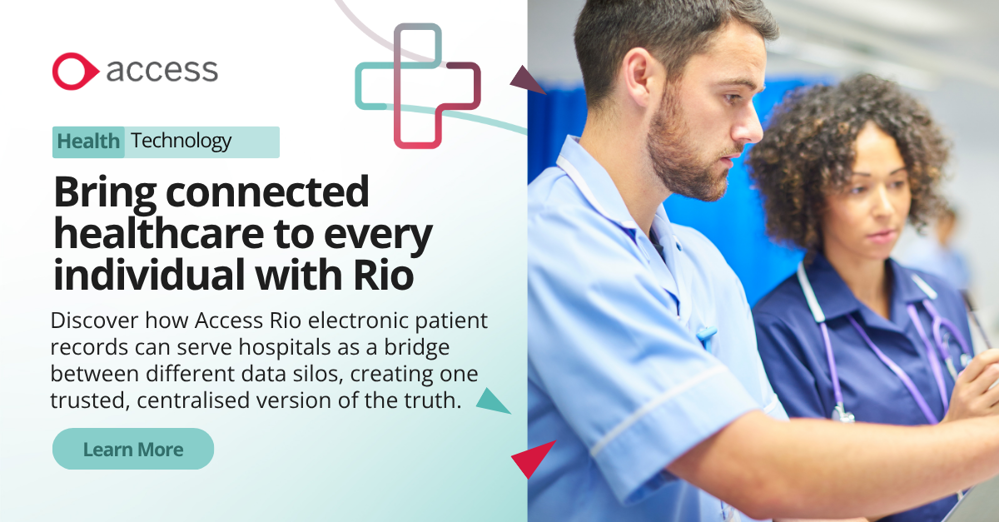
Technology that reduces your clicks, unifies data and gives you easy access to past records saves you time and simplifies your workflow. With the right digital infrastructure in place, your teams will no longer be stretched across multiple platforms, using their time to piece together the picture rather than delivering care. Access Rio EPR is one such example of centralised records, providing one source of the truth that can be jointly access, proofed, and updated.
Consistent and regularly updated patient records leave them feeling prepared for their shift. When it’s easy for them to identify what’s in their workflow, they’ll find it easier to tick off their to-dos, resulting not only in better staff wellbeing but also a more efficient care setting.
Improving communication
Miscommunication can be a massive time sink for people who work in healthcare, especially when you have multiple staff members crossing over shifts. Improving communication means improving continuity of care.
Healthcare solutions that do this well are the ones that stitch information together ahead of time and keep a clean, single source of truth for patient records. When your teams have the correct information, they can get on with their jobs from the minute their shift starts. It also creates fewer mistakes and ensures that patient safety is always at the forefront.
Managing workload
Industry-designed use of AI means that technology has now become a personalised support system. It is not only reactive it’s predictive, helping you and your team to spot trends ahead of time before they become problems. This gives your teams a helping hand with their workload, providing extra resources to prioritise their patients and clearly see tasks.
Our Access Evo platform is an underlying element across our entire software range now, providing real-time analytics to help with prediction and planning.
Helping you make better clinical decisions
All of the above combined means that your team can make better decisions for your patients in a way that avoids burnout. This restores confidence in teams and gives them back their sense of purpose and self-esteem.

Measuring success is not just about efficiency. It’s about staff wellbeing. Without your staff, your business suffers so taking burnout seriously, and putting steps in place to reduce it, should be part of your risk mitigation.
So, what now? Audit your current systems through the lens of burnout. Ask yourself whether your systems and digital setup truly help your staff or whether they hinder how well they can do their jobs.
If your current systems are not meeting the mark, it’s a great idea to work with a trusted healthcare partner to understand your unique setup, co-design clinical systems and deliver targeted improvements for your workplace.