

 AU & NZ
 SG
 MY
 US
 IE

On 2 October 2026, the average UK price of diesel passed £2 a litre for the first time, at 200.01p. That's 57.6p more than at the end of February. It has since dipped just below £2, but it remains close to record levels.
Conflict in the Middle East and attacks on Russian refineries have squeezed global supply, and Brent crude is currently trading at around $107 a barrel, roughly 76% higher than a year ago. The UK is especially exposed: more than half the diesel it uses is imported.
For anyone running vans or lorries, this is a line on the P&L that grows every time a vehicle leaves the yard. And the 5p fuel duty cut ends on 31 December. Unless the Chancellor changes course at the Budget on 28 October, duty will rise by 3p a litre in January and 2p more in March.
You can’t control the price of diesel. But you can control how many miles your fleet drives, how full each vehicle is, and how often a journey gets wasted. That's where the real savings are.
Where your fleet's fuel budget really goes
Most fleets don't overspend on fuel because drivers are careless. They overspend because the plan sends vehicles further than they need to go. The biggest leaks tend to be:
- Inefficient route sequences. Routes built by postcode, habit or a planner's best guess rarely find the shortest path between drops.
- Underused vehicles. Half-full vans run separate routes when the work could fit on fewer vehicles.
- The wrong vehicle for the job. A 7.5-tonne lorry doing work a van could handle burns fuel you didn't need to buy.
- Failed deliveries. Every missed drop means a second trip, and a second tank of fuel spent on the same order.
- No visibility once vehicles leave. Without live data, detours, idling and unplanned stops go unnoticed.
What this looks like on paper
Here's an illustrative example: a fleet of 20 diesel vans, each driving 150 miles a day at 30mpg, working 250 days a year. That's 750,000 miles and around 113,650 litres of diesel a year.
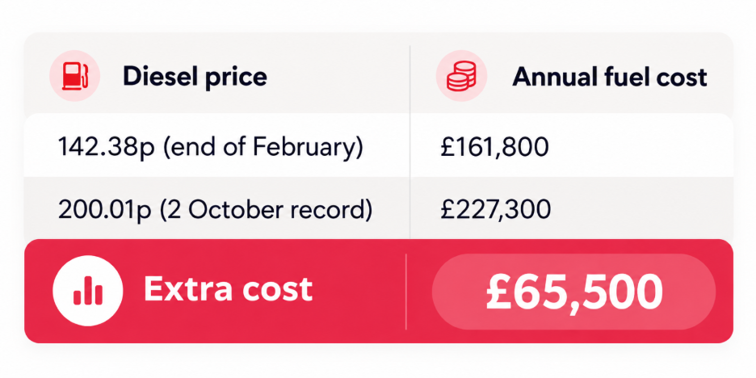
That's an extra £65,500 a year for the same work, just from the price rise. Cut the fleet's mileage by 20% at the record price and you'd save around £45,500. That recovers most of the increase without raising a single customer price.
How route optimisation with Access MaxOptra cuts fuel costs
Access MaxOptra is route optimisation and delivery management software built for businesses running multi-drop fleets. It tackles each of those leaks directly, and it can cut daily mileage by up to 20%.
Smarter routes, fewer miles.
Access MaxOptra's algorithms build the most efficient sequence of drops for every vehicle. They take into account delivery time windows, vehicle types, load capacity, and driver hours. Planners stop thinking in postcodes and start thinking in actual distance and drive time.
Fuller vehicles, fewer vehicles.
By planning against real load capacity, Access MaxOptra packs more work onto each route. Some days, that means one less vehicle on the road entirely.
The right vehicle for every route.
With a mixed fleet, Access MaxOptra matches each job to the most suitable vehicle, so larger, thirstier vehicles only go out when the load genuinely needs them.
Fewer failed deliveries.
Accurate ETAs and automated customer notifications mean customers know when to expect you. That cuts missed drops, and the wasted return trips that follow.
Live tracking and real-time changes.
The Access MaxOptra driver app and live map show where every vehicle is. When a new order lands or a road closes, planners can re-optimise on the day instead of sending a vehicle on an unnecessary detour.
Analytics that show where costs sit.
Access MaxOptra compares planned routes with what actually happened, reporting on mileage, drive time and cost per route. You can spot the routes, vehicles or habits that are quietly costing you money, and fix them.
The result is a fleet that does the same work, or more, with fewer miles. And because fuel is only one cost tied to mileage, the savings carry through to maintenance, tyres, overtime and emissions too.
Beyond the route: the wider Access toolkit
Fuel isn't the only cost under pressure. When diesel climbs, inbound freight, packaging and materials tend to follow. Access MaxOptra is part of The Access Group, and it connects with other Access products that help you tighten costs across the wider operation.
- Access Mintsoft for order and fulfilment management, so orders are picked, packed and ready for dispatch on time.
- Access Unleashed for inventory management, helping you avoid costly overstocking and emergency reorders.
- Access Supply Chain for end-to-end visibility across wholesale and distribution.
- Access Weighsoft for accurate weighbridge data, so you know exactly what's going out and coming in.
Used together, they give you one joined-up view from order to doorstep, with fewer gaps for costs to slip through.
Five ways to reduce fleet fuel costs this month
- Work out your real cost per mile. Use today's diesel price, not last year's budget figure.
- Audit your routes. Look for routes that overlap, cross back on themselves or run half-empty.
- Check your failed delivery rate. Every failed drop is fuel spent twice.
- Match vehicles to loads. Make sure your largest vehicles only go out when the work needs them.
- See what optimisation could save you. A demo with your own delivery data will show you the difference in miles, and in pounds.
Diesel prices may ease in the months ahead, or they may not. Either way, every mile you take out of your operation now is a saving you keep for good.