AU & NZ
 SG
 MY
 US
 IE


Access set out to explore the health and social care landscape in Wales further when it brought councils and health boards under one roof at the Marriott Hotel in Cardiff on 17 November. It was a chance to open up the conversation, find out what is currently working, what is missing, and what we could do to support organisations in delivering better care and making their lives working in the sector that little bit easier.
Here's how the day played out.

When a Family Notebook Holds More Answers Than the System
Following a warm welcome from Access Directors of Health and Local Government, Steve Wightman and Andy Sparkes, the first session kicked off with a discussion around the National Target Architecture, hosted by Matthew Jones from Channel 3 Consulting.
Matthew took us through a hard-hitting example of a woman who had fallen at home, and the notebook her family kept to track what happened afterwards. The speaker suggested that notebook was the most complete record of the person's care. For a health service, that is an uncomfortable finding.
The scale of the problem was just as telling. Many separate applications were found across NHS Wales, and the national repository kept growing. This just solidifies that more systems don't automatically produce a fuller picture, and makes the test for every product in this space, ours included, simple: does it help put another system away, or does it create one?

Why Joined-Up Care Requires Compromise
Halfway through the session, Matthew was joined by Michael John from KPMG and Joe McDonald from Access's Advisory Board, who also led the Great North Care Record.
Both agreed that organisations need shared data foundations before they build anything on top. They described a "collective action dilemma", where every organisation waits for somebody else to move first.
Joe, however, was optimistic about Wales's potential, describing it as a "Goldilocks-sized population" where the scale is manageable enough to get things right. The panel's suggested approach was practical: national standards for architecture and systems, with local decisions on how services are designed. Effectively, a way to stop everyone waiting at once.

Bringing Health and Social Care Together with Access Evo
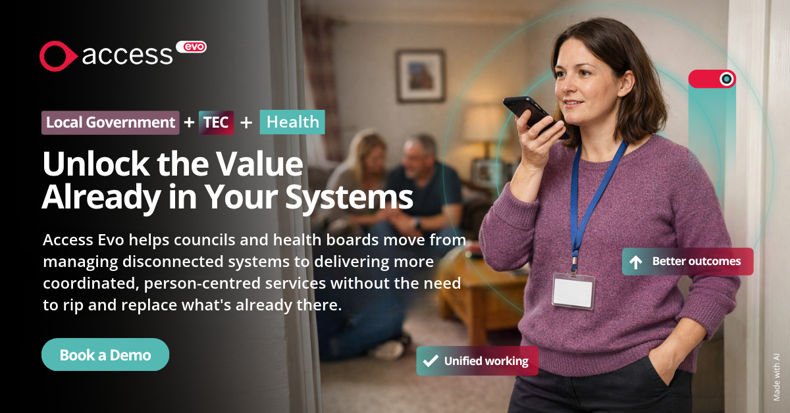
Next up, Access's Product Director for Integrated Care, Chris Wilson, alongside Senior Product Managers Angela Robertson and Clayton Cosgrove, introduced our Access Evo platform as one login and a single place to look when it matters most.
For anyone running a service, the security model is where the real reassurance sits. Data stays in private environments, and each person sees only what their source system would let them see. That matters whether the record lives in Access Rio, the clinical system many health teams rely on, or Mosaic software, the case management system councils use for social care.
Bring in third-party data and the picture starts to fill in, addressing the morning's central problem of a record that should have existed but never quite did.
'How Can I Help You Today?' or 'Sut Alla I Eich Helpu Chi Heddiw?'
The Navigator demo brought that idea to life. A single feed, a Welsh language toggle, and Mosaic sitting as one tab among several. In Wales, where services must work in both languages, that toggle is a requirement rather than a nice extra.
Clayton then built a custom view in around five minutes, showing how teams could quickly shape dashboards around the way they work, without lengthy configuration projects.
The live demo finished with a run-through of workflows and AI features, reiterating the importance of keeping humans in the loop. It was a session that showed the difference technology could make by bringing it all to life on screen.

Lessons from Neath Port Talbot's Digital Transformation
Steve Hyett from Neath Port Talbot took to the stage with a story that will ring true for anyone who has lived through a system change. His council swapped out a 20-year-old in-house system covering children's services, adult services and finance, and his session was the most practical of the day.
The lessons were refreshingly honest:
- Plan for more than 50 workshops, because processes vary far more than anyone expects.
- Test migrations repeatedly, since a single test never tells the whole story.
- Train people by role rather than by system, so they learn the work they actually do.
- Bring practitioners in early and appoint a product owner and manager sooner rather than later.
- Start integrations earlier than seems necessary.
When talking about what was involved in the implementation, Steve explained:
"We had to do a huge amount more around the people, not just the technology."
Every lesson on that list reflects this: how people work, what they need to learn and who they trust to guide them. The system took about two years to settle, offering a realistic guide for anyone planning a similar rollout.

Supporting Independent Living with Access Assure
Nerys Hebdon, Access's Head of TEC Customer Enablement, showed how Access TEC uses AI to learn activity patterns and deliver personalised, proactive care at home. The cost comparison landed hardest, with an average care package costing around £18,000 a year and residential care around £50,000. In contrast, Access Assure costs just a few hundred pounds annually.
Hannah Ashour, also from Neath Port Talbot, then shared a story about the impact of TEC on a family. It concerned a 93-year-old woman who lived at home with sensors, though no cameras, and a family app. As visits dropped off, inactivity alerts led the family to find her after a fall. She died at home, with her family.
The alerts helped keep the family informed, but the story also reinforced the importance of ensuring that information reaches everyone involved in a person's wider care plan.
Microsoft on the Future of AI in Health and Social Care
Prior to lunch, Microsoft's Kevin Lasitz and Victoria Southam introduced the concept of the 'frontier firm', exploring how AI can work "in the flow of human ambition" rather than disrupting the way people work.
Their argument centred on two foundations: intelligence, built from data, knowledge and people, and trust, ensuring technology remains secure and governable.
They showcased how Copilot could take on everyday administration, giving staff more time for the conversations and judgements that care depends on. It was a familiar theme throughout the day, particularly during the afternoon roundtables, where organisations raised concerns around growing demand, data quality and the administrative pressures facing their teams.

Reflecting on a Highly Thought-Provoking Day
Every organisation in the room brought its own challenges, and we came away with a far richer picture of them. Some are working with systems that were never built to talk to each other. Others are facing demand that keeps climbing, or data that drifts out of date before anyone notices.
Despite these different pressures, what stayed with us most was the shared sense of purpose in the room. Everyone was working towards the same goal: making health and social care more connected, accessible and effective for the people who depend on it.
For us at Access, the day was just as much about listening as it was about sharing what our technology can do. Hearing directly from the people working across these services gave us a better understanding of where the gaps remain, what needs to change and where we can play a part in making that happen.
There's clearly more work to be done, but if the conversations in Cardiff showed us anything, it's that the appetite for change is there.
If your organisation is facing similar challenges, we'd love to continue the conversation. Get in touch with our team to explore how Access Evo and our wider health and social care solutions could help you connect services, make better use of your data and support the people who rely on your care.