AU & NZ
 SG
 MY
 US
 IE

The case for capacity
Capacity thinking is right about a good deal. A citizen who needs help to get out of bed needs a person, and no sensor replaces one. Extra beds, urgent care sites and staff relieve real pressure.
The planning has been done. NHS England’s winter letter, published on 17 July, asked every area to agree joint plans with local authorities, with boards signing them off by 30 September. The pressure those plans respond to is easy to see in discharge.
Age UK found that on a typical day in 2025/26, around 13,000 people stayed in hospital after they were medically fit to leave, up about 70% since 2021, and it estimates the delays cost the NHS £2.66 billion.
Plans answer that with capacity because capacity is what a plan can count. It is also an expensive answer to a problem that visibility can ease: people wait in hospital while the information needed to assess them is still being gathered.
Three places councils lose sight
On the ward. Much of the wait for discharge comes from uncertainty. The team can’t be sure the person will be safe at home, and without evidence of how they manage day to day, the assessment takes longer than it needs to.
At the door. Once the person has left the ward, nobody can see how things are going. The alarm gives them a way to call for help, and the assessment that follows still relies on what the person says and what a worker sees in a short visit.
After the door. Once someone is home, most teams hear about a problem from a neighbour, a relative or a 999 call. A person who stops moving around, or falls in the night, may not trigger anything until morning. Admissions, readmissions and anxious families pay for that gap.
Three stages, one shared cause: the team can’t see how the person is managing at home until something goes wrong.
Three layers of visibility
A winter plan needs three layers, and councils already run the first.
- Alarm. The person can raise the alert. This stays the foundation of any TEC service.
- Insight. The service builds a picture of how the person manages day to day, so an assessment rests on evidence.
- Response. The alert reaches someone with time to act on it.
An alert is worth only as much as the response behind it. A sensor that flags a change to a team with no capacity to visit has made the problem visible and left it unsolved, which is why the third layer matters as much as the second.

Supporting discharge to assess: Access Assure
Discharge to assess works when the team can see how someone manages at home from the first day.
Access Assure supports discharge to assess by giving workers evidence for the assessment that follows.
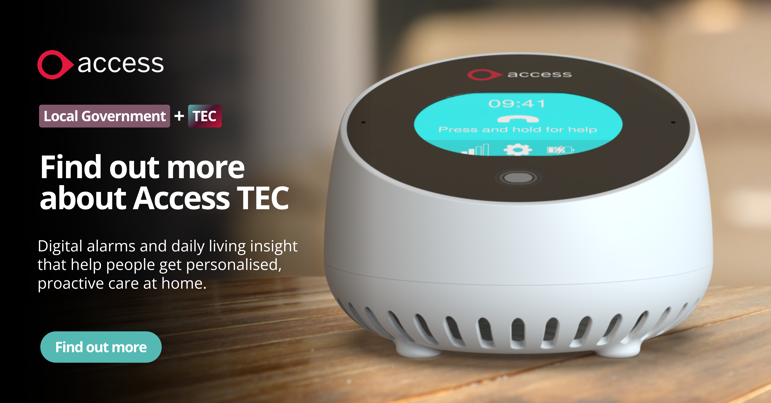
The person goes home with a digital alarm, so they can call for emergency help whenever they need it. While they settle in, discreet sensors in the home collect information on their routine, such as getting up, nights out of bed and using the kettle. The platform shows that picture to the social worker, occupational therapist or provider, who can use it to assess what support the person needs.
For the person, the alarm stays within reach while the data builds. For the social worker or OT, the assessment rests on how the person is actually managing, not a snapshot from one visit.
Seeing it at discharge: Access Oysta
A discharge moves at the speed of confidence.
Access Oysta is a grab bag for discharge: the person leaves hospital with mobile TEC that is quick to deploy and easy to use, and carries fall detection, activity tracking and emergency alarms, so they can recover independently at home knowing help is within reach.
Live data feeds into the Access Assure platform, where the discharge team can make decisions on evidence, which makes a more personalised care package possible. The Friends and Family app gives carers and loved ones their own view of the person’s wellbeing, with activity updates and alerts.
For the person, help is within reach. For the family, there is a way to see how things are going. For the discharge team, there is a decision they can stand behind.
Our view is that confident discharges are the ones that hold, and that confidence comes from being able to see.
What this means for your winter
Capacity will still decide how many people you can look after on the worst day of January. Visibility gets people home sooner and gives assessments evidence to work from. Teams that can see how someone is managing at home from the first day after discharge spend less of the winter reacting.
Winter doesn’t test your capacity first. It tests what you can see.