

 AU & NZ
 SG
SG
 MY
MY
 US
US
 IE
IE


What is AI Augmentation?
How much AI is actually being used in recruiting right now?
Most agencies have already moved past the "should we?" question. Access's own AI in Recruitment 2026 Outlook research found 78% of recruitment agencies are now using AI in some form. The gap that actually matters is what happens next: just 6% have embedded it deeply enough for it to function as a core operating layer rather than a bolt-on tool. Another 42% apply it to isolated, low-impact tasks, and 47% are still piloting without a clear strategy or way to measure what's working.
The wider HR picture backs this up. SHRM's State of AI in HR 2026 report, based on a survey of 1,908 HR professionals conducted in December 2025, found recruiting is the single most common entry point for AI across the entire HR function, ahead of HR technology, learning and development, and employee experience.
Adoption used to be the differentiator. Now it's what an agency does with that adoption that separates the leaders from everyone else.
Why do recruiters need this in the first place?
Recruiters have always carried a heavy admin load. A 2025 Totaljobs study of 748 HR leaders and over 2,000 UK jobseekers found recruiters lose an average of 17.7 hours per vacancy to manual admin tasks, equivalent to more than two full working days per hire. Scheduling, data entry, chasing confirmations, updating records. Multiplied across a typical workload, that's thousands of hours a year spent on tasks that don't require a recruiter's judgement at all.
That's a systems problem, and it's exactly where AI creates the most leverage.
What's the difference between standard AI and agentic AI?
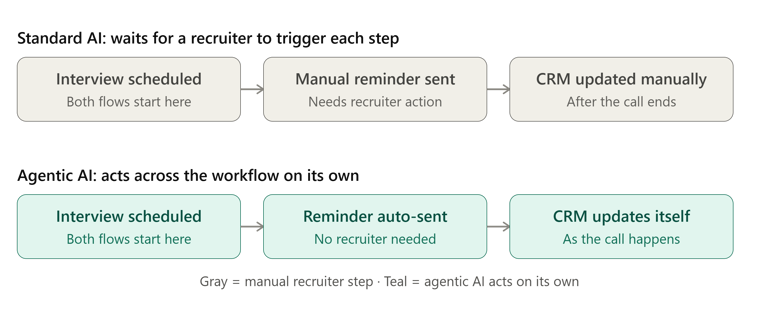
The difference comes down to one thing: standard AI suggests, agentic AI acts.
Instead of waiting for a recruiter to trigger each step, agentic AI works across the full workflow on its own: re-engaging candidates, updating records, progressing pipelines. In practice, that means interview confirmations get chased automatically and CRM records update themselves as calls happen, with no one opening a tab to do it manually.
What does an AI-augmented recruiter actually look like day to day?
The agencies seeing the best results are the ones who've been deliberate about where AI creates real leverage, not the ones with the most tools installed.
Four use cases stand out:
- Compliance surfaced before it's a problem. Instead of consultants discovering a compliance gap mid-process, AI flags it at the start of the day, before it can derail a placement.
- Plain-English candidate search. Consultants search talent pools by describing what they need, not by building Boolean strings or navigating filter menus. Time to shortlist drops accordingly.
- Real-time answers on live calls. When a client asks about margin or availability mid-conversation, the answer surfaces instantly. The consultant sounds like they know everything, which matters in a relationship-driven business.
- Meeting intelligence that updates itself. AI joins the call, extracts the structured detail, and pushes it straight to the CRM. No manual write-up after every conversation.
None of these are gimmicks. Each one removes friction from a moment that already mattered in a recruiter's day, it just used to cost more time than it should.
This is also where most agencies are leaving value on the table. Access's AI in Recruitment 2026 Outlook found job ad writing is now automated at 70% of agencies, but the workflows that directly drive revenue, business development sequencing and CRM automation, sit at 34% or below. Strategy says compete on relationships. Execution hasn't caught up yet.
Why do some AI rollouts fail even when the tool works?
Because the technology moves faster than most teams' ability to absorb it. The hardest part isn't choosing which AI tool to buy. It's bringing the team along.
AI only delivers value when people actually use it day to day. A feature nobody trusts is expensive shelfware, however good the underlying model is. Agencies making real progress treat adoption with the same seriousness as implementation: structured rollouts, one clear use case at a time, visible early wins shared across the team.
Start with one low-risk, high-volume use case. Build confidence. Then expand from there.
The data backs this sequencing up. Access's AI in Recruitment 2026 Outlook found only 1 in 5 recruitment agencies see measurable ROI from their AI investment, and the gap isn't about which tool they bought. Training investment, leadership ownership, and team-wide adoption separate that top fifth from everyone else. More than half of agencies (56.6%) name poor data quality as their biggest blocker, and most respond by shopping for a different platform rather than fixing the underlying data. The report's finding is blunt: switching tools rarely solves it.
What comes after task automation?
The next stage goes beyond automating individual tasks: AI that anticipates what's needed, manages entire workflows end to end, and improves the more it's used.
The agencies that win this next stage won't necessarily be the largest ones. They'll be the ones getting more output per recruiter, a team of ten performing like a team of fifteen, without the overhead of hiring five more people. The team stays the same size. What changes is how much better the work gets. Access's research backs this: high-growth recruitment agencies report four times more AI ROI than agencies in decline, using the same tools. Execution explains that gap, not access to the technology.
Recruitment AI delivers ROI when it helps recruiters complete core tasks faster. With quick actions and agent-based capabilities, teams can bypass complex workflows and focus on the 90% of their day that drives outcomes, while the platform adapts in real time to what they need next.
- Laura Tressler, General Manager at Access Recruitment
The gap between agencies running on AI-augmented workflows and those still running everything manually will keep widening. Waiting doesn't make the technology more finished. It just makes the gap bigger.
See what this looks like for your team
Book a walkthrough of Access Evo and see how agentic AI slots into your existing workflow, not a parallel system you have to manage on top of it. Or go deeper first: read the full AI in Recruitment 2026 Outlook report for the complete data behind this article.
This article draws on Access's own AI in Recruitment 2026 Outlook research, customer outcomes and feedback from Access's Customer Advisory Board programme, and third-party industry research cited below.
