AU & NZ
 SG
SG
 MY
MY
 US
US
 IE
IE


Hotel websites are your gateway to revenue success as 37% of British travellers book accommodation directly on official hotel websites, making it the second most popular booking method after OTAs, according to YouGov's UK Travel Trends 2024 report.
So, how can digital marketing work for your hotel? In this article, we share insights into what channels work and how you can integrate them into your marketing plan. Once you have the knowledge and tools in place to create a strong marketing strategy, direct bookings will come in thick and fast.
Why owning your guest relationships matters more than you think
Owning your guest relationships puts you in a stronger position that those who rely on OTAs. According to CBRE, ADR and RevPAR rates increased by 4% in 2025 and cancellations fell to 18.24%, showing guests are more committed to following through with their stay. Having a marketing strategy that keeps them engaged from pre-arrival to post-stay is just as important for your hotel.
Knowing what your guests are looking for or the current trends people are searching is what will make your hotel website show up in the right places. For example, short stays are dominating the market with around as the average domestic overnight trip in Britain lasts just 2.9 nights, according to the Great Britain Tourism Survey, with travellers taking 106 million domestic overnight trips and spending an accumulation of £32.9bn.
Think about short-stay packages or quick getaways that guests can book at short notice. This drives bookings directly to you rather than through an OTA.
What OTA commission is really costing your operation
OTA commission typically costs hotels between 15 and 25% of every booking, meaning a significant share of your room revenue goes to the platform rather than your business. They get you in front of people browsing for the best hotels in a competitive market, but this comes at a cost. 77% of hotel bookings in Europe come through OTAs, so, for smaller and independent hotels without a big budget big chains have, it can be difficult to find a way out.
Now with the new EU Digital Markets Act, this forces OTAs to remove the rate parity clauses so hotels can offer lower prices and have control over what you offer guests and when. This has seen a number of cases of OTA sites which appeared cheaper fall from 19.3% to 12.6% showing that the door to competitive pricing is wide open. Use this to pull guests in with prices that match their budget and steer them away from OTA temptations.
Why guests who book direct are worth more
Guests who book direct spend more per stay, cost less to target and are easier to retain through post-stay marketing than those who arrive via OTAs. The rate of direct digital channels are projected to overtake OTAs as the dominant booking source for hotels by 2030. This works in your favour if you want to increase profit gaps and fill more rooms quickly.
Discovery is also shifting significantly, as Access Hospitality's research into how hotels are found online saw 43% of travellers using mobile phones to search for hotel stays and 55% finding hotels through social media, often before they have opened a booking platform. If your hotel is not visible in those first moments, then OTAs get the initial contact and the commission that comes with it.
Your hotel website is doing the work so make sure it’s ready
Every piece of content, social post or email campaign sends guests to your website. Nearly 60% of hotel bookings are now made on smartphones, a figure that rose sharply in 2025, so if pages are slow or clunky, guests won’t stay and will look elsewhere.
There is also a growing demand for AI integration, as our data shows that 51% of hoteliers expect AI-enabled booking searches and automations to significantly impact the market. These tools provide faster responses and relevant offers as guests move through the booking stages without them noticing the system behind it. Hotels adopting AI are distancing themselves from those who still relying on manual processes, and the gap will only get wider.
What to fix on your website before spending any budget on digital marketing
Before aligning your budget to marketing, assess what your current position is and identify the areas you need to fix. Go through these points and see how many apply to your website.
- Load in under 3 seconds on a mobile connection.
- Display correctly on all screen sizes without horizontal scrolling.
- Show clear room photography with natural light and honest portrayal.
- Include visible pricing and an obvious booking button above the fold.
- Hold a valid SSL certificate (the padlock in the browser bar).
- Display guest review scores from Google and TripAdvisor on the homepage.
- Take guests from room selection to confirmed booking in as few clicks as possible.
These are the minimum standards search engines expect, and they will rank you higher if you meet them. Getting these points covered before you invest in marketing tools will give you a better idea of where you need to start.
Turn your hotel website from a brochure into a booking channel
Industry research shows around 80–85% of users abandon the hotel booking engine, meaning for every 100 people who land on your website, only around 2 complete a booking. A fast, intuitive booking engine built into your website will convert more of your existing traffic without any additional marketing spend.
All the website improvements above only deliver revenue if guests can complete a reservation with you directly. Without a booking engine on your website, a guest who finds you online may complete their reservation on an OTA site simply because it is easier.
Showing up when guests are actively searching
Hotel SEO is how guests find your site during their search, but the work doesn’t need to be difficult or complicated. It’s about search engines understanding who you are, where you are and what you have to offer, plus you don’t need a dedicated agency to do it.
How guests search for hotels and what that means for you
Most guests begin their hotel search on Google using location-based queries, which means your website, Google Business Profile and landing pages need to be optimised around those specific searches to appear before OTAs do. Guests searching for a hotel stay usually start with location as it’s the first deciding factor. Appearing in those search results requires your website and Google offering to show up in the right places with eye-catching images and optimised pages that target common search queries like ‘hotels near the Peak District’.
According to Statista, Booking.com has the strongest brand recognition, but Google is the popular place where guests start their search. Websites with a strong review section and optimised landing pages with a search-first intent will rank better and show up first when they are browsing.
3 things that will get your hotel into Google's local results
Local search visibility is the way to get your hotel website off the ground and be at the top when guests are looking for their next trip. Use these actions to see how your direct bookings perform from online searches.
1. Complete your Google Business Profile
Include categories, photos and updated opening hours so guests have accurate information.
2. Guest reviews
Encourage guests to leave verified reviews and offer an incentive through a post-stay thank you email.
3. Consistent hotel information
Make sure your hotel name, address and contact details are the same across all platforms, as inconsistency will push you down the rankings.
How paid advertising fills the gaps your other channels leave
Once you have implemented the necessary changes to your hotel website, consider boosting your traffic through paid advertising. Paid search gives you the ability to fill the gaps organic channels can’t at short notice.
When paid search actually makes sense for your hotel
Paid search works differently than OTA commissions, as instead of paying a percentage of every completed booking, you pay for a click to your website. Net Affinity reports that around 7% of hotel bookings are made within 7 days of arrival which comes in handy if you want to quickly fill rooms with a tight deadline. This could come from sudden demand spikes in the area like local events or change in weather that surges booking opportunities. Paid Campaigns set up in advance mean you can respond in real time and see results much faster than through organic channels.
How to make metasearch and paid advertising work for you
To make metasearch work, connect your live direct rates to platforms like Google Hotel Ads and TripAdvisor so your price is visible when guests compare options, then use paid search to capture high-intent queries your organic pages aren’t ranking for yet.
Metasearch platforms like Google Hotel Ads, TripAdvisor and Trivago display your room rates alongside OTA prices so guests can compare in one place. Around 94% of travellers use metasearch sites at least occasionally when comparing hotel rates before booking, according to EyeforTravel and Fornova research. Having a competitive direct rate visible on these platforms is now becoming an expectation by guests looking to book so they can get the best deal. Investing in metasearch lets you appear alongside OTAs rather than relying on their platforms to secure your bookings.
Why email is still your most direct line to past guests
Email marketing is where you have the most control as you own the audience and the messaging. This channel shows a consistent return on investment as a well-timed email targeting previous guests costs little to send and can generate more direct bookings without tapping into your budget. Hotel email marketing is driven by your PMS and booking engine data, so every message is timed and tailored around actual reservation behaviour.
How to build a guest email list that works
Build your list through direct bookings, at check-in via your hotel PMS and in a post-stay email. Be specific about what guests are signing up for and offer something they can use in return like free loyalty points or early access to seasonal offers. Document your GDPR consent process and make unsubscribing easy, as a few engaged past guests will always outperform a bought list of thousands each time.
What to send your guests and when it will land
Pre-arrival emails are strong upsell opportunities as a message a few days before a guest stay offering a room upgrade or dinner reservations adds value. Post-stay ‘thank you’ messages with review requests and a return offer keeps your hotel in their mind and make repeat bookings more likely. Turning guest loyalty into guaranteed revenue through cost-efficient incentives like email campaigns will help you rely less on paid channels and help build guest relationships organically.
Getting social media right for your hotel without taking over your time
Social media shouldn’t take away the focus on delivering exceptional guest experiences but simply makes you more visible in the right places. Around 61% of guests have booked a hotel after seeing it on Instagram, while 32% first discovered their hotel stay on TikTok, according to Oysterlink's 2026 Hospitality Social Media Marketing report. Social media helps to show off your hotel property with behind-the-scenes videos and room tours that attract guests to click on your site.
Which social media platforms are worth your time?
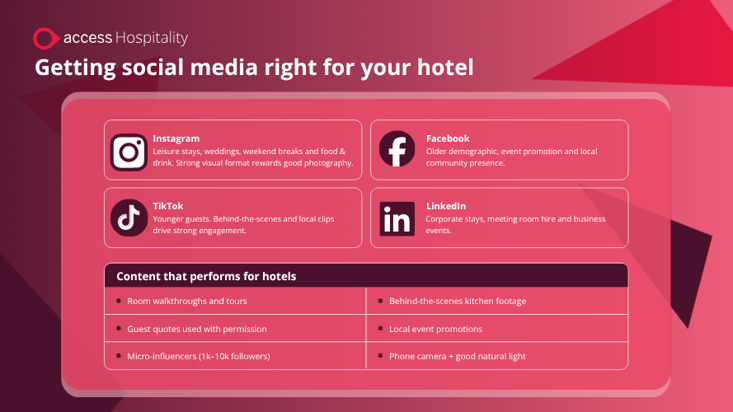
Instagram and Facebook cover the majority of guests who are looking for a leisurely hotel stay and are the obvious starting point. Instagram is strong for showing off your visual content through pictures, particularly for weddings, weekend breaks and food and drink, while Facebook steers towards the older generation and is optimised for event promotion.
TikTok is also worth exploring if you are targeting the Gen Z category, particularly with behind-the-scenes content and local clips that drive more engagement. LinkedIn makes sense if corporate stays, events or meeting room hire are part of your business, but by picking a few platforms and commit to posting on them consistently.
The kind of content that genuinely performs for hotels
Room photography, behind-the-scenes clips, local event content and guest testimonials consistently outperform polished promotional posts for hotels on social media. Honest and specific content drives the best performance as exclusive glimpses of your kitchen, pictures of your rooms, guest quotes used with permission and local event promotions all drive more direct clicks. Influencers with between 1,000 and 10,000 followers can deliver authentic reach at low cost, particularly for food and drink content, according to Catala Consulting research. You just need a decent phone camera with good light to do the job, nothing fancy or high-tech.
Put digital marketing at the centre of how your hotel grows
Digital marketing doesn’t need to be expensive or complicated to fill more rooms. Consistent local SEO, fast landing pages and a regular email campaign will do more for your hotel profits than you might expect. For your paid marketing plan, consider the impact this will have on your audiences and the results you want to see. Paid advertising isn’t cheap, so have a strong campaign behind it to target specific guest demands.
More direct bookings, less OTA dependency and a stronger online presence are achievable without overhauling your operation. Access Hospitality helps hoteliers carve out their marketing strategies by designing digital marketing tools that work in the background to save time and create a strong online presence. We’ve seen customers achieve an 185% increase in revenue over the first 6 months using our hotel digital marketing tools, helping them drive more traffic and business so teams stay focused on guests rather than admin.
Ready to reduce your reliance on OTAs and start filling rooms through your own channels? Download our free guide to see how we can help your hotel grow.