AU & NZ
 SG
SG
 MY
MY
 US
US
 IE
IE

What is an exit interview?
An exit interview is a structured conversation between an organisation and an employee who is leaving their position. The main purpose of the exit interview is to gather valuable feedback about the employee’s experience at the company. At its core, this process serves as a final opportunity to understand what drove the employee's decision to leave, identify areas for improvement within the organisation, and maintain positive relationships even as professional ties are severed. Positive relationships can lead to lasting relationships and potentially employee advocacy.
The benefit of exit interviews is that you can get an honest representation of how employees feel about the organisation. As they are departing, there’s less worry about any career repercussions. For the organisation, you can gain various insights:
- Reveal systemic issues affecting employee satisfaction
- Highlight successful management practices worth replicating
- Identify training needs for remaining staff
- Understand competitive pressures in the job market
- Refine their employee value proposition (for tips on improving your EVP, read our blog ‘Best Employee Value Proposition Examples (and free evp template)’.
Unlike performance reviews, which focus on evaluating current work and setting future goals, exit interviews centre on reflection and organisational learning. You can learn more about performance reviews in our blog, ‘How to conduct a performance review’. They're different from disciplinary meetings, which address specific issues or misconduct, and from stay interviews, which aim to retain current employees by addressing their concerns proactively.
For departing employees, exit interviews can provide closure and the opportunity to contribute to positive change in their former workplace. The positive outlook and nature of the process can provide valuable opportunities for future networking opportunities, employee advocacy, and potential re-employment. For more details on turning leavers into brand ambassadors, read our blog, ‘How to improve employee advocacy - turning leavers into brand ambassadors’.
Are exit interviews mandatory?
There’s no legal requirement in the UK for exit interviews, leaving the practice completely voluntary for both the employer and employee. Individual contractual agreements could dictate that an exit interview is required.
Many organisations incorporate exit interviews into their standard offboarding processes. In large organisations, exit interviews can play an important role, where systematic feedback collection becomes crucial for maintaining operational effectiveness.
The potential consequences of regularly skipping exit interviews can have an impact on development and employee retention. Without this feedback mechanism in place, companies may remain unaware of systemic issues affecting staff satisfaction, missing crucial opportunities to address problems before they drive additional departures. When you have an exit interview template to inform the process in place, you can gather the feedback in an organised fashion. Without this, patterns of dissatisfaction might go unnoticed, leading to repeated turnover in specific departments or roles. Furthermore, organisations lose valuable intelligence about competitive pressures, salary expectations, and market conditions that departing employees often possess. The absence of exit interviews can also signal to remaining staff that their opinions and experiences are undervalued, potentially affecting morale and engagement.
15 essential exit interview questions
Crafting the right exit interview questions requires careful consideration. To get the most impactful feedback, structure your questions to provide information that will prove most valuable for organisational improvement. The following set of questions can help you collect comprehensive feedback across key areas, including job satisfaction, management and leadership, company culture and environment, professional development opportunities, and more.
Job satisfaction
Understanding how employees felt about their role provides fundamental insights into position design and expectations management.
1. What aspects of your job did you find most fulfilling, and which elements were least satisfying?
2. Did your role align with the job description and expectations set during the recruitment process?
3. How would you describe your workload during your time here - was it manageable, overwhelming, or insufficient to keep you engaged?
4. Did you feel your contributions were appropriately recognised and valued by the organisation?
Management and leadership feedback
The quality of management significantly influences employee retention, making this area crucial for exit interview exploration.
5. How would you describe your relationship with your direct line manager, and what could they have done differently to better support you?
6. Did you receive adequate feedback and guidance on your performance, and how could this process have been improved?
7. What is your perception of senior leadership's vision and communication throughout the organisation?
Company culture and environment
Organisational culture significantly impacts employee satisfaction and retention decisions. It can also be a powerful recruitment tool as candidates want to find a company culture that aligns with personal values.
8. How would you describe the company culture, and did it align with your personal values and working style?
9. Did you feel included and valued as part of the team and broader organisation?
Professional development opportunities
Career progression concerns frequently drive departures, making this area essential for exit interview discussions.
10. Did you feel the organisation invested adequately in your skills development and training?
11. How well did the company prepare you for your next career steps, whether internally or externally?
Reasons for leaving
Carefully structured questions about departure motivations can yield surprising insights, despite being an obvious topic of discussion.
12. What were the primary factors that influenced your decision to leave?
13. Was there a particular incident, change, or realisation that prompted you to start looking for alternative employment?
Recommendations for improvement
Concluding with forward-looking questions demonstrates that feedback will be valued and potentially acted upon.
14. Based on your experience, what would you recommend the organisation focus on to improve employee satisfaction and retention?
15. If you were to advise a friend considering a position here, what would you tell them about working for this organisation?
How to conduct effective exit interviews
When you get to the stage of conducting the exit interview, it’s important to establish an environment where the departing employees feels most comfortable. With that, there’s a few considerations. If possible, give the departing employees an option of choosing who they conduct the exit interview with. For example, they may want the opportunity to speak with their line manager due to an existing relationship, or with HR to raise sensitive information and issues.
Timing is also important to consider as leaving employment can be an emotional endeavour. Best practice would place exit interviews towards the end of the notice period, once the initial emotional response to leaving has passed. Offering different formats for the process can also be beneficial. An in-person format may be daunting or not feasible for remote employees. Online format can be an easier way for employees to express their thoughts.
Perhaps most importantly, creating a comfortable and honest environment will yield the most valuable feedback. Your exit interview questions should be open-ended and not leading. Through good relationships, you can raise the prospect of employee advocacy schemes and creating brand ambassadors from your leavers. For examples of successful brand advocacy programmes, read our blog, ‘How to improve employee advocacy - turning leavers into brand ambassadors’.
Lastly, don’t forget to document the interview, ideally with an exit interview template that standardises the process. This data can then be fed into your HR system, and you can begin to spot any trends, particularly when you use a system like PeopleXD Evo, where powerful People Analytics surfaces trends.
How to analyse exit interview data and improve employee retention
Collecting exit interview feedback is only half the job. The organisations that gain the greatest value from exit interviews treat the data as an ongoing source of strategic insight rather than a one-off administrative exercise.
"Exit interviews are gold dust. If you commit to using that feedback to make changes, you'll see macro trends you'd miss otherwise. Spot patterns, drill down, and act at the right point in the employee lifecycle. AI lets you do this at scale."
Oli Quayle, AI Evangelist, The Access Group
The key to meaningful analysis is to compile a significant number of responses and identify trends, rather than focusing on individual comments. Using a consistent exit interview template ensures feedback is captured in a standardised format, making it easier to compare responses across departments, job roles, locations and time periods while maintaining employee confidentiality.
When combined within a central HR system such as Access PeopleXD Evo, exit interview feedback becomes even more valuable. AI-powered analytics and natural language search can quickly identify recurring themes, highlight frequently mentioned issues and uncover patterns that would otherwise take hours to find manually.
You can analyse both quantitative data, such as employee ratings, and qualitative feedback to identify trends around career progression, management, work-life balance, company culture or workload.
Once trends have been identified, group feedback into common themes and assess how frequently each issue occurs, how serious it is, and the potential business impact of addressing it. This enables HR teams to prioritise improvements that are most likely to strengthen employee retention and engagement.
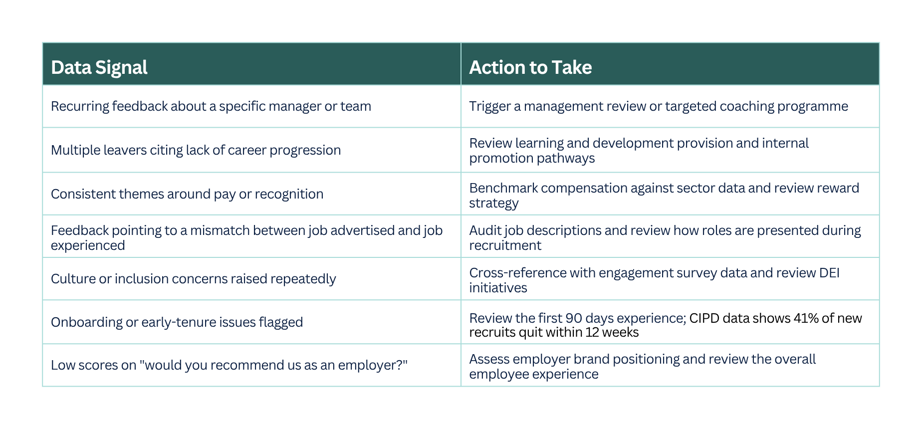
The final and most important step is acting on what you've learned. Develop measurable action plans with clear ownership, deadlines and success metrics. If communication from senior leaders is a recurring issue, introduce regular leadership updates or improve internal communication channels. If career development is driving resignations, invest in mentoring, clearer progression frameworks or additional training opportunities.
Finally, share exit interview insights with line managers, department heads and senior leadership on a regular basis. Quarterly reporting aligned with business planning cycles ensures feedback informs decisions, helping organisations continuously improve retention, workplace culture and the overall employee experience rather than allowing valuable insights to sit unused.
Set yourself up for success with our free exit interview template
To help you establish a professional and effective process from the outset, we've developed a comprehensive exit interview template that incorporates the essential exit interview questions and framework discussed throughout this guide. Our template includes structured sections for job satisfaction, management feedback, company culture, professional development, reasons for leaving, and recommendations for improvement.
By downloading it, you'll be equipped with proven questions and analysis frameworks that can be immediately applied within your organisation. This resource represents best practices from successful programmes across various industries and organisation sizes.
If you’re at the start of your journey to standardise your employee lifecycle, we have a host of other resources that may be helpful.
Perhaps you’re looking for ways to attract the best candidates with your brand; our guide to Build an employer branding strategy can help you position your company as an employer of choice.
If you’re a little further along through the cycle and you’re finding that engagement is an issue, our Employee Engagement Survey Template can help you understand what your people really need to stay motivated, loyal, and productive.
The review process in an organisation can also reveal and support growth opportunities that could otherwise be a barrier to an employee staying with you. Our Employee Performance Review Template is designed to help you conduct thorough, fair, and development-focused reviews that strengthen your team and drive results.