AU & NZ
 SG
 MY
 US
 IE


What are the new minimum wage rates from April 2027?
The apprentice rate applies to apprentices under 19 and those aged 19 or over in the first year of their apprenticeship. If an apprentice is 19 or over and has completed their first year, they’re entitled to the minimum wage for their age. For details, visit GOV.UK.
How much will the minimum wage rise add to your rota?
For every 100 paid hours at the current National Living Wage, you’ll need to budget an extra £50 in basic pay (before any additional employer National Insurance or pension contributions).
To work out the increase for your venue, take a typical week’s rota and multiply the paid hours at each affected rate by the hourly increase. Here’s an example for a restaurant with people currently paid at the minimum rates for their age.
|
Worker category |
Paid hours |
Increase per hour |
Extra weekly basic pay |
|
Aged 21 and over |
300 |
£0.50 |
£150.00 |
|
Aged 18 to 20 |
80 |
£0.42 |
£33.60 |
|
Total |
380 |
|
£183.60 |
Run the same calculation for a busy week as well as a typical one. If you run several venues, do it for each site. Once you have the basic pay figures, factor in any additional employer National Insurance, pension contributions and any pay rises you choose to make above the new minimum.
What should hospitality employers check before April?
-
Who’s due to move into a new pay band? Look ahead to birthdays and when apprentices are due to finish their first year. If you’re using a rota from earlier in the year to forecast April, make sure you use the rate each person will qualify for at the time.
-
Will the new rates narrow the gap between roles? If a team member’s new rate is close to what you pay a shift leader, decide whether to adjust the shift leader’s rate before you sign off the budget.
-
Do your shift timings still reflect when you need cover? Look at bookings and sales alongside the rota. For example, if Saturday bookings now peak later in the evening, you could start some shifts later so you have more people on the floor during the busiest part of service.
-
Are HR and payroll teams working from the same figures? If you aren’t using a system that will take care of things automatically, agree who’s updating pay rates and when, then compare a costed April rota with your payroll forecast to catch any differences before the first pay run at the new rates. For our customers, the new rates will be applied through a bulk update.
What else is changing for hospitality?
The wage rise is one part of the picture for 2027. If you’re reviewing next year’s costs and planning what your teams need to prepare for, there are a few other things worth checking.
-
Employer National Insurance. The standard employer rate stays at 15% and the annual secondary threshold stays at £5,000 for 2027/28. A higher wage bill can still mean higher contributions, so include that in your forecast alongside the increase in basic pay. See the Budget’s rates and allowances.
-
Business rates in England. The Budget announced further support from April 2027 for retail, hospitality and leisure properties. If you run more than one venue, check what each property qualifies for before you put an assumed saving into the budget. See the business rates measures in the Budget.
-
Employment rights. Alongside the Budget measures, Employment Rights Act changes are being phased in. If you rely on variable-hours staff, check how you offer shifts, how much notice you give and what happens when a shift is cancelled, so you can identify which practices may need to change as the Employment Rights Act is introduced.

How can the Hospitality People Suite help you plan for higher wage costs?
The worked example gives you a figure for one week. The next job is to turn that into rotas your site managers can use and make sure payroll has the right information when those shifts are worked. Here’s where the tools in our Hospitality People Suite fit in.
-
Build a rota and check it against demand. Auto-scheduling generates an initial rota using the rules you’ve set and historical data. Our Forecasting booster then helps you check whether that cover matches expected demand, hour by hour, using past sales, trading patterns, local events and weather. Managers can adjust shifts before publishing, with a clearer view of when they’ll need more people on the floor.
-
Keep up with changes after the rota is published. Proactive alerts flag changes in labour predictions, so managers can review the rota as the week develops. If expected demand falls or a busy period shifts, they can adjust cover before service.
-
Apply the new wage rates in bulk. The new minimum wage rates will be applied through a bulk update, saving the work of changing each affected employee’s rate individually.
-
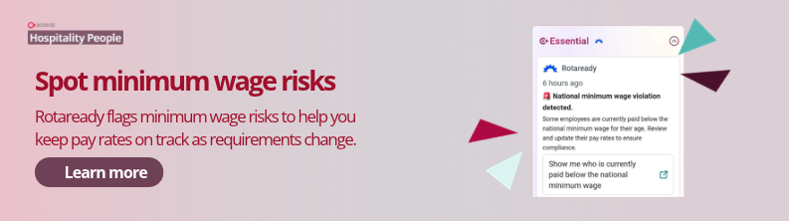
Spot when someone’s pay needs reviewing. Proactive alerts flag employees paid below the minimum wage for their age, as well as team members approaching their 18th or 21st birthday. Managers can review the affected people and update their rates in time, helping prevent underpayments.
-
Pay your team accurately for the hours they work. Approved time and attendance flows directly from Rotaready into payroll within our Hospitality People Suite, reducing manual entry and the risk of errors. You can also set overtime rules so pay is calculated consistently against the rules you’ve agreed, helping prevent overpayments and under payments.
Forecasting is incredibly easy to use and saves us roughly an hour each week. But the real value lies in how it's helped us optimise labour costs.
Since adopting Rotaready's AI feature set, we've seen labour cost reductions of around 1% in some locations. While the impact varies depending on site-specific nuances, it's been a great to have something to challenge our norms and help us make smarter scheduling decisions.
We're excited to see the continued improvements as Forecasting learns more about our business.
Plan your April rotas with confidence
Once you know what the new rates will add to your wage bill, you can work out what that means for each venue. Do you need to adjust the labour budget? Would starting a shift later give you better cover during the busiest part of service? And has payroll got the new rates ahead of the first pay run?
With our Forecasting booster, you can see how busy you’re likely to be hour by hour. It uses past sales, trading patterns, local events and weather to help you decide where you need more cover and where you can run with fewer people and on average, it improves rota accuracy by 5%.
Want to see what this could look like for your venues? Talk to our team about how you plan rotas and manage payroll today, or book a demo to see how the Hospitality People Suite can help you plan cover around demand and keep rota and pay information in sync.