

 AU & NZ
 SG
SG
 MY
MY
 US
US
 IE
IE

Is self-serve the future of candidate and client engagement?
People manage their banking, their NHS records, their pension, all without picking up the phone. Recruitment is one of the last places where a human still has to stand in for things that could easily be self-served.
Candidates and clients now expect the same self-service control they get from their bank or their GP, and agencies still running everything by email and phone call are starting to lose ground to the ones with a proper recruitment portal for agencies in place.
The UK recruitment market has raised the bar
The UK recruitment market in 2026 is more demanding than it has been in years, and the pressure is coming from multiple directions at once.
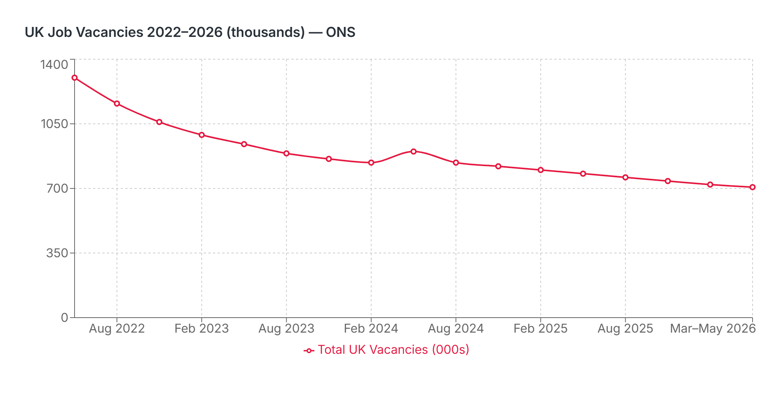
Vacancies have been falling steadily since mid-2022 and are now below pre-pandemic levels, sitting at around 707,000 in March to May 2026, down from a peak of 1.3 million four years ago. Unemployment, meanwhile, has risen to around 5%, with roughly 2.5 unemployed people competing for every open role. For agencies, that means a more crowded candidate pool, more cautious clients, and thinner margins on every placement.
The KPMG and REC UK Report on Jobs has tracked this shift month by month. Subdued market confidence and squeezed client budgets have dampened overall recruitment activity, and agencies are expected to deliver speed, quality, and flexibility with smaller teams and tighter resources. The days of a rising tide lifting all boats are over.
When the market was buoyant, agencies could differentiate on access and on who had the best candidates or could fill a role fastest. Now, with more candidates available and clients more selective about where they spend, the differentiator is shifting to the quality of the experience delivered, not just the placement itself.
Hiring managers increasingly want visibility into their pipeline without picking up the phone, and whether a candidate comes back depends as much on how they were treated as on the outcome. The agencies growing in this environment are the ones treating their service as a product.
The hidden cost of "How we've always done it'"
There's a version of this problem that looks like a people problem. Recruiters who don't communicate enough. Candidates who won't stop chasing for an update.
Look closer and the pattern is the same every time: a manual process with no visibility built in, asking a person to fill the gap. The cost lands in wasted hours and frayed trust, far from any line on a P&L.
Recruiters spend a disproportionate amount of their time acting as information intermediaries, chasing documents and relaying updates, rather than doing the relationship-building work that drives revenue.
For candidates, not knowing where they stand is corrosive to trust, and trust is the currency of recruitment. For clients, a lack of pipeline visibility creates friction exactly when they're making decisions about people who need answers quickly.
For contractors, the timesheet and compliance process is often the most painful touchpoint of all. IR35 (the tax legislation governing contractor employment status) and GDPR (the data protection law governing how personal information is stored and shared) have both added real complexity here. A single engagement can involve a status determination, right-to-work evidence, and a new timesheet and invoice every week, each one needing its own chase or approval. None of this is sustainable when margins are tight and clients have options.
What candidates and clients actually want
What people expect now is transparency, speed, and control. Candidate experience research from CareerPlug found that 58% of applicants expect a response within a week of applying, against an actual median response time of 6.7 days, and that 47% would withdraw from a process over poor communication alone.
Clients feel the same shift in their own working lives. They manage supplier relationships, legal contracts and HR systems through portals as standard, and increasingly expect their recruitment partners to offer the same. Human contact still matters, but it's best saved for the conversations that need judgement and nuance, not the ones that only need a status update. Delivering this well reads as professionalism up front. In a market where clients are comparing multiple agencies, that signal does real work.
Disconnected systems and the fragmentation trap

Many agencies have tried to solve this already, and in doing so, created a new problem.
A candidate portal bolted onto the website. A separate client portal for status updates. Timesheets running through a third system entirely. None of it talks to the CRM, and often, none of it talks to each other. Data ends up living in silos, the recruiter still has to manually reconcile information between systems, and the "portal" becomes another thing to manage rather than something that saves time.
For the end user, a fragmented experience across three disconnected logins is arguably worse than having no portal at all.
It signals disorganisation rather than the professionalism it was meant to project. The direction UK recruitment technology is moving in is consolidation: fewer, smarter tools working together as one ecosystem, not a patchwork bolted together over several years of well-intentioned fixes.
What a unified recruitment portal for agencies looks like
Picture a candidate who can log in, update their own profile, upload compliance documents and track exactly where they stand in the process, all without sending a single email to their consultant.
Picture a client who can review a shortlist, leave feedback and approve timesheets from any device, at any time, without waiting for a callback to find out what's happening.
Picture a contractor who submits their timesheet in minutes, gets it approved without a phone call, and receives payment on time.
For the agency, efficiency is only the visible half. The other half is the brand it projects. Agencies offering this level of experience stand out, particularly to clients evaluating multiple options, and the experience of working with them feels considered rather than chaotic. Size and track record used to decide who won in this market. Now it's the agencies that have made it easier to work with them, and harder to leave.
Naming the gap: What a self-service portal actually solves
A self-service portal is a hub where candidates, clients, and contractors can access information, submit documents, and track progress without needing to contact a recruiter directly. The technology's there. Candidates and clients already expect this. What's missing, in a lot of cases, is a name for it.
That's the shift already happening, whether an agency has built for it yet or not.
The moment a client decides to move on rarely happens in a review meeting. It happens somewhere much smaller: the third email chasing a shortlist, the update that lands two days late, the question that sits unanswered until someone finally picks up the phone. That's the moment worth paying attention to, the quiet one that decides things weeks before either side says so out loud.