AU & NZ
 SG
SG
 MY
MY
 US
US
 IE
IE


What are community alarm systems?
Personal and social (or community) alarm systems are often small wearable alarms , worn either as pendants or watches that enable older or more vulnerable people get the help they need when they need it.
They give people the freedom to do more and live independently for as long as possible, provide reassurance and increase confidence.
They are designed with the intention to be safe and easy to use whilst also offering family and friends reassurance and a piece of mind.
Personal alarms are important for individuals and their community because it allows individuals to remain living at home and remain independent for as long as possible.
Social alarm systems allow individuals to live their day to day lives as they choose and receive help and support when they need it.
For individuals that live on their own, or individuals that a prone to falls, community alarms offer a solution to ensure if something does happen, support will be there for them, and at speed, when needed.
This minimises the consequences of events , for example, by reducing the amount of time spent lying on the floor after a fall.
Community alarms help individuals get the support they need fast. Evidence has proven that they can be potentially life-saving especially when individuals could be suffering a stroke or heart attack. For many reasons a single press of the pendant is often simpler than dialling 999.
Highly responsive community alarms can improve the chance of a full recovery and prevent the need for further admission into hospital.
Family and friends can be reassured that loved ones will get the support they require if they need it and can be alerted when this happens so they are not left to worry.
For local authorities, community alarms help ensure delivery of more joined-up, person-centred care. Under the Care Act, it is their responsibility to ensure they deliver care that gives individuals the opportunity to be independent, prevent care needs from becoming more serious, and offer information and advice to residents to help them make positive decisions about their care.
Types of community alarms
In terms of community alarms there are a variety of types to choose from to best suit yours or your local communities needs. These may include: basic alarms, pendant alarms, fall detectors, and mobile alarms.
Basic personal alarms:
Basic alarms work by letting someone in the same home know that assistance is required.
Basic alarms normally work by making a loud noise when the button is pressed. When the alarm is set off it is heard within the home and this helps people move around independently knowing someone can help if it is needed.
Basic alarms tend to go off until the alarm is acknowledged or reset or cancelled (or the battery runs out).
Community alarms:
Community alarms work slightly differently. These alarms connect older and more vulnerable people with an emergency response centre that is staffed 24 hours a day, every day. .
The user can manually call for assistance either via the integral button on the base unit or from a worn pendant with an alarm button.
Pendants work by sending a radio signal to the base unit that calls the alarm receiving centre, typically, via a connected phone line. The staff at the emergency response centre are trained to respond to anything from falls, accidents, to bogus callers
When they are contacted the operator speaks to the user, via the base unit, to identify the issues and then triages the requirements to respond effectively. They may decide whether to call one of an individual’s trusted contacts, call a local responder service or the emergency services.
There are lots of companies that offer these alarms.
Providers may include your Local Authority, Housing Association, Social Services Department, charities and national private providers.
There are many different names for Community alarms used by service providers including
- Pendant Alarms
- Dispersed alarms
- Button and box
- Technology Enabled Care (TEC)
- Lifelines (originally a brand name, but now a generic term – like Hoover)
- Social Alarms (a reference the British Standard for Social Alarms)
Community alarms have a high degree of resilience and robustness as they are designed to be used for life critical alarms. For example, during a power failure they will continue to work as the have an integral battery backup. The pendants use a dedicated radio frequency that can’t be used by other non-alarm services.
Telecare
Telecare is another term that is used generically to describe community alarm services. Strictly speaking telecare refers to devices that can raise alarm calls automatically without the user needing to press an alarm button. Telecare devices work like pendants as they send a radio signal to the base unit to make an alarm call to the monitoring centre. Like pendants most of these devices are battery powered.
Even if the user is unable to speak with the alarm receiving centre operator during an alarm call the operator will know where the alarm call has come from, the type of alarm and will be able to organise a suitable response.
There are a large range of telecare devices that can be provided depending on a person’s needs. Telecare can detect environmental issues such as smoke and heat, Carbon Monoxide or natural gas or used for more personal care issues like bed exit, property exit or fall detection.
Mobile Alarms
Mobile alarms enable people to raise a call for help when they are out of their home. In addition to the benefits of community alarms they support people to remain active and engage in their communities.
Mobile alarms usually consist of a single alarm button and when pressed the device sends an alarm signal using a mobile phone signal, this also sends location information. The devices work in a variety of different ways. Some will notify an app used by a family member when the button is pressed, others will also provide two way speech to the users device. Some will connect to alarm receiving centre in a similar way to community alarms with two way speech calls. They all provide location information to enable an appropriate response.
Other features bundled in mobile alarms may include geo fencing, an automatic alert when some leaves a safe area/ enters a high risk area, fall detection, step and some basic health data recording.
Types of Personal and Community Alarms – The pros and cons
Type of Alarm |
Pros |
Cons |
Basic Alarm |
|
|
Community Alarm |
|
|
Telecare devices |
|
|
Mobile alarms |
|
|
The table above demonstrates a variety of pros and cons for each type of community alarm. Most, apart from a basic alarm, rely on monthly or annual payments.
Basic alarms are good and practical if you need reassurance and that people are nearby to help. Basic alarms do not tend to offer contact centre support and if the persons needs are more complex that may be a necessity for you.
Community alarms, and mobile alarms often offer two-way conversation functionality with call-centres. This helps streamline the support an individual receives by allowing alarm-receiving centres to determine the issue more quickly and decide the most appropriate response. .
In order to decide what type of alarm is best for you, your family, or your local authority, you should consider individual needs and what benefits you would like to see from using an alarm.
How much do personal alarms cost?
In general the more functionality an alarm has the more expensive it tends to be, what is important it to identify what you, your family, or your local community needs from a community alarm.
Basic alarms tend to be more affordable. The other types of alarms vary depending on the functionality they have and whether there are installation fees included or not.
The prices can also vary depending on whether community alarms are being paid for annually or monthly.
Some people are eligible for VAT relief on their community alarm service and this is often based around a disability. Please ask your provider if your are eligible. Alarms are sometimes subsidised by your local authority if meet certain requirements, for example:
- If you a physical or mental impairment that affects your ability to carry out everyday activities
- If you have a condition such as diabetes or arthritis that’s treated as chronic sickness
- You are terminally ill
So when looking for what the best community alarm is for you, it is best to check your eligibility with your local authority.

The analogue-to-digital switchover
Moving to digital with personal and community alarm systems
The UK's telephone network is being upgraded from traditional analogue landlines to new digital connections. The original target of 31 December 2025 has been extended, and Openreach has confirmed the analogue network will be retired by 31 January 2027. As of September 2023, Openreach stopped selling analogue phone lines to new customers to help prepare for this transition.
This means that community alarm base units relying on analogue telephone connections will need to be upgraded. New digital alarm hubs generally use a cellular connection via a SIM card (like a mobile phone) and do not require an existing telephone/landline connection. Some models also connect to an existing router in the home.
Why this matters for telecare providers and local authorities:
Approximately 1.7 million vulnerable people in the UK currently rely on telecare services, and typical analogue telecare alarm systems are becoming increasingly unreliable.
The migration of customers has been paused twice due to concerns about the impact on those who rely on telecare alarms, highlighting the urgency of upgrading.
Through a Charter for Network Operators signed in March 2024 (and withdrawn in March 2026) companies such as Openreach, CityFibre, and CommunityFibre agreed to commitments ensuring telecare customers have compatible solutions in place following the upgrade.
Local authorities and telecare providers are being asked to disclose which phone lines have telecare devices on them through data-sharing agreements with communications providers.
What to look for in a community alarm?
As already discussed community alarms can be available from a wide range of companies. Regardless of the type of equipment and level of the service you require, there are some key things to look for when you establish which alarm is best for your community:
- How easy is it to use?
- Is the look and feel acceptable?
- Is there an option for a local response service or will you rely on family and friends?
- Does it connect digitally?
- Is there a monthly fee?
- What is the range of the pendant? E.g. can it be used in the garden to raise an alarm call?
- Batteries – Does the alarm need charging or batteries replaced regularly?
- Who receives the alarm? Someone in the same home, an alarm receiving centre or maybe direct to a family member?
- Is the pendant waterproof? – can the user wear it in the bath or shower?
- Accessing the home in an emergency – how will help enter the home? Who holds a key? Will you need a keysafe? How much will that cost?
- False alarms – How easy is it to cancel a false alarm?
Access TEC - a full digital telecare ecosystem
At The Access Group, our technology enabled care (TEC) offering is built around two complementary solutions: Access Assure and Access Oysta.
Access Assure – Smart Home Monitoring
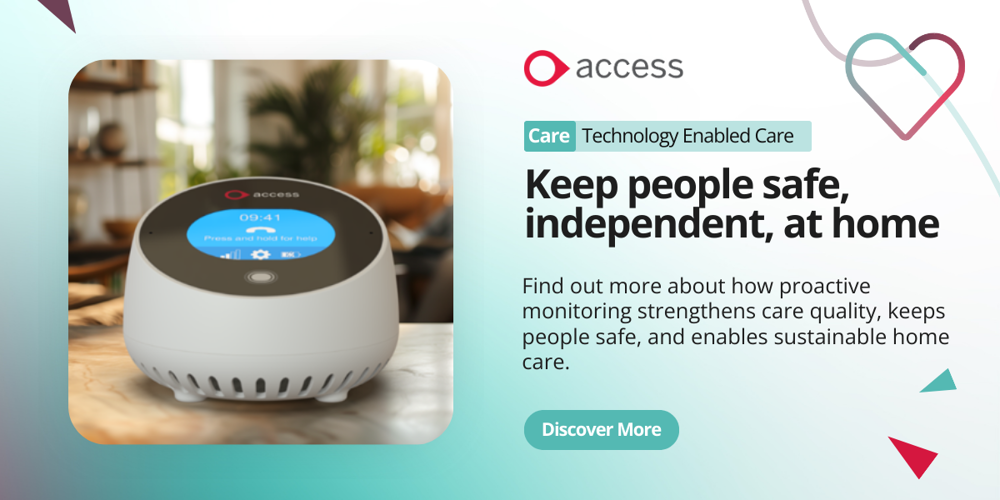
Access Assure is an award-winning, next-generation digital telecare solution. It is, by design, a full-service digital social alarm ecosystem. It uniquely combines traditional reactive alarm functionality with proactive digital monitoring of activities of daily living to support preventative and sustainable care delivery in the home.
How it works:
The Access Home Hub acts as the central gateway, collecting data from a range of paired devices including IoT sensors, telecare devices, and smart plugs, and delivering it to a secure, cloud-based machine learning analytics platform.
The platform learns individual activity patterns within 14 days, and then begins alerting carers and loved ones to any changes in those patterns, often days before something more critical happens.
Timely alerts are sent through the Access Assure app, keeping family members and the wider support and care circle in the loop.
Family members and carers can create customisable smart alert rules to specify what, when, and how to be notified, whether reassuring (e.g. 'Mum is going about her normal routine') or flagging a concern (e.g. the front door opened at night).
One-click reporting helps reduce the time spent analysing data, allowing more time for proactive, personalised care.
Integration with care planning: Smart alerts and alarm data from the Access Assure Home Hub are now visible in our care planning mobile app, giving care workers full visibility before a visit starts. This seamless communication between caregivers, healthcare professionals, and the individual ensures care services are safe, effective, and high quality.
Access Oysta – Mobile & Wearable Safety
Access Oysta helps increase confidence in individuals to live more independently both inside and outside the home, through discreet wearables that provide the reassurance that support will always be there when needed. The solutions include care and lone-worker devices, wearable GPS alarms, and sensors, allowing organisations to manage and respond efficiently to immediate and longer-term care needs.
Real-world results:
- Telford and Wrekin District enabled carers to support up to nine times more people on night supervision shifts using Oysta devices.
- Camden Council reduced hospital discharge delays, allowing individuals to return home up to three days sooner.
- Access Oysta HelpAtHome enabled patients to leave hospital sooner, saving the NHS an estimated 630 bed days, equating to £252,000 in financial savings.
Access Device Management Platform - All data from both Access Assure and Access Oysta is centralised in our cloud-based Device Management Platform, ensuring better joined-up care is delivered to improve outcomes across the care continuum.
Why choose Access TEC?
At The Access Group, we know how stressful and emotional it can be when a loved one starts to become less independent and families start to worry. It can be difficult to know what is best to do especially when they are still medical fit and are able to continue their do day-to-day activities.
We want to ensure that individuals and their families are aware of the options they have to be reassured their loved ones are doing well and following usual activity patterns.
We know that local authorities are struggling with limiting budgets, increased pressure from hospital discharge delays, and ensuring they are delivering their responsibilities under the Care Act.
In this article we wanted to ensure that local authorities, individuals, and their families, have access the all information they need about community alarms, to help them decide what type of alarm is best suited to their needs.
Community alarms remain a vital tool for supporting independence, safety, and wellbeing for older and vulnerable people across the UK. But the landscape is changing fast. With the analogue telephone network being retired by January 2027, now is the time for local authorities, housing associations, and care providers to invest in digital telecare solutions that go beyond the traditional alarm.
Access TEC, combining Access Assure and Access Oysta, offers a complete, certified, and future-proofed digital telecare ecosystem that shifts care from reactive to proactive, helping individuals live independently for longer while giving families and professionals the insight they need to act before a crisis occurs.
- TEC Quality Certified since 2019 – the only UKAS-accredited scheme for technology enabled care in the UK, meeting TSA's 10 Common Standards focused on safety, innovation, quality, and continuous improvement.
- Proactive, not just reactive – our digital insight-led approach is built to predict rather than detect, through continuous observation and with the least human effort.
- Cost-effective – Access Assure enables local authorities, acute trusts, and social care providers to help service-users meet their independent living goals at a fraction of the cost of other care alternatives, ensuring budgets spread further.
- Subscription model – scalable without significant upfront costs, with predictable budgeting and access to up-to-date technology at the end of each subscription term.
- Smooth digital transition – we ensure the switchover from analogue to digital telecare takes place with minimal disruption. In Jersey, 95% of self-funding end-users were happy to switch to our digital telecare straight away, with devices set up in as little as 25 minutes.
Our technology-enabled care offers a variety of functionality and types of hubs and wearable alarms that can best suit yours and your local community’s needs.
Discover our digital telecare and ask your provider to contact us today about our Assure service, where you can focus on increasing independence through proactive prevention based on insight, and gain positive reassurance with the safety net of a reactive emergency alarm.
Learn more about the availability of technology enabled care in your local area today.