AU & NZ
 SG
SG
 MY
MY
 US
US
 IE
IE


Throughout the day we held expert panels discussing the growth of technology through solutions like Ambient Voice Dictation, as well as delving into neighbourhood care further to see the current state of play and what needs to happen next to further implementation, before circling back to our own Rio EPR solution and how our new intelligence platform Access Evo is levelling up our software to be more helpful and more intuitive.
Ambient Voice Dictation
Our first panel of the day centred on Ambient Voice Dictation – the evolution of traditional dictation and transcription by utilising AI for better output. Access Rio Smart Notes is one such example of this, with our Smart Notes solution able to clearly identify different speakers, transcribe different languages, and make summary notes from the recording; notes that can then, pending human approval, auto-fill relevant forms as part of patient records.
Our guest speakers for the morning session were Lydia Yates, Digital Project Manager at Lancashire and South Cumbria Foundation Trust and the lead on their implementation of Access Rio Smart Notes. Joining Lydia were Daniel Whittaker, an Advanced Clinical Practitioner in a home-based treatment team for Lancashire & South Cumbria NHS Foundation Trust, and James Woollard – CCIO at Oxleas NHS Foundation Trust and National Specialty Adviser in Digital Mental Health at NHS England.
The conversation, steered by our own Laura Thompson (Director of Marketing, Healthcare), bounced between the three speakers who spoke on their experiences around ambient voice dictation and our Access Rio Smart Notes solution. James Woollard kicked things off with how Oxleas got into Smart Notes late 2024 in the pursuit of better ways of reporting patient testimony and diagnosis. For Oxleas, their staff discovery work highlighted a large proportion of the working day was being used on notation. This led to the question: how do they improve the quality of work-life for staff?
For Daniel Whittaker, he explained that as a digital champion he kind of ‘fell in’ to utilising ambient voice technology by virtue of being part of a fast-paced team that needed to optimise their rapid assessment work. Paperwork was a big hindrance for them, so AI assistance was a promising opportunity for optimising workflow.
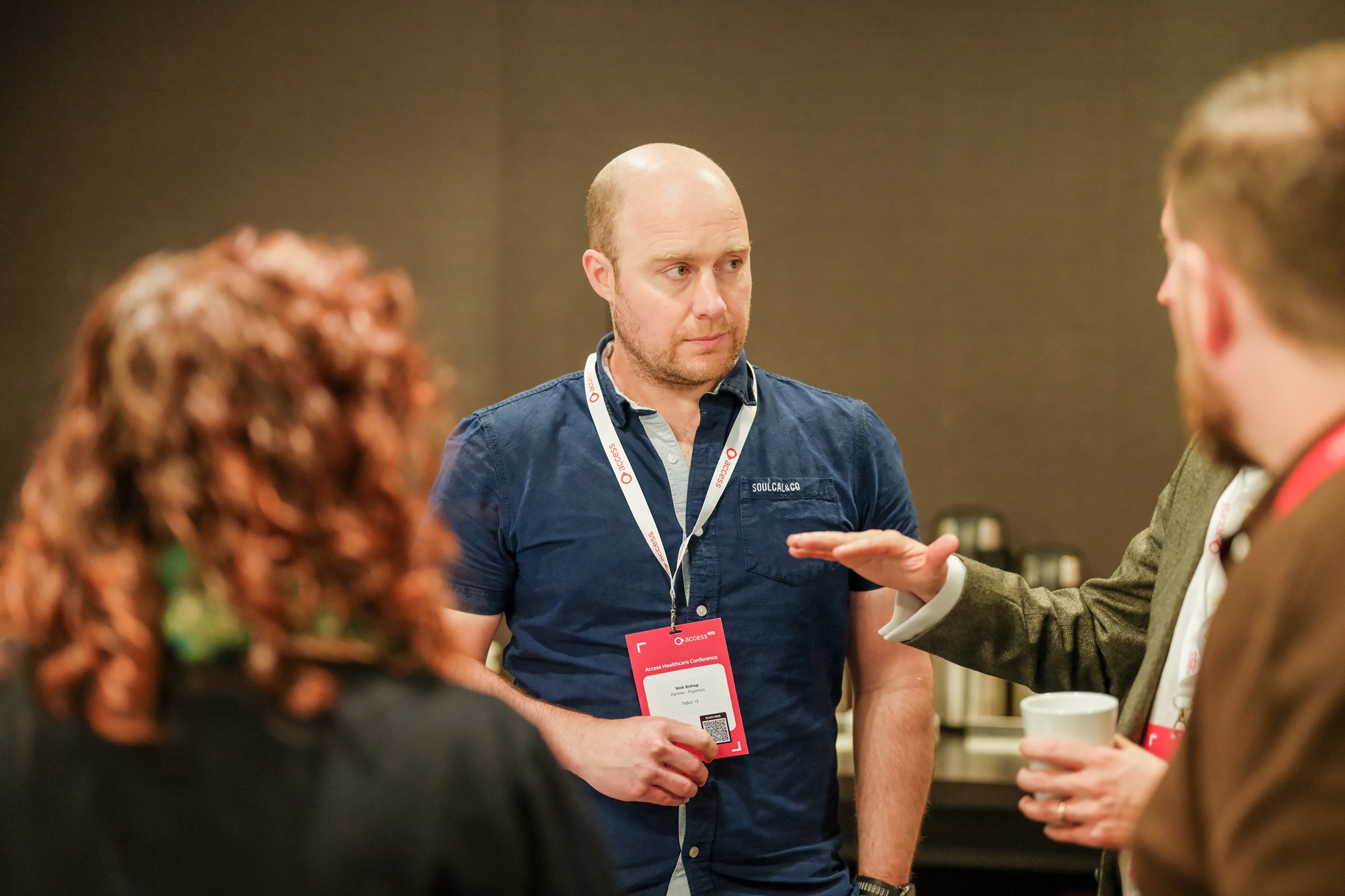
This was echoed by Lydia Yates, DPM at Lancashire and South Cumbria Foundation Trust. Lydia delved deeper on the staff support angle and explained that “Historically, digitally, we tend to just say, "There you go." And we don't include people; we just expect them to do it.”
This time round, Lancashire and South Cumbria had a pilot scheme with regular check-ins and support from Access along the way. A smaller starting point allowed them to spot the issue with outdated smartphones being used by the team – devices that wouldn’t be suitable for using apps like Rio Smart Notes. This could be addressed before wider rollout and before first impressions were damaged.
The conversation continued to work through the challenges experienced in having form fills for very different teams (physiotherapy, neurodivergency etc), as well as the change in working habits about how to record notes and when to record them. Lydia pointed to an initial nervousness around using a new solution – something common when onboarding any software – but Daniel went a step further and said that nervousness is often mistaken for a digital maturity issue and touched on how clinicians can be “really precious” about how they like to work and how they like to take notes.
That cultural shift is crucial to better engagement, because as Daniel flagged a bit later in the discussion: more usage and understanding of how ambient voice technology works for you is allowing for more personalisation of tools like Rio Smart Notes.
James Woollard also joined in on this, saying “they [clinicians] almost want the product to be perfect for them without having to do any work to make it perfect for them.” For him, digital maturity is a cultural mindset about individual engagement with technology. James believes that, as a manager, it’s on him to hold his nerve and suffer some initial hardship for the long term good.
One issue that did come up was the issue around back-to-back appointments and how there needs to be gaps to work with AVT solutions to get notes completed as soon as possible, rather than waiting until later and potentially risking the continuation of memory recollection to support the notation work, but as Daniel Whittaker said, the time save is worth it because of how labour intensive the work AND the notation combination can be. By saving time on the notes, that information and recollection is there ready to revisit, making for a quicker process and less stress worrying that you’ll miss any information.
James Woollard concluded the session with elephants: if you ask someone in the past to draw an elephant, they’ll likely do a crude job because they lack the information compared with someone now. The same applies to healthcare technology; our knowledge is lacking until we’re enlightened. We need to address the elephant in the room and talk about the benefits of ambient voice technology, artificial intelligence, and the solutions – like Access Rio Smart Notes – that can utilise these advancements and make sure we overcome the work culture hesitation, the nervousness, the AI doubts, and the digital literacy limitations.
Moving House: Our Journey to Rio
The second session of the day focussed on Hereford and Worcestershire Health and Care NHS Trust and their switch to Access Rio EPR. The panel featured Anna Evans – Deputy CCIO, Alex Somers - Digital Clinical Leader & Service Lead for Older Adult Community Mental Health Services, and Gemma Felton - Digital Clinical Innovation Administrator.
Hereford and Worcestershire is a Community and Mental Health Trust, handling children’s care, young people, and families, as well as offering specialist mental health support, primary care, and specialist physical health services. With the Trust representing two counties, they had to manage more than 4,500 users on their EPR system, as well as almost half a million patient records. These all needed moving over to Rio, and to work on deployment for five service delivery units.
HWHCT onboarded their first EPR in 2016 but suffered significant downtime in 2022. That period of disruption showed staff what functionality they relied upon, as well as leading to discussions about what more they would like from a solution, and that led the Trust to Access and eventually Rio EPR, which coincidentally went live one year ago today (at time of conference).
Anna spoke about how Hereford and Worcestershire wanted a ‘blank slate’ with Rio, so that they could build new, structured data from to ensure high quality. With that in mind, they migrated a very minimal data set: DOB, basic demographics, current GP, as well as open referrals and critical safety notes like allergies or safety concerns. Old records were still accessible as a backup, but the Trust was able to push on and build better on Rio and flesh out patient records in a way that suited their service delivery and their working habits.
One source of truth was very welcome, especially given the more recent changes and enhanced requirements around clinical safety, but so too did Rio help tackle standardisation. Anna pointed out that they had approximately 789 letter templates on their previous EPR solution. This has dropped to 13 on Rio EPR.
Alex Somers went next, exploring how his team set aside dedicated time to provide clinical expertise and input on the Rio EPR project and subsequent training – bridging the gap between clinical and digital for a more rounded solution.
“It was really important that there was a clinical voice throughout every work stream so that the comms that were sent out were really relevant to people and that [they] didn't just skip over that email and ignore it.”
This involvement also touched back on standardisation, with staff being encouraged to move away from paper record usage and basic MS Excel spreadsheets to using the new, bespoke tools. This was especially helpful for reporting and monitoring waiting lists.
Within Rio, Alex also showcased on the big screen how the Trust have developed specific service guidance documents dubbed SPAGs - service process at a glance. Key information, offered in short form with the option of further depth where necessary.
The talk rounded out with Gemma Felton, who discussed how Rio was onboarded and how Hereford and Worcestershire Health and Care NHS Trust moved away from digital ‘champions’ to a Rio rep. Staff were invited to sign up, which more than 100 people did, and it was their job to create desire in the teams by showcasing the benefits of using Access Rio.
Gemma’s team held ‘hands-on’ onboarding sessions and educated reps to provide awareness about why Rio was being implemented and the intentions of the Trust longer term regarding patient records. With the help of a bit of merchandise, the Trust gave identity to the Rio reps to encourage pride in their work and that sense of confidence in their advocacy – that they were being backed in their approach to engage with colleagues.
To date, the Trust still has 100 Rio reps a year on – proof that their approach to early engagement, training access, and encouragement has worked really well and can serve as best practice for future solution deployments.
“Users do feel confident using Rio. They've got the reassurance that work they put onto Rio won't be lost. They say that the information is clearer to read, and clinicians can quickly understand a patient's journey using the riverview function.”
Integration Across The Neighbourhood
The third of our four keynote sessions was led by Pam Kaur - Head of Digital Systems Maturity and Strategy at Midlands Partnership Foundation Trust, and Mark Goodfellow - Digital Clinical Lead at Shropshire Community Health NHS Trust.
This session focused on the Access Intelligent Care Platform (AICP); our operational improvement platform that helps link multidisciplinary teams together to ensure optimal efficiency with care delivery to support the maximum amount of people, to the highest standards, as soon as possible.
Pam’s talk focused on the shared geography between the two Trusts and how there are patients with crossover experiences, which in turn led to difficulties regarding the access of real-time information.
“It's such a pain not being able to get information when you need it at the time that you need it to make the right decisions,” said Pam. “We needed a solution to solve the following problems: fragmented information, records that are split across these two different trusts, and a real heavy reliance on manual processes and calling each other up to kind of fill those information gaps.”
This had a knock-on effect for the patient experience, with many people having to repeat their story. It’s duplicate information that’s an inefficient use of time for healthcare professionals and frustrating for the individual – potentially eroding their willingness to utilise healthcare services.
For MPFT, the adoption of AICP has improved patient safety through shared alerts, allergy information, and safeguarding notes. It has encouraged greater collaboration and more coordinated support, which has boosted staff morale because clinicians finally have the real-time information they wanted.
“What's next for us? We're going to do phase two… and looking at expanding it with forms,” says Pam. “And we want to roll it out to other services. I've got a lot of services at MPFT that are coming and knocking on the door and going, "We really want to see this product." Specifically for social care, because we've had this whole long-term problem where we can't access the social care system. We still need to document in the social care system due to legal and statutory requirements. But actually, this solution could be the answer to getting the information for our mental health staff and our social care staff.”
Mark Goodfellow followed on from Pam’s talk with a bold introduction: “We'll start with the killer quote, and that quote is that AICP has transformed children's safeguarding.”
Shropshire Community Health NHS Trust wanted a solution to be able to link together police, social care, and safeguarding with clinical documentation. One source of the truth for all. One reliable record. At present, nine different systems review information for all the above.
The existing workflow prior to AICP was to phone, leave a message for somebody, wait for them to get back, often be forced to leave a voicemail, and then they might eventually get that information. Now, Mark says, it's just a case of back to mission, checking AICP to have that information that they need at their hands, ready for that strategy meeting.
Mark highlighted how AICP helped move Shropshire away from what he calls the ‘pyramid of filtration’ and a slow trickle of information, to AICP’s approach: communication between the Trust user, site staff, and all facilitated by a digital clinician.
Rio and Evo: This is what comes next
The final talk of the day was led by Laura Thompson and Lee Meredith from The Access Group, providing fresh insights into the new Access Evo – our intelligence platform that utilises AI to enhance existing software and provide a web of connectivity between all solutions.
Lee ran the audience through Rio and Rio Evo; our EPR’s specific AI enhancements to even more intuitive and optimal working. The primary point was a reassurance that Rio Evo protects the data and configurations our customers already have, meaning no lost progress from past work and tailoring of the Rio EPR solution.
The session pushed on to explore how Access Evo, and Rio Evo, sits behind the core functionality of Rio EPR so as not to be intrusive. It’s there when needed, offering help, tutelage, and direction. There will be a new front door to using the solution, and a smarter presentation of the software, but beyond that it’s still the same great Rio application. This is particularly helpful for those with additional support needs as users, be that due to health reasons or digital literacy issues.
A key point from Laura was how NHS clinicians spend on average 13.5 hours per week on documentation; a necessary duty but a time consuming one that could be better served working with patients. Half of this time is estimated to be looking to surface information that’s buried in records, but there is the issue of offering an improvement but having staff too busy to learn the latest update and adapt. This is where clinical input matters; building software and updates that are intuitive and negate any hesitation. By not giving staff a reason to not use the newest tool, we can change the culture and encourage greater positivity about constantly improving technology.
Lee Meredith then finished the session with a Rio Evo demo, which you can see in the video above. In the run-through you can see many of the new Evo features like Navigator to see the real impact of our new platform and the benefits to come from an even more personalised app experience.

This year’s conference was a great experience to engage with our customers and showcase the huge progress The Access Group are making with Access Evo. Keep an eye out for invitations in the spring for our 2027 conference!