AU & NZ
 SG
SG
 MY
MY
 US
US
 IE
IE


According to our recent AI in Hospitality report research, hotel managers use on average 5 different systems to manage their operations, and 60% say that the data these systems produce is incomplete or even missing. If revenue managers are working with inaccurate data and an inefficient operational system, this doesn’t help them make confident decisions.
In this article, you will get a clear explanation of what RevPAR actually means, the 2 simple formulas to calculate it, guidance on what good RevPAR looks like and 5 easy steps to improve it. If you are a decision maker in your hotel revenue, this is the place you can come back to.
What does RevPAR mean in hospitality
RevPAR essentially stands for Revenue Per Available Room, but understanding what it measures and how it compares from other metrics is what makes it useful.
The RevPAR definition explained simply
Think of it like this: RevPAR measures the amount of room revenue a hotel produces for every room available in a set period of time, regardless of whether those rooms are sold or not. But most importantly, it’s slightly different from the average daily rate (ADR) which only looks at rooms that were actually occupied.
Here’s a simple example:
A hotel with 100 rooms achieving 70% occupancy at £150 ADR is performing very differently from one achieving 90% occupancy at £100 ADR, even if the guest numbers look similar. RevPAR captures that difference in a single number, so you have the whole picture at a glance.
Why RevPAR matters more than occupancy alone
High occupancy sounds like a win, and in many cases it can be. But a hotel running at 95% occupancy with deeply discounted rates can be leaving more money on the table than one running at 80% occupancy with a controlled rate strategy.
RevPAR helps you see past the occupancy figure and gives you the clarity to judge whether your pricing is actually working. It gives revenue managers a shift in perspective when they use RevPAR alongside their occupancy data to build a clearer picture, as high occupancy doesn’t necessarily mean more revenue per room.
How to calculate RevPAR using either formula
Now you know what RevPAR can do for your hotel, it’s time to calculate it. There are 2 ways to get to the same number, but we find both are useful in different operational needs.
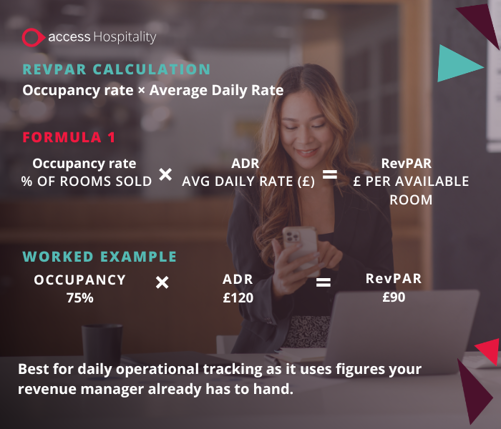
RevPAR calculation method 1
The most common RevPAR calculation is:
Occupancy rate x Average Daily Rate (ADR)
Example:
If your hotel achieves 75% occupancy one night and your ADR is £120, your RevPAR is £90. We recommend using this method for daily tracking and operational reporting because it uses figures most revenue managers already have available.
RevPAR calculation method 2
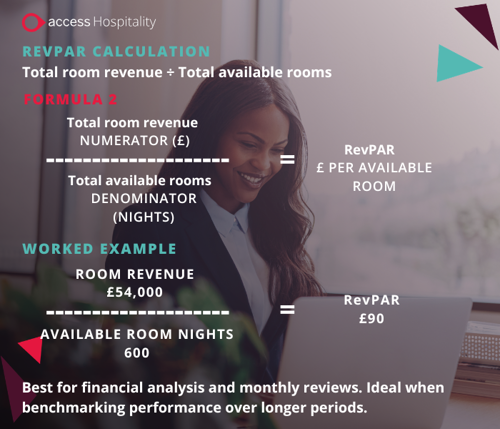
The other formula is:
Total room revenue / Total available rooms
Example:
If your hotel generates £54,000 in room revenue across a specific amount of time when you had 600 available room nights, your RevPAR is again going to be £90. We find this approach works well for financial analysis, monthly reviews and benchmarking over a longer period.
What a good RevPAR looks like for hotels
There isn’t a definitive number that demonstrates what good RevPAR looks like, but in our experience, we know that it heavily depends on your location, property size and season.
Benchmarks to have in mind
It might be hard to figure out where to start or how to measure success when it comes to your RevPAR numbers. Smaller, independent hotel properties naturally will sit at the lower end of the scale, while big groups and luxury properties may see record numbers that can’t be comparable.
But whatever size your hotel is, the benchmark we always encourage our customers to look at is their hotel’s performance over time and how that will compare to a specific competitor market that fits their scale. If you want a further insight into how you’re comparing in the industry, you can track your RevPAR index (RGI) with your RevPAR to the average of comparable hotels to get a clear picture of your revenue results.
Why RevPAR only gets you so far
The main thing to remember is that RevPAR is a room revenue metric and doesn’t capture your income from other areas of your operations like F&B, parking, events or package experiences. You might see a hotel with strong RevPAR, but if their services are poor, then they become less profitable overall than a property that has a lower RevPAR and control over their operations.
5 simple ways to increase RevPAR in your hotel
Improving your RevPAR means working closely on both occupancy and average rate. Here are 5 practical ways we see hoteliers using that makes the biggest difference to increase RevPAR.
1. Use dynamic pricing to protect the average rate
Flat or seasonal rates will see you leave revenue on the table. With dynamic pricing, you adjust room rates in time with demand or trends such as local events, booking speed and competitor availability. 3 in 4 hoteliers we asked in our recent AI report said access to consolidated, real-time data would meaningfully speed up their decision-making, which is what makes dynamic pricing work so well.
Hoteliers using a dynamic pricing strategy constantly see a stronger RevPAR, especially during busier periods when static rates can’t keep up with the pace in demand.
2. The commission drain that’s hiding in your channel mix
Every OTA booking costs you more than you might see on the invoice which reduces your net RevPAR and impacts your room revenue. Shifting even a portion of your bookings to direct channels or your own booking engine improves the revenue you retain per available room.
We suggest always tracking your distribution mix alongside RevPAR as a habit. It shows you where the financial gap is and it’s much quicker than chasing higher rates.
3. Short stays during peak periods are a hidden RevPAR killer
During high-demand periods, minimum length of stay restrictions help protect RevPAR by preventing short stays from impacting high-value and longer bookings. Reviewing cancellations and rate fence policies during sudden spikes in demand helps retain revenue that otherwise would be lost to last-minute alterations.
When revenue managers have access to real-time booking data rather than manual reports, these decisions become much faster and more confident.
4. Shoulder periods don't have to mean discounted rates
RevPAR tends to drop during quieter periods not because demand disappear, but because pricing strategies become similar. Use your hotel data to identify target audiences, whether that’s corporate travellers on a weekday or guests looking for a leisurely weekend.
Understanding your guests and what they are looking for in these lulls will help you reach the right audience at the right time and avoids them expecting discounts when peak-seasons end.
5. When revenue and operations aren't connected, guests feel it first
Improve RevPAR isn’t just a revenue management task, but it needs to consider the wider operational team. Higher occupancy puts pressure on staffing and scheduling, so adjusting accordingly to demand is important to avoid guest experiences from suffering.
Hoteliers are wasting on average 322 hours a year switching between disconnected systems, so teams are often pulling reports from one system and feeding them into another. When this amount of time is spent on manual reporting, it directly impacts RevPAR opportunities moving forward.
How connected hotel technology turns RevPAR insight into action
Manual processes and disconnected reporting slow down the decisions that drive RevPAR growth. Technology doesn’t fix all the pricing strategy headaches, but it does remove the obstacles that are in the way of creating a good one.
What your PMS needs to do to support RevPAR decisions
Most revenue decisions depend on having occupancy and rate data that is up-to-date and easy to influence. But when that data sits across multiple systems or requires manual reporting, these decisions might be made too late.
A hotel PMS that surfaces RevPAR, ADR and occupancy in one place while working alongside your booking engine and channel management, gives your team the information as and when they need it. This will enable faster and better decision-making for your pricing strategies rather than quick ones made without the bigger picture.
Forecasting and budgeting with RevPAR in mind
Setting RevPAR budgets by segment and period while tracking performance against those specific targets on a weekly basis, puts you in a strong place to identify gaps early on so you can fix it quickly. RevPAR targets should feed directly into your budgeting and forecasting strategy, so identifying where improvements need to be made before they take effect will help keep your RevPAR on track.
RevPAR is just the starting point
By reading this article, you should have a better understanding of what RevPAR is and why it matters. We’ve covered what it measures, how to calculate it and where to apply it in your revenue decisions. Knowing the number is only the beginning; understanding what drives it and having a connected system in place to act at the right time is what separates hotels that are improving their RevPAR from those that are simply tracking it.
For a complete picture of your hotel performance, we recommend sitting RevPAR alongside TRevPAR (Total Revenue Per Available Room), GOP (Gross Operating Profit) and labour cost as a percentage of revenue. RevPAR is an important starting point, but it is only one number which sits among several others that also matter.
At Access Hospitality, we work with independent and large group hoteliers to bring revenue and operational data into one place. We understand the real importance of hotel management and RevPAR metrics and how your hotel data can reveal more hidden secrets to optimise pricing strategies and revenue opportunities. Now you have knowledge about the importance of RevPAR and hotel data, why not take a look at our AI in Hospitality report that explores the hidden gaps your hotel might have without the right technology in place.