

 AU & NZ
 SG
SG
 MY
MY
 US
US
 IE
IE


Firstly, why does charity advertising matter today?
Recent UK data shows why charity advertising is now essential. According to the Advertising Association, UK charity advertising spend increased by 64% between 2021 and 2023, reflecting rising competition for public attention. At the same time, CAF’s latest UK Giving report highlights that only 50% of people give regularly, down from 58% in 2019.
The NCVO “The Road Ahead 2025” report also warns of a “perfect storm” for charities: rising demand for services, falling income, and intensified competition - making clear, compelling advertising more important than ever.
“The ongoing challenge of the cost-of-living crisis and the increase in National Insurance and minimum wage has hit charities hard. Yet there have also been big developments in digital."
- Zoe Amar, Digital Strategist and Commentator, Third Sector
So, where do you start? Charity advertising must always begin with your audience and cover all aspects of raising awareness. This can be done in multiple ways over various channels.
What should a strong charity advertising strategy include?
Your strategy should reflect:
- Who your audience is
- Where they spend time
- What motivates them
- What problem you want your advertising to solve
Include measurable targets such as increasing donations, boosting volunteer sign-ups, or raising awareness of your cause.
“We simply could not reach people and create the impact we do without the awareness generated by Ad Grants.”
– Elizabeth Hutton OBE, Kicks Count
5 ways to advertise your charity
Which charity advertising channels deliver the best results?
As charity copywriter, Jennifer Ruthe (and author of our expert guide to great fundraising copy) explains, a unified brand, consistent style and key messages that talk to your audience will always be the best way forward. Get the foundations right and you’re ready to create connections that inform, engage and inspire.
1. Use social media
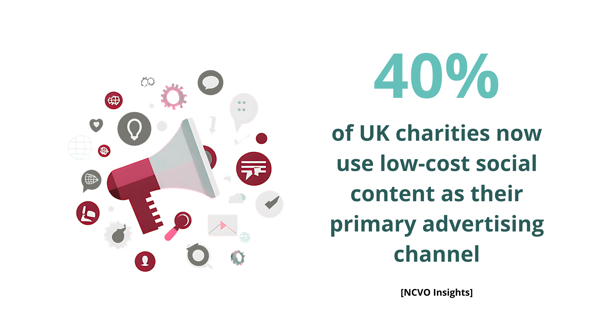
According to Data Reportal [1], over half the world’s population now uses social media.
 It's one of the most powerful tools in your charity toolkit - but don’t go into it blindly. Social media management takes time and resources, so choose the channels that match your audience, brand and purpose. There’s Facebook of course. But as the digital landscape shifts and new trends emerge, there are other options to consider as well, like:
- YouTube: A great way to share emotive charity advertising, stories and information, video content is a powerful tool that helps bring supporters and potential new donors closer to your work.
- Instagram: Use stories to capture authentic moments that spotlight your impact (don’t forget to add a donate sticker so donors can take action).
- Twitter: Join the conversation, follow and engage with like-minded organisations to build an active and online community bound by shared values.
- LinkedIn: About more than just fundraising LinkedIn is a great place to build professional networks and attract new talent for your team and board.
- TikTok: Not just for Gen Z, as its popularity grows, more and more charities are getting on board the TikTok trend.
Whichever channel (or channels) you choose, remember to keep it real, keep it social and keep it working. Just because you represent an organisation, it doesn’t mean you can’t be human. There is value in authenticity, so don’t just spray ads and asks. Use social media as a tool to build your supporter community.
Need a little inspiration? Check out our blog on ‘Social media for charities’.
2. Make the most of PR and outreach ideas for charities and non-profit organisations
We all want our five minutes of fame. It’s fine if you’ve got a big budget. But have you ever wondered how to advertise a charity and generate great PR without spending a penny? There are more ways than you might think…
Guest blogs
- Write guest blogs and opinion pieces that showcase your expertise and share success. No editor likes a thinly disguised fundraising appeal or ask - so look for opportunities where you can add real value and insight.
Press releases
- Share Press Releases for newsworthy events. It doesn’t need to be long, but it does need to pack a punch. Find your angle, write a headline that turns heads and pitch it out to relevant publications and journalists (why not use newswire tools to help spread the word?).
Get ready for awards season!
- More than just great décor, awards are fantastic PR. Third Sector, Chartered Institute of Fundraising and Charity Comms all offer their own annual calls, so make sure you’ve got their application deadlines in your calendar.
Apply for media appeals
- Bringing you news coverage and donation income, media appeals like The Guardian, The Telegraph, The Times and Radio 4 are the perfect way to get your message out there. Yes they’re competitive, but remember - you’ve got to be in it to win it.
Make the most of partners and influencers
- If you're struggling to build your brand, there is no harm in piggy-backing on someone else's. Corporate partnerships and influencers are perfect for this. Your partners will love the chance for some positive publicity, and their brand will help you to stand out. Find out more on how to get corporate partnerships for your charity.
3. Email marketing
A staple for most charities and non-profits, email marketing is a great way to stay in touch with your donors, share news, events and stories, and mobilise charity advertising campaigns and appeals.
- Just remember to keep it personal. It is all too easy to delete an email, so tailor your content and try and get on a first-name basis if you can.
- Remember to stay within the bounds of UK GDRP.
- Time your campaigns well. No one needs an email every day.
- Develop a content plan and schedule that works for your audience and uses data to drive campaign decision-making.
4. Using Google Ad Grants for Pay Per Click (PPC)
With Google holding 86% of the global search engine market (according to data published by Statista), Google Ads boost charity advertising by directing quality traffic to your site [2]. The best bit? You don’t have to spend a penny – with qualifying non-profits receiving $10,000 a month – that’s ~£95K of free digital advertising every year [3].
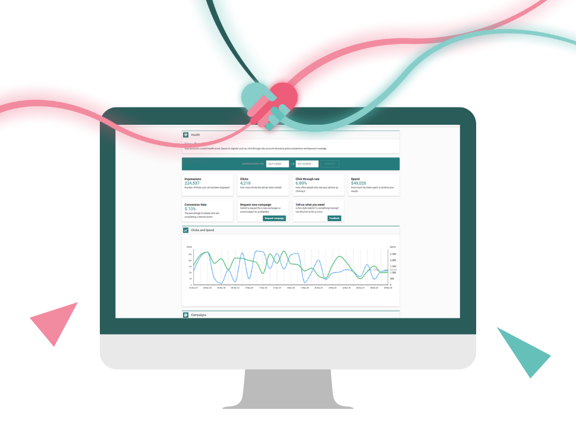
Not sure how it works? We written a guide to PPC advertising for your charity explaining the PPC process. Better yet, our Google Ad grant management tool uses artificial intelligence to optimise your campaign management (okay, so that bit isn’t free, but with organisations like Ovacome boosting their digital traffic by as much as 89%, the ROI is fantastic!). Here's an example of a Charity Ad Grants dashboard:
“Google is critical for us. Without Ad Grants, families in need might not find us. The Access team are brilliant at structuring campaigns, refreshing ads, and advising on changes in the landscape. It’s an invaluable service.”
- Jill Haines, Marketing and Communications Manager at FTCT
5. Promoting charity events
We love working with charities and non profits because there’s always something different going on. There are your core services of course, but let’s not forget all the community fundraisers, challenge events, galas, auctions and campaign appeals that run alongside.
Whether it’s the launch of a new programme or fundraiser, every event (and the run-up to it) is a touch-point for your donors, supporters and service users. Use them, and don’t be afraid to cross channels and share your message across different platforms. Take the chance to reach more people. Give them the opportunity to engage, get involved and get to know you, and word will soon start to spread.
Download our guide to organising a charity fundraising event.
How do charities know whether their advertising is working?
DATA. DATA. DATA. To quote Digital Transformation Expert and Consultant, Ian Patterson, “you cannot manage what you cannot measure”.
Running a strong charity advertising campaign means making data-driven decisions. Split test your tools and measure your performance in terms of reach, engagement, conversion and value. Without this information, you will find yourself working in the dark.
Need a torch? Our live campaign tracker will help you make real-time decisions that use your analytics and data. Whether or not you decide to team up with Access, before you go write down this simple formula: Test. Learn. Refine. Repeat. It’s just four words. But together they are the foundation for success.
External sources
- Data Reportal (2022). Global Social Media Stats.
- Statista (2021). Worldwide desktop market share of leading search engines from January 2010 to December 2021
- Google Ad Grants (2021). Let Google fuel your non-profit mission.
