AU & NZ
 SG
SG
 MY
MY
 US
US
 IE
IE


Why digital fundraising for charities is at an inflection point
The context is worth understanding.
The 2026 CAF UK Giving Report found just 55% of UK adults donated to or sponsored a charity in 2025, down from 69% in 2016. That's around six million fewer donors in a decade.
Total public giving fell by nearly 10% in a single year, from £15.4bn to £14bn.
Young people aged 16–24 are now the least active donors of any age group, and the most likely to say they're not interested in charities.
And according to the 2026 Charity Digital Skills Report, only 28% of UK charities have a digital strategy in place, while 63% say squeezed finances are the biggest barrier to their digital progress.
Mark Greer, Managing Director of the Charities Aid Foundation, was candid when the latest figures landed:
"We have been relying on a declining number of dedicated donors, but the reality of this trend has begun to bite."
But the picture isn't all headwinds. 81% of charities made digital progress over the past year despite those pressures, and CAF's research shows that when people feel genuinely engaged with a charity, they give generously. The opportunity is real; here's how to build towards it.
Start with an honest digital audit
It helps to get a clear picture of where you are, before planning where you want to go. Pull your data and ask some direct questions:
- Which channels are driving income, and which are generating activity without results?
- What's your online donor retention rate?
- What proportion of first-time online donors give again - and within what timeframe?
That last question tends to be revealing. The Manifesto Mind the Engagement Gap report found that 44% of supporters don't typically engage after their first donation. There's a significant opportunity here for charities that can improve their early-stage supporter journeys.
Your audit should also cover data infrastructure. Fragmented systems and siloed donor records make it harder to personalise, segment, or report accurately. It's a growing focus across the sector: 51% of charities say improving how they collect, manage and analyse data is a priority this year, and 38% of large charities name CRM limitations, from poor reporting to systems that don't integrate, as one of their biggest barriers to digital progress (Charity Digital Skills Report 2026).
Know why your supporters give, not just who they are
Many charity digital strategies have a good handle on who their donors are, but less clarity on why they give. But, that second piece tends to be what drives more effective fundraising.
Manifesto's research, drawn from 2,000 UK supporters, identified four needs that influence whether someone stays engaged over time:
Control and respect
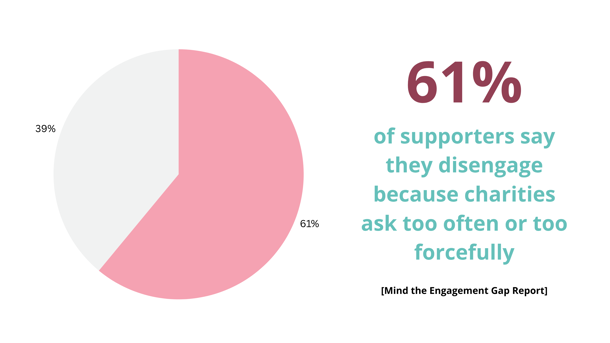
Charities sent an average of 62 emails per subscriber, a 9% year-on-year increase. Segmenting by engagement level and offering genuine channel choice can make a meaningful difference to churn rates.
Impact visibility
31% disengage if they don't know how their donation was used. Digital gives you the ability to close that loop in ways that weren't previously possible, but it's an opportunity that's still underused. If your donation page promises "your £25 could provide a week of hot meals," your post-donation journey should show what that gift achieved.
Values alignment
35% would disengage if a charity's values no longer matched their own, and 51% would stop giving if they lost trust in the charity's reputation. Your content strategy is continuously either building or eroding that trust, so it's worth being deliberate about it.
Motivation recognition
People give for deeply personal reasons. Where charities can capture motivational data at the point of first gift and use it to shape subsequent communications, they tend to see stronger long-term engagement and income.
Map your supporter journeys
A good number of digital fundraising challenges turn out to be journey problems rather than channel problems.
Consider a fairly common pattern: a supporter clicks an ad, lands on a donation page, gives, receives a generic thank-you email, then hears nothing for six weeks until the next appeal arrives. It's a series of disconnected moments rather than a coherent relationship, and it could be why first-time donors don't become second-time donors.
Mapping your key digital journeys end-to-end - from first touchpoint through to second gift and beyond - can surface where momentum stalls and where handoffs between teams create gaps.
CAF's UK Giving Report 2026 also adds to that picture: an estimated 2.8 million people cancelled a direct debit or standing order to a charity in 2025, and average monthly gifts fell from £72 to £65.
That's a retention and journey challenge, and one that becomes more addressable once you can see it clearly in the data.
Build for the channels your supporters actually use
The Manifesto research highlights a gap between how charities communicate and how supporters prefer to be contacted. Email is the preferred channel for 58% of supporters. Phone is preferred by just 1%, yet remains a widely used tactic across the sector.
Email done well - segmented, impact-led, with genuine preference controls - remains among the higher-value digital channels available to charities. A few things the data suggests about making it work:
- Social media use varies considerably by age. Preferred by 33% of 18–24-year-olds, but only 12% of those aged 65+. A single social strategy can find it difficult to serve both audiences well.
- Around two-thirds of giving is unplanned, prompted by fundraising pages, social media or collection buckets. Donation page design, mobile optimisation and checkout experience deserve investment, not just a functional minimum, because you rarely get to choose the moment someone decides to give
- Layered strategies tend to outperform single-channel approaches. Combining email, social, and matched giving periods generally produces stronger results than any one channel in isolation.
The digital fundraising strategy checklist
A strong digital fundraising strategy for charities is likely to cover:
- Digital audit - which channels perform, where journeys lose momentum, what your data can support#
- Audience insight - why supporters give, not just who they are
- Journey mapping - end-to-end visibility with gaps and friction points identified
- KPI framework - relationship quality and lifetime value alongside income metrics
- Channel strategy - considered choices about which channels to prioritise for which audiences
- Data and technology - a clear-eyed view of whether your infrastructure can deliver what your strategy needs
- Test-and-learn rhythm - regular reviews that treat strategy as a working document
Digital fundraising for charities round up
The gap between where many charities are with digital fundraising and where they could be is more strategic than financial. Teams that are making progress have tended to stop treating digital as a collection of separate tactics and started building it as a joined-up, supporter-centred experience. That shift is within reach for teams of any size.
Can Access Raise help you?
Access Raise is an all-in-one platform for charity digital fundraising, awareness and impact. Take a look.