AU & NZ
 SG
SG
 MY
MY
 US
US
 IE
IE


Social Prescribing for Children
Social prescribing for children and young people has become a policy priority. NASP has published a report outlining how social prescribing could play a greater role in supporting children and young people's mental health and wellbeing, based on extensive consultation with youth and mental health organisations, NHS leaders, Link Workers, researchers and experts, as well as young people themselves.
Social prescribing involves connecting people to non-medical activities and services that help improve their health and wellbeing - a way of tackling the root causes of mental health problems like loneliness, isolation, or problems with money, housing or addiction. For children, those root causes are often visible long before they reach a GP. They show up in the classroom. They show up in the pastoral office. They show up in the youth club on a Tuesday evening.
Research published in BMC Public Health found that pathways into social prescribing for children and young people vary significantly from the adult model - which typically utilises a primary care pathway, with referrals for children and young people coming mostly through educational institutions but also through GPs and self-referral.
Schools are already the de facto front door for children's mental health. The question is whether the system is built to receive what schools are trying to send.
The underlying problem
Connected to Thrive proposes a joined-up system in which schools, youth organisations, GP practices and hospitals would all be able to make referrals to Link Workers. Referrals to these roles often come from schools or communities, but may also come from the health system.
The vision is multi-stakeholder by design, but most social prescribing infrastructure was not built for that. It was built for primary care. A landmark study using Access Elemental data noted that most previous research had focused on small-scale local evaluation data or limited types of referrals - like just those from GP practices. The platforms, the workflows, and the reporting structures were designed around a GP making a referral to a Link Worker in the same PCN. That model works well for adults, but for children and young people it misses most of the people who can actually see the problem early.
A school pastoral lead who spots a Year 9 student struggling with isolation cannot log into EMIS Web. A youth worker who has built trust with a young person over six months cannot generate a referral through a clinical system. A hospital discharge nurse sending a teenager home after a crisis admission cannot hand off to a community Link Worker through the same channel a GP would use.
The result is that the referral either does not happen, or it happens informally; a phone call, an email, a handwritten note… with no audit trail, no outcome tracking, and no way to demonstrate impact to commissioners.
The same study found that individuals living in deprived areas, younger adults, men, and ethnic minority groups are accessing the service predominantly via non-medical routes, underscoring the importance of investing in diverse referral pathways beyond GP practices. The young people most likely to benefit from school-based social prescribing are the same young people least likely to reach a GP in the first place.
The infrastructure gap is not a minor operational detail. It is the reason the Connected to Thrive vision stalls at the point of implementation.

Levels of effect and impact
The first-order effect of expanding social prescribing for children and young people is more Link Workers, more community activities, more young people connected to support. That is the part of the conversation that gets the policy attention and the funding announcements.
The second-order effect is what happens when you try to run a multi-stakeholder referral system through infrastructure designed for a single stakeholder.
Schools, youth organisations and hospitals refer informally. Link Workers receive a mix of structured digital referrals from GPs and unstructured informal contacts from everyone else. They cannot report consistently on what they are receiving, where it is coming from, or what happens next. Commissioners cannot see the full picture either. The case for sustained funding becomes harder to make, not easier.
Research published in Frontiers in Health Services found that successful delivery depends on the capacity of Link Workers and supportive organisational structures, and that alternative pathways - including delivery outside the waitlist through schools - may facilitate implementation and impact. Facilitating those pathways requires more than goodwill, however. It requires a platform that can receive a referral from a teacher with the same reliability and auditability as a referral from a GP.
What the infrastructure needs to do
For the Connected to Thrive vision to work in practice, the referral infrastructure needs to do four things that most current deployments do not:
- Accept referrals from non-clinical stakeholders. A school pastoral lead, a youth worker, a housing officer, a hospital discharge nurse… all of them should be able to make a structured digital referral to a Link Worker without needing access to a clinical system. The Access Group's Social Prescribing guide lists referral agents as including GPs, nurses, housing officers, social workers, crisis support workers, discharge nurses, and teachers or tutors. The platform needs to reflect that reality, not just the GP-centric version of it.
- Maintain a single audit trail across all referral sources. When a young person is referred by their school in October, seen by a Link Worker in November, and then referred again by their GP in January, the system needs to know that. Without a unified record, Link Workers duplicate effort, young people repeat their story, and commissioners see fragmented data that understates the true volume of activity.
- Enable outcome tracking regardless of who made the referral. The evidence base for children and young people's social prescribing depends on being able to demonstrate what happens after a referral; not just for GP-referred young people, but for school-referred, self-referred, and community-referred young people too. Mental health is the primary reason for social prescribing referrals, accounting for approximately 34% of all cases - a figure that is almost certainly an undercount because it only captures what the current infrastructure can see.
- Support self-referral alongside professional referral. For young people, the ability to refer themselves - or to be referred by a trusted adult who is not a clinician - is not a “nice-to-have”. It is often the only realistic pathway of engagement with the system.

Access Elemental: the platform that already does this
There’s a reason we at The Access Group are writing about such an important gap in social prescribing support for children and young people. Access Elemental is the most widely adopted social prescribing platform in the UK, used by more than 20 million members of the public across England, Scotland, Wales, and Northern Ireland, involving over 37,500 health and care professionals and more than 4,400 social prescribers.
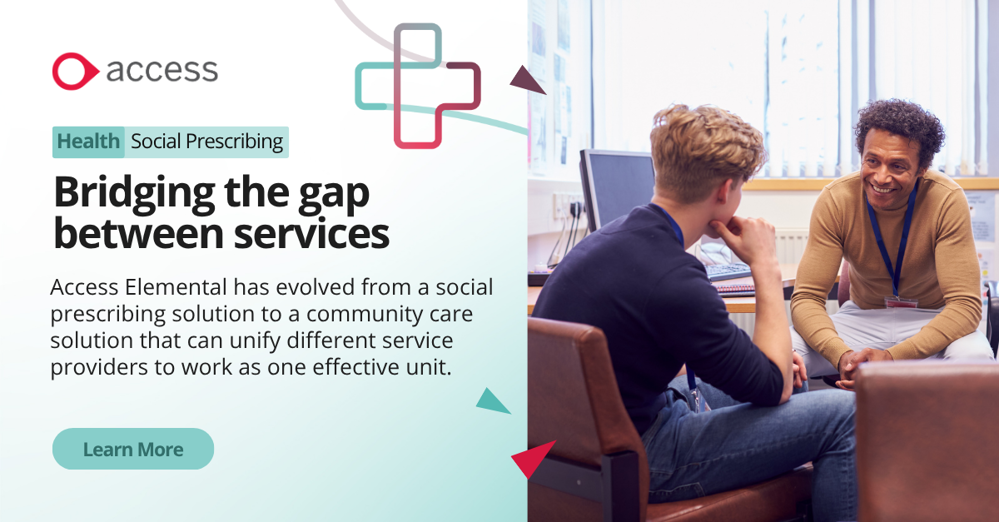
Directly relevant to the Connected to Thrive agenda is that Access Elemental was built for multi-stakeholder referral from the start. It is a cloud-based platform that fully integrates with primary care systems, secondary care systems and social care systems so that users can make, manage, and report on referrals to social prescribing, care coordination and health coaching safely and securely.
It already works with local councils, health and social care trusts, community and voluntary sector organisations, housing associations, prisons, and education organisations to co-design and deliver better community and wellbeing outcomes.
The platform can be customised depending on who is making referrals, with referrals set to be received via the standalone platform or via several clinical and in-house systems. That flexibility is exactly what a school-based referral pathway requires. A teacher does not need EMIS Web. They need a straightforward, secure way to make a structured referral that lands in the same place as a GP referral - with the same audit trail and the same outcome tracking.
As the UCL-led research using Elemental's data concluded: “By leveraging digital platforms like Access Elemental, we can ensure that non-medical referral routes are optimised to reach underserved communities, promoting equitable access to essential health and social care services.”
What needs to happen next
The Connected to Thrive vision will not be delivered by Link Worker recruitment alone. Since 2016, the number of children and young people in contact with CAMHS has expanded at over four times the pace of the psychiatry workforce. Children and young people need to be met earlier with support for their mental health, before reaching crisis point. Social prescribing is one of the most credible early-intervention mechanisms available, but it only works if the referral infrastructure matches the ambition.
Therefore, three things need to happen:
- ICBs commissioning children's social prescribing need to specify multi-stakeholder referral capability from the outset. Not as an optional add-on, but as a core requirement. If the platform cannot accept a referral from a school, it cannot deliver the Connected to Thrive model.
- Schools need to be onboarded as referral agents, not just signposting partners. There is a meaningful difference between a school that tells a young person "you could speak to a Link Worker" and a school that makes a structured digital referral that creates an audit trail, triggers a response, and feeds into outcome data. The latter requires platform access and a small amount of training. It is not a large ask.
- Outcome data needs to flow back to schools. One of the reasons school-based referral pathways remain informal is that schools rarely hear what happens after they make a referral. Closing that loop - giving pastoral leads visibility of whether the young person engaged with the Link Worker and what support they received - builds confidence in the pathway and makes future referrals more likely.

Change is needed
Staff making referrals to CAMHS often find that referral thresholds are so high, in part due to lack of service capacity, that their patients are turned away. Social prescribing is not a replacement for clinical mental health services, but for the large number of young people who do not meet CAMHS thresholds - or who are waiting months to find out whether they do - it is a meaningful alternative that can be delivered now, through infrastructure that already exists.
Access Elemental is the UK's most widely adopted social prescribing platform, supporting multi-stakeholder referral across health, social care, local authorities, and education. To find out how Access Elemental can support school-based social prescribing referral pathways in your area, get in touch with the team.