AU & NZ
 SG
SG
 MY
MY
 US
US
 IE
IE


Why do employees leave large organisations?
Resignations in large businesses are rarely caused by a single issue. More often, they stem from a combination of factors that build up over time. Understanding these drivers is essential for HR leaders who want to reduce attrition and improve employee satisfaction.
Lack of career progression opportunities
One of the most common reasons employees leave is a lack of career progression. In large organisations, it is easy for individuals to feel overlooked or stuck in their roles, especially if internal mobility is limited or unclear. When employees do not see a clear path for advancement, they are more likely to seek opportunities elsewhere.
CIPD’s workforce reporting analysis found that only 10% of FTSE 100 firms disclosed total training costs, and just 33% reported on apprenticeships. This lack of transparency may reflect limited investment in career development.
Poor management and leadership
Management quality can also impact why employees leave as employees who feel unsupported, micromanaged or undervalued by their line managers are more likely to disengage and eventually resign. Investing in leadership development and ensuring managers are equipped to support their teams can have a significant impact on retention.
The Inclusion at Work Panel highlighted that ineffective leadership and poor D&I practices can undermine employee trust and retention, especially when interventions lack evidence-based design.
Inadequate compensation and benefits
While salary alone may not keep someone in a role, feeling underpaid or lacking access to meaningful benefits can push employees to leave. Large businesses must regularly benchmark their pay structures and offer flexible, competitive benefits packages that reflect the needs of a diverse workforce. Compensation planning tools like Access Pay Planner help organisations simplify compensation planning, enabling fair, transparent pay processes and smarter salary reviews that align with company goals.
This level of transparency can foster trust and reduce any potential pay-related grievances, which can improve retention in a competitive job market.
Burnout and work-life imbalance
Burnout is increasingly cited as a reason for leaving, particularly in high-pressure environments. Long hours, unrealistic expectations and poor work-life balance can lead to chronic stress and disengagement. Offering flexible working arrangements, promoting wellbeing and managing workloads effectively are all essential to reducing burnout.
In 2023/24, 776,000 UK workers reported work-related stress, depression or anxiety, accounting for 16.4 million lost working days. The HSE reminds employers that managing stress is a legal duty under the Health and Safety at Work Act.
Cultural misalignment and lack of inclusion
Finally, cultural misalignment and a lack of inclusion can drive employees away. If individuals do not feel they belong or cannot see themselves reflected in leadership, they are less likely to stay. Building an inclusive culture where all employees feel valued and heard is not only the right thing to do, but also a powerful retention tool.

What is the cost of employee turnover in large businesses?
For large organisations, the financial impact goes beyond recruitment fees and exit interviews as every resignation carries hidden costs that affect productivity, team cohesion and long-term performance. Understanding these costs is essential for building a business case for retention investment.
Recruitment and onboarding costs
The most immediate cost is recruitment as advertising roles, paying agency fees and allocating internal resources to screen and interview candidates all add up. Once a new hire is selected, onboarding and training require time and money, often pulling experienced staff away from their own responsibilities to support the process.
While exact costs vary, CIPD’s Future Workforce Reporting found that only 1 out of 100 FTSE firms disclosed recruitment costs, suggesting that many organisations underestimate or underreport the true financial impact of turnover.
Learn more about how integrated onboarding software can support this approach.
Lost knowledge and productivity
Beyond recruitment, there can be a significant loss of productivity. It can take months for a new employee to reach full effectiveness, especially in complex roles. During this time, teams may struggle to meet targets, and service quality can suffer. In high-turnover environments, this cycle repeats frequently, creating instability and inefficiency.
When experienced employees leave, they take with them years of institutional knowledge, client relationships and process expertise. Replacing this is not straightforward, and in many cases, it cannot be fully recovered. This loss can affect innovation, decision-making and continuity across departments.
Reputation and customer experience risks
High turnover can signal internal problems to clients, partners and potential recruits. It may suggest poor management, low morale or a lack of strategic direction. In competitive markets, this perception can damage employer branding and make it harder to attract top talent.
Finally, turnover affects team morale. Remaining employees may feel overburdened, undervalued or anxious about their own future. This can lead to disengagement, further resignations and a decline in overall performance. For large businesses, the ripple effect of one departure can be felt across entire departments.
How do you calculate employee turnover?
Calculating employee turnover can help you understand workforce stability and identify trends that may signal deeper issues. For large businesses, where even small percentage changes can represent hundreds of employees, having a clear and consistent method is vital.
The most common way to calculate turnover is by using a simple formula:
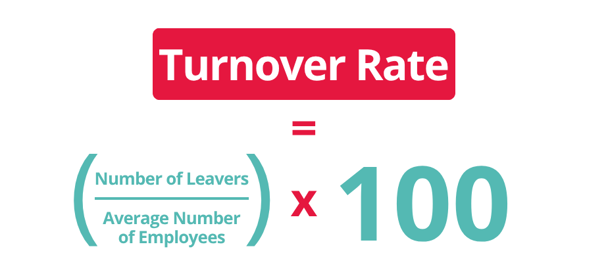
To apply this, first determine the number of employees who left during a specific period. This can be either monthly, quarterly or annually. Then, calculate the average number of employees during that same period. This average can be found by adding the number of employees at the start and end of the period, then dividing by two.
For example, if a company had 1,000 employees at the start of the year and 1,050 at the end, and 120 employees left during the year, the calculation would be:
(120 ÷ 1,025) × 100 = 11.7% annual turnover
It’s important to distinguish between voluntary and involuntary turnover. Voluntary turnover includes resignations and retirements, while involuntary turnover covers redundancies and dismissals. Tracking these separately helps HR teams understand whether turnover is driven by employee dissatisfaction or organisational restructuring.
Benchmarking your turnover rate against industry standards can also provide valuable context. According to the CIPD Labour Market Outlook – Summer 2025, the average annual turnover rate across UK organisations is 15.2%, with 9.8% attributed to voluntary exits. This marks a slight decrease from the previous year, suggesting that retention efforts may be improving across some sectors. However, turnover remains higher in industries such as hospitality, retail and care services, while professional services and manufacturing tend to report lower rates.
Large businesses may also benefit from segmenting turnover data by department, location or job level. This allows for more targeted interventions and helps identify hotspots where retention efforts should be prioritised.
The ONS Labour Market Overview shows that the UK employment rate for people aged 16–64 was 75.1% in mid-2025, with economic inactivity at 21.0%. These figures help contextualise turnover within broader workforce dynamics.
What are the most effective employee retention strategies for large businesses?
Retaining employees in large organisations relies on retention strategies that are scalable, data-driven and embedded into wider culture. The most effective way to implant these strategies is to plan proactively, engage employees, help them develop and champion inclusive practices.
Data-driven retention planning
Data in the form of workforce analytics can help businesses identify patterns in turnover, flag high-risk departments and predict which employees may be considering leaving. This allows for early intervention, whether through career conversations, workload adjustments or tailored development plans. Data also helps measure the impact of retention initiatives over time, ensuring resources are focused where they make the biggest difference.
Employee engagement programmes
Employees are more likely to stay when they feel heard and valued. Engagement tools such as pulse surveys, feedback platforms and recognition programmes help build trust and transparency. These tools also give managers real-time insights into morale and sRead the full TFG Success Story to hear about how the Access Engage platform helped TFG immediately average 150 daily logins. Alternatively, watch Episode 7: Invest in your greatest asset – your people, of our Do the Best Work of Your Life series, to hear more from Dianne and explore how to deliver an employee benefits strategy that improves wellbeing and retention and delivers business value. atisfaction, allowing them to respond quickly to emerging concerns. As Dianne Hoodless from TFG Group explains, retention is about showcasing value and building loyalty through clear communication and accessible benefits:
“Most businesses today would rather retain than recruit and for good reason. Recruitment is expensive and time-consuming. That’s why we’ve created dedicated benefit booklets to show employees exactly what’s on offer. We want to retain the talent we already have. It’s also why we’re constantly communicating and updating our benefits platform. To attract new hires, we need to be better than our competitors, and that means offering a one-stop shop for meaningful, accessible benefits.”
Read the full TFG Success Story to hear about how the Access Engage platform helped TFG immediately average 150 daily logins. Alternatively, watch Episode 7: Invest in your greatest asset – your people, of our Do the Best Work of Your Life series, to hear more from Dianne and explore how to deliver an employee benefits strategy that improves wellbeing and retention and delivers business value.
Career development and internal mobility
Career development is a major driver of retention as employees want to see a future for themselves within the organisation. Structured learning pathways, mentoring schemes and clear promotion criteria show that the business is invested in their growth. Internal mobility can encourage employees to move across departments and take on new challenges, which can impact whether they want to stay and progress.
As Zoe Wilson, Director of ReThink HR, in Episode 6: Future Proof Your People with L&D of our Do the Best Work of Your Life series put it:
“Once people get into it and see how easy and bite-sized learning can be, they start to see themselves developing, growing, and gaining opportunities to take on new projects or pursue internal moves. That’s when it becomes powerful—when employees have real stories about how learning has helped them. Celebrating those stories internally can even become part of your strategy to attract new talent.”
This highlights how personal growth and visible career pathways can energise your workforce and reinforce a culture of continuous development.
Inclusive culture and belonging
Employees who feel they belong are more engaged and less likely to leave. Inclusion should form a central part of organisational processes. This includes leadership accountability, employee resource groups and transparent reporting on diversity and equity metrics.
The 2024 Inclusion at Work Panel Report recommends replacing ineffective D&I practices with evidence-based interventions. It found that many organisations still adopt divisive or low-impact strategies, despite significant investment.
Flexible working and wellbeing support
Flexible working in the form of hybrid models is very much a part of the norm in most industries as the workforce demands it. Those models, wellbeing support, and realistic workload management can all contribute to a healthier working environment. When employees feel their wellbeing is prioritised, they are more likely to remain committed and productive. The ONS Sickness Absence Report found that 148.9 million working days were lost in 2024 due to sickness or injury, averaging 4.4 days per worker. Mental health and burnout are key contributors, especially among older and part-time workers.
Different age groups can also respond differently to strategies so tailoring them can have a greater impact; for example, Gen Z employees are often more likely to want flexible working arrangements, whereas an older cohort of employees may focus more on their pension and health benefits.
How TFG London revolutionised their employee benefits
How can large businesses retain top talent in competitive markets?
Top performers are often the first to be approached by competitors. They are highly skilled, ambitious and aware of their market value. For large businesses, retaining these individuals requires a personalised, strategic approach that recognises their contribution and supports their long-term growth.
Identifying and nurturing high-potential employees
Talent reviews, performance data and manager feedback can help pinpoint individuals who consistently exceed expectations or show leadership potential. Once identified, these employees should be offered tailored development plans, including stretch assignments, leadership training and exposure to senior decision-making. This not only builds capability but also signals investment in their future.
Personalised retention plans
Retention also depends on how well the organisation understands what motivates its top talent. While salary and benefits matter, many high performers are driven by purpose, autonomy and opportunities to innovate. Stay interviews can be a useful tool here, offering insight into what keeps these employees engaged and what might tempt them to leave. The feedback gathered should inform personalised retention plans that reflect individual goals and career aspirations.
Employer branding and EVP
When employees are proud of where they work, they are less likely to consider external offers. A strong employee value proposition (EVP) that clearly communicates the organisation’s purpose, culture and development opportunities can help reinforce loyalty. This should be visible both internally and externally, through consistent messaging across careers pages, social media and leadership communications.
Discover how to build or refine your EVP with our template which provides a structured approach to building a compelling employer brand.
Recognition
Top talent often operates at a high level without needing constant feedback, but that doesn’t mean it should be overlooked. Public recognition, strategic incentives and opportunities to lead high-impact projects can reinforce their value to the business and reduce the risk of disengagement.
For more details about how to reward and recognise your employees, read our complete guide to reward and recognition, and discover everything from setting budgets and developing a winning strategy to utilising the right forms of reward and recognition for your business and your employees.
How can you build a retention strategy that works?
A retention strategy based on a proactive, data-driven approach that addresses the root causes of employee turnover will be the most effective. From career stagnation and burnout to poor management and cultural misalignment, the challenges are complex, but solvable.
PeopleXD Evo is designed to meet these challenges head-on. As a suite solution, Evo offers multiple ways to retain people, through predictive analytics, integrated learning platforms, flexible benefits, and real-time engagement tools. It helps HR leaders move from insight to action, creating personalised retention strategies that scale across departments and locations.
If your current HR systems are holding you back, it may be time to explore the risks of sticking with outdated tools. Learn more about the problems of legacy software and how integrated platforms like PeopleXD Evo can unlock new retention potential.
And if you're considering a change, our guide on how to choose HR software can help you make the right decision for your business.
Retain your people. Reduce your costs. Reimagine your HR.
Explore what’s possible with PeopleXD Evo.