

 AU & NZ
 SG
SG
 MY
MY
 US
US
 IE
IE

What Is Earned Wage Access? A Plain-English Guide for UK Employers
Earned wage access (EWA) is a workplace benefit that lets employees withdraw a portion of the wages they've already earned, before their scheduled payday. It's not a loan: there's no interest, no credit check, and no repayment.
The employee is accessing money that already belongs to them, some platforms call this early wage access or wage access, but the mechanism is the same. That distinction is what makes EWA different from every other form of pre-payday borrowing, and it's why a growing number of UK employers are adding it as a benefit rather than treating it as a lending product.

What is earned wage access?
Earned wage access (EWA) is a workplace benefit that allows employees to withdraw a portion of wages they have already earned, before their scheduled payday. It's not a loan: there's no interest or credit check, and the amount accessed is deducted from the employee's next pay rather than repaid separately. The employee is simply accessing money that already belongs to them. That distinction matters.
With 49% of UK workers living paycheque to paycheque (ADP People At Work Report, 2025), the gap between earning money and receiving it creates real financial pressure. EWA closes that gap, not by lending employees money, but by giving them access to what they have already worked for.
Definition: what EWA means in plain English
Earned wage access at its simplest means employees can access their earned wages before payday, rather than waiting for the standard monthly or weekly pay cycle.
The term appears under several names. EWA meaning is consistent across all of them: earned wages, wage access, early wage access UK, and on-demand pay all describe the same core mechanism. The terminology varies by context: EWA is the industry and regulatory term; on-demand pay is the consumer-facing version. Both refer to the same thing.
The earned wage access definition that matters to employers is this: it is a benefit you offer your workforce, integrated with your payroll system, that gives employees real-time access to the wages they have already accrued. No advances. No debt. Designed to work alongside your existing payroll process.
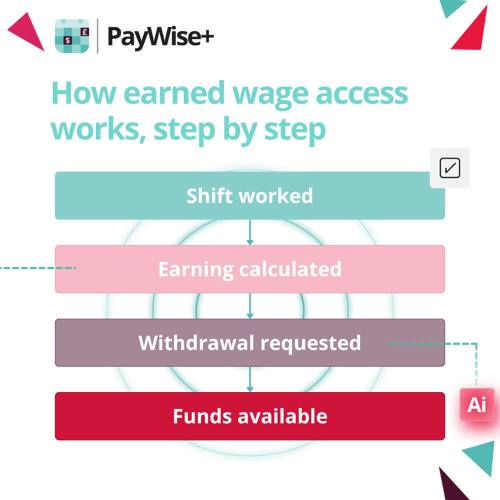
How earned wage access works, step by step
The mechanism is straightforward:
- An employee works a shift.
Their hours are logged in your payroll or workforce management system. - Earnings are calculated using payroll and/or workforce management data.
The EWA platform integrates with your payroll to calculate what the employee has earned to date. - The employee requests a withdrawal.
Through a mobile app, they choose how much of their earned wages to access, up to a set limit. - Funds are transferred to the employee.
The amount is transferred to their bank account, typically within seconds.
At the next scheduled payday, the amount already withdrawn is simply deducted from the employee's net pay. No separate repayment. No interest. The payroll cycle continues as normal.
EWA vs on-demand pay vs salary advance: terminology explained
These terms are sometimes used interchangeably, although terminology and scheme structures can vary. Earned Wage Access specifically refers to accessing wages that have already been earned before the normal payday.
Earned wage access is the industry and regulatory term, the language used in the EWA Code of Practice and in policy discussions. It is precise: the employee accesses wages they have earned, not wages they will earn.
On-demand pay is the consumer-facing term for the same mechanism. If you are reading a product page aimed at employees, you will likely see this phrase. If you are reading a regulatory document or a procurement brief, you will see EWA. They describe the same thing. For a fuller explanation, see our guide to what is on-demand pay.
Salary advance is another name for the same mechanism. In fact, the FCA officially refers to EWA providers as Employer Salary Advance Schemes (ESAS). Like EWA and on-demand pay, a salary advance is not a loan: no interest is charged, no credit check is required, and no debt is created. The employee is simply accessing wages they have already earned.
The term genuinely worth distinguishing from all three is payday loan, that's a loan against future earnings, which creates real debt and is regulated as consumer credit by the FCA.
Benefits of earned wage access for UK employers
EWA is often framed as an employee benefit, and it is. But the business case for employers is equally strong. The three areas where employers see the clearest return are retention, productivity, and recruitment.
Retention and reduced turnover
Employers using PayWise+ report a 25% reduction in staff turnover. That is not a marginal improvement, in sectors where recruitment costs run to thousands of pounds per hire, a quarter fewer than leaver represents a material saving.
The mechanism is straightforward. Access to earned wages can provide additional flexibility when employees face an unexpected cost or short-term cash-flow gap. Combined with the wider financial wellbeing offer, this can form a valuable part of an employer's retention proposition.
80% of PayWise+ users report feeling higher loyalty to their employer. Loyalty is hard to manufacture through policy. It tends to follow from feeling that your employer has your back. Offering earned wage access benefits employees in a way they notice and remember, and that translates directly into retention.
Productivity and reduced absenteeism
92% of UK employees experienced financial stress in the past year (Zellis Financial Wellbeing Report, 2025). Financial stress costs UK businesses £15.2bn annually in lost productivity. Those two figures together describe a problem that sits squarely on the employer's balance sheet, even if it rarely appears there explicitly.
Employees who are worried about money are not fully present at work. They are distracted, more likely to call in sick, and less able to focus on the task in front of them. 93% of PayWise+ users say the platform helped them navigate financial challenges which means 93% of users were less financially stressed, and therefore more able to show up and perform.
For a detailed breakdown of the productivity impact, see our analysis of the true cost of financial stress. Earned wage access for employers is not a welfare gesture. It is an operational investment with a measurable return. Deloitte research shows that for every £1 spent on well-being support; employers see a £4.70 return (Deloitte).
Recruitment advantage
54% of PayWise+ users say it is their most valued workplace benefit. Not one of their most valued, their most valued. In a hiring market where candidates compare benefit packages as carefully as salary, that is a significant differentiator.
The advantage is sharpest in sectors where shift-based work is the norm and competition for staff is intense. EWA UK employers in hospitality, health and social care, and recruitment are already using it as a headline benefit in job adverts. For employers competing for shift-based workers, EWA can provide an additional point of differentiation within the wider employee benefits package.
For sector-specific guidance, see our pages on EWA for hospitality teams, EWA for care workers and EWA for recruitment agencies.

Is earned wage access safe and regulated?
This is the question most employers ask before they commit. The short answer is yes, but it is worth understanding why, rather than taking that on trust.
Is EWA a loan? The short answer
No. Earned wage access is not a loan.
A loan involves borrowing money you do not yet have, with an obligation to repay it, usually with interest. EWA lets employees access wages they have already earned. There is no interest, no credit check, and no repayment schedule. The employee is not borrowing money. They are accessing their own earnings early.
This distinction is not just semantic. It is the reason EWA does not create a debt for the employee, does not affect their credit score, and does not create a new tax event for the employer. Earned wage access is not a marketing claim, it is an accurate description of how the product works.
FCA, HMRC and the EWA Code of Practice
Most EWA/Employer Salary Advance Schemes currently operate outside FCA credit regulation because they do not generally meet the definition of credit. Scheme structures can vary, however. Employees are not borrowing money, they are accessing wages already earned, so the regulatory framework that governs consumer credit does not apply.
That said, responsible EWA providers operate within a voluntary framework. The EWA Code of Practice, established in 2023, sets out standards for transparency, employee protection, and responsible operation. The Access Group is one of seven founding signatories of the EWA Code of Practice, a commitment to operating to the highest standards in the sector, regardless of what regulation requires.
HMRC rules allow qualifying salary advances to be reported alongside the remainder of the employee's salary at the normal payday, rather than requiring a separate FPS for each advance. Because the employee is accessing wages already earned, not receiving an advance or a loan, the tax treatment follows the normal payroll cycle. The amount accessed is simply deducted from net pay at the next scheduled payday.
Employee data and privacy
Any EWA platform requires access to payroll data to calculate real-time earnings. Employers rightly want to know how that data is handled.
PayWise+ processes payroll data in line with GDPR requirements. Data is encrypted in transit and at rest. Employees interact with the platform through a secure mobile app, and access to earnings data is limited to what is necessary to calculate and process withdrawals. No data is shared with third parties for marketing purposes.
For employers with specific data handling requirements, particularly in regulated sectors, the PayWise+ implementation team can provide a full data processing agreement as part of the onboarding process.
How to choose an earned wage access provider
Not all EWA providers are the same. The market has grown quickly, and the differences between providers, in integration capability, compliance standards, and ongoing support, are significant.
What to look for: payroll integration, compliance, support
When evaluating earned wage access providers UK, four questions cut through most of the noise:
- Does it integrate with your existing payroll?
Real-time earnings calculation requires a live connection to your payroll system. A provider that cannot integrate cleanly with your payroll will either require manual workarounds or offer a less accurate earnings calculation. Ask specifically about your payroll system, not whether they integrate with payroll in general. - Is the provider a signatory of the EWA Code of Practice?
This is the clearest signal of responsible operation. Signatories commit to transparency, fair employee terms, and responsible lending practices. It is a voluntary standard, but it is meaningful, and it is the question your legal or compliance team will ask. - What does implementation look like?
A good provider will give you a clear timeline and a named implementation contact. For businesses already using compatible Access payroll systems, existing integrations can help simplify implementation. For external payroll systems, the typical timeline is 7–14 days. - What support is available after go-live?
EWA is a live financial service. Employees will have questions. Your HR team will need support. Ask what the ongoing support model looks like, not just the implementation process.
How PayWise+ delivers earned wage access
PayWise+ is an employee financial wellbeing platform, not just an EWA tool. Earned wage access is one capability within a broader platform designed to support employees' financial health across multiple dimensions.
Alongside EWA, PayWise+ includes:
- FSCS-protected savings:
Employees can set aside a portion of their earnings directly from the app, into a protected savings account. - Penny, the AI financial coach:
Personalised guidance on budgeting, saving, and managing money, available 24/7. - Real-time earnings tracking:
Employees can see exactly what they have earned to date, at any point in the pay cycle. - Retailer discounts:
Access to savings on everyday spending, from supermarkets to utilities.
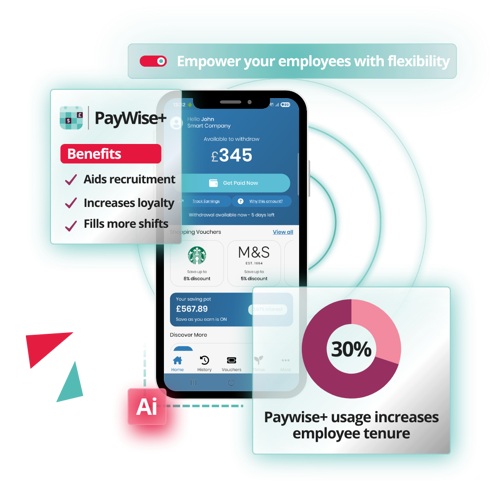
This breadth is what differentiates PayWise+ from EWA-only providers. An employee who uses PayWise+ is not just accessing wages early, they are building better financial habits, with tools that support them beyond immediate need.
Key stats: what employees say about EWA
The data from our employee financial wellbeing research is consistent across all four key measures:
- 93% of PayWise+ users say the platform helped them navigate financial challenges
- 25% reduction in staff turnover reported by employers using PayWise+
- 80% of users feel higher loyalty to their employer
- 54% say PayWise+ is their most valued workplace benefit
These are not satisfaction scores. They are operational outcomes, the kind that show up in your retention data, your absence rates, and your recruitment pipeline.
See how PayWise+ works for your team
Frequently asked questions
What is earned wage access?
Earned wage access (EWA) is a workplace benefit that gives employees access to wages they have already earned, before their scheduled payday. It is not a loan, no interest or credit check applies, and there is no separate repayment. The employee accesses money they have already worked for, and the amount is deducted from their next pay.
What does EWA mean?
EWA stands for earned wage access, a workplace benefit that gives employees flexible access to wages they have already earned, before their normal payday. It is sometimes called early wage access, on demand pay, or wage access. These terms are often used to describe the same type of benefit.
Is earned wage access a loan?
No. Earned wage access is not a loan.
Employees access wages they have already earned, there is no interest or credit check, and no separate repayment is required. It is their own money, made available before the scheduled payday. This is why EWA does not affect an employee's credit score and does not create a new tax event for the employer.
How is EWA different from on demand pay?
Earned wage access and on-demand pay are commonly used to describe the same type of benefit: employees accessing wages they've already earned before payday. EWA is the industry and regulatory term, used in the EWA Code of Practice and in policy discussions.
On-demand pay is the consumer-facing term, more commonly used in product marketing. For a full explanation, see our guide to what on-demand pay is.
How is EWA different from a salary advance?
They're not different, salary advance is another name for the same mechanism. The FCA officially refers to EWA providers as Employer Salary Advance Schemes. Both let employees access wages they've already earned, with no interest, no credit check, and no debt created.
Does earned wage access cost employers anything?
The cost of Earned Wage Access depends on the provider and commercial model. With PayWise+, commercial arrangements can vary depending on your organisation and setup. Where an employee transaction fee applies, employees are always shown the applicable fee before choosing whether to access their earned wages.
Speak to the PayWise+ team for a breakdown of the options available for your organisation.
How quickly can EWA be set up?
Setup times depend on your existing payroll or workforce management system and the requirements of your organisation. For businesses already using compatible Access systems, existing integrations can help make implementation particularly straightforward.
Our implementation team manages the technical setup and works with your HR and payroll teams through the key stages of onboarding.