

 AU & NZ
 SG
SG
 MY
MY
 US
US
 IE
IE

Employee financial wellbeing: The complete guide for UK employers
Nearly nine in ten UK employees say financial stress is affecting their work, yet most organisations still treat financial wellbeing as an afterthought. With money worries now costing UK businesses billions in lost productivity each year, building a genuine employee financial wellbeing strategy has moved from nice-to-have to business-critical.
This guide covers everything UK HR leaders and business owners need to know: what financial wellbeing actually means, the latest UK statistics, a practical five-step framework for building your strategy, and the tools and benefits, from earned wage access to AI-powered financial coaching that deliver measurable ROI.

Table of contents
- What is employee financial wellbeing?
- The three pillars of financial wellbeing at work
- Why it matters: the cost of financial stress
- Key UK financial wellbeing statistics
- How to build a financial wellbeing strategy
- Types of financial wellbeing benefits and tools
- How PayWise+ delivers financial wellbeing
- Seamless integration
- FAQs
What is employee financial wellbeing?
The Money and Pensions Service (MaPS) defines financial wellbeing as "knowing that you can pay the bills today, can deal with the unexpected, and are on track for a healthy financial future." That definition is deliberately practical. It is about control, confidence, and resilience, not wealth.
Ask most HR directors what drives employee stress and they will say workload, management, or culture. Financial pressure rarely makes the list, even though it is sitting behind all three. Employers control the single biggest variable in most people's financial lives: their income. That makes financial wellbeing an employer responsibility, whether organisations choose to treat it as one or not.
Financial resilience, in practice, means an employee can cover an unexpected £500 car repair without going into debt. It means they are not mentally calculating whether they can afford lunch while sitting in a team meeting. It means they have enough of a buffer that a delayed payslip does not trigger a crisis.
Employers sit at the centre of this picture. As the primary income provider for most working adults, the decisions an organisation makes about pay timing, benefits, and financial support have a direct bearing on whether employees reach that state or spend their working lives falling short of it.
You may also see the term "financial wellness" used interchangeably with financial wellbeing. Both refer to the same concept. "Financial wellbeing" is the UK standard; "financial wellness" is more common in US usage. This guide uses the UK convention throughout.
The three pillars of financial wellbeing at work
A complete financial wellbeing strategy addresses all three of the following:
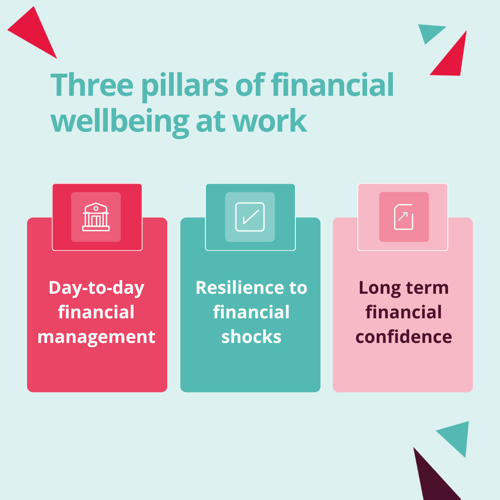
- Day-to-day financial management: The ability to budget, track spending, and meet regular financial commitments without stress. This is where most employees struggle first, and where practical tools like earned wage access and retail discounts have the most immediate impact.
- Resilience to financial shocks: The ability to absorb unexpected costs without resorting to high-interest borrowing. This is built through savings schemes, emergency funds, and access to wages already earned.
- Long-term financial confidence: The ability to plan pensions, future savings goals, and a sense that financial security is achievable. This is where financial coaching and education programmes play their part.
A programme that addresses only one pillar is a single benefit, not a financial wellbeing strategy. The distinction matters for employees, and for the business case.
Why it matters: the cost of financial stress on UK businesses
Financial stress does not stop at the office door. It walks in with your employees, takes a seat, and quietly degrades everything from concentration to decision-making, and can even influence the likelihood that someone will still be working for you in six months.
Impact on productivity and performance
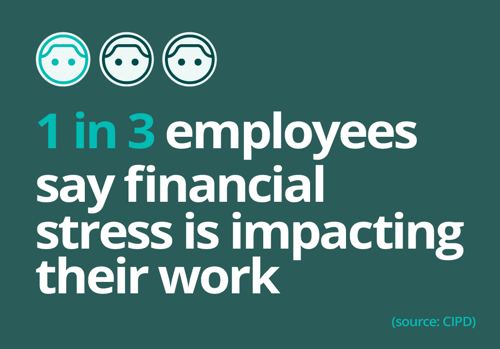
The CIPD Good Work Index 2025 found that 31% of UK employees say money worries have negatively affected their work performance. That is nearly one in three people on your payroll. They can be distracted, disengaged, or making errors because of financial anxiety, not because of the job itself.
Financial stress consumes cognitive bandwidth. When an employee is running mental calculations about whether they can cover rent, they are not fully present for the task in front of them. Concentration drops, decision quality falls and errors increase. This is presenteeism: physically at work, mentally elsewhere, and it is harder to measure than absenteeism, which makes it easier to ignore.
Deloitte research puts a number on the return: for every £1 invested in employee wellbeing support, employers see £4.70 back. That figure accounts for productivity gains, reduced absenteeism, and lower turnover costs. It’s a business case, not a marginal return.
Retention, absenteeism and presenteeism
Financial stress is the leading driver of employee stress in the UK. ADP's People at Work Report 2025 found that 49% of UK workers live paycheque to paycheque, meaning nearly half your workforce has no meaningful financial buffer. For this group, a delayed payment, an unexpected bill, or a gap between pay dates is a crisis, not an inconvenience.
Financially stressed employees take more unplanned sick days. They are more likely to be actively job-hunting, often for roles that pay marginally more, or that offer financial benefits their current employer does not. When they leave, the cost of replacing them is substantial: recruitment fees, onboarding time, and the productivity gap while a new hire gets up to speed.
Employers using PayWise+ report 25% lower staff turnover compared to pre-implementation. Applied to the average cost of replacing an employee (typically 30–50% of annual salary), that single metric represents a significant return on a relatively modest investment in financial wellbeing provision.
Financial stress costs UK businesses £10.3 billion annually in lost productivity. Most organisations absorb this cost without measuring and addressing it.
Key UK financial wellbeing statistics
-
92% of UK employees experienced financial stress in the past year (Zellis Financial Wellbeing Report, 2025). This is the baseline condition of the UK workforce, not a minority concern.
-
89% of UK employees say financial stress directly affected their work performance (Zellis, 2025). The gap between experiencing stress and it affecting performance is smaller than most employers assume.
-
49% of UK workers live paycheque to paycheque. For these employees, the fortnight before payday is a period of genuine financial anxiety.
-
31% of employees say money worries negatively affected their work performance. This figure is conservative, it captures only those who self-report a direct performance impact.
-
78% of employees contribute more at work when they feel financially confident (Zellis, 2025). The inverse of financial stress is measurably higher engagement, not neutrality.
-
59% of employees believe it is important that their employer has a financial wellbeing policy. Employees evaluate whether their employer takes this seriously, they are not passive recipients of whatever benefits are on offer.
-
54% of employees with access to financial wellbeing tools expect their finances to improve (Zellis, 2025). Access to tools changes outlook, which changes behaviour.
-
For every £1 invested in employee wellbeing support, employers see a £4.70 return. The ROI case is established. The question is whether organisations act on it.
-
Financial stress costs UK businesses £15.2 billion annually in lost productivity. This is the aggregate cost of a problem most employers are not measuring.
-
25% reduction in staff turnover reported by employers using PayWise+. Platform-level evidence of what financial wellbeing investment delivers in practice.
-
93% of PayWise+ users say the platform helps them navigate financial challenges. High adoption rates indicate genuine utility, not a benefit that sits unused.
-
80% of PayWise+ users feel higher loyalty to their employer because of the platform. This figure connects financial wellbeing investment directly to reduced churn.
-
54% of PayWise+ users say it is their most valued employee benefit. Not their most valued financial benefit, their most valued benefit across everything their employer provides.
For further details, see our employee financial wellbeing research and insights on how employers are supporting financial wellbeing in 2025.
How to build a financial wellbeing strategy
A financial wellbeing strategy is a structured approach to understanding what your employees need, choosing the right interventions, and measuring whether they work. The five steps below are designed to be actionable for an HR manager working with a realistic budget and a board that wants evidence before committing.
Step 1: Assess your employees' current financial health
Design starts with asking. Most employers skip this step. The CIPD found that only 20% of UK organisations ask employees about their financial wellbeing even once a year, which means 80% are designing programmes for a problem they have never investigated.
Start with an anonymous survey. Ask employees whether they experience financial stress, whether it affects their work, and what kind of support would be most useful. Five to eight questions is enough to establish a baseline. Keep it anonymous: employees will not answer honestly if they fear the data could be traced back to them.
Segment the results by role type, pay band, and location where possible. A salaried office worker and a shift-based care worker have different financial pressures. A programme designed for one will not serve the other. The survey data tells you where to start.
Step 2: Define your financial wellbeing goals
Before choosing a single benefit or platform, define what success looks like. Goals should connect directly to measurable business outcomes, not to abstract notions of employee happiness.
Useful goal frameworks include reduce voluntary turnover by X% over 12 months; reduce unplanned absence by X days per employee per year; improve financial wellbeing score in the annual engagement survey by X points; increase uptake of existing financial benefits from X% to Y%.
Without a baseline measurement and a defined target, you cannot measure ROI. Without measurable ROI, the programme will struggle to survive the next budget cycle. Setting goals is the mechanism that keeps financial wellbeing investment funded.
Step 3: Choose the right financial wellbeing benefits
Different workforces need different benefits. The key distinction is between quick wins and longer-term investments.
- Quick wins: Benefits that deliver immediate, tangible value to employees. Include earned wage access, retail discount programmes, and access to financial coaching. These have high uptake rates because employees see the benefit in their daily lives within days of implementation.
- Longer-term investments: Pension enhancement, save-as-you-earn schemes, and structured financial education build resilience over time. They are important, but they are not where most employees feel the impact first.
Match your benefit choices to your workforce demographics. Shift workers, frontline staff, and employees on lower incomes benefit most from earned wage access and retail discounts. Salaried employees with more financial stability may place higher value on savings schemes and coaching. A platform that combines both, like PayWise+, removes the need to choose.
Step 4: Communicate your programme effectively
The most expensive financial wellbeing programme is one your employees have never heard of. Awareness drives uptake, and uptake drives impact. A benefit that 10% of employees use delivers a fraction of the value of one that 70% use.
Effective communication channels can include:
- Induction packs for new starters (financial wellbeing benefits should be introduced on day one, not discovered months later)
- Manager briefings (line managers are the most trusted source of information for most employees)
- App notifications and in-platform messaging
- Payslip inserts for employees who are less digitally engaged
Set a communication calendar. Review uptake data quarterly. If a benefit has low adoption, the first question is not whether to replace it, it’s whether employees know it exists.
Step 5: Measure impact and ROI
A 90-day review and a 12-month review are the minimum cadence for a financial wellbeing programme. At 90 days, you are looking at uptake rates and early engagement data. At 12 months, you are comparing turnover, absenteeism, and engagement scores against your pre-implementation baseline.
Platforms like PayWise+ provide employer dashboards with anonymised usage data showing how many employees are using which features, how frequently, and what the aggregate financial impact looks like. This data is the evidence base for the next budget conversation.
Track the following metrics as a minimum:
- Benefit uptake rate by feature
- Financial stress survey scores before and after implementation
- Unplanned absence rate
- Voluntary turnover rate
- Employee engagement score (financial wellbeing module, if your survey includes one).
Types of financial wellbeing benefits and tools

The financial wellbeing benefits market has matured significantly in the past five years. What was once a choice between a pension and an EAP is now a spectrum of tools addressing every dimension of financial health. This section covers the three categories that matter most, and what to look for in each.
Earned wage access (on-demand pay)
Earned wage access (EWA), also called on-demand pay, allows employees to withdraw a portion of wages they have already earned before their scheduled payday. Employees access wages already earned, with no interest or credit check; the payroll deduction is automatic at month end. The employer's payroll process is unchanged.
The mechanics are straightforward: an employee works a shift, the hours are recorded, and a portion of the resulting pay (typically up to 50%) becomes available to withdraw via an app. At month end, the payroll deduction is automatic.
EWA is a different thing entirely from payday loans and salary advances. Payday loans carry interest rates that can exceed 1,000% APR. Salary advances are discretionary, require manager approval, and carry an implicit stigma. EWA is a structural change to how pay works, one that gives employees control without creating debt. For a detailed comparison, see which on-demand pay provider is best for your business.
PayWise+ includes earned wage access as a core feature, with withdrawals available up to 50% of earned wages, no interest charged, and no additional payroll administration for employers.
AI-powered financial wellbeing guidance
Static financial education such as a PDF guide, a one-off webinar or a link to a money advice website has a poor track record of helping employees. Employees engage with it once, if at all, and the impact fades quickly. Generic advice does not connect to an individual's specific financial situation.
AI-powered financial coaching changes this. Penny, our AI financial tool, provides a confidential space for employees to ask financial wellbeing questions, receive general guidance and be signposted to relevant tools and support where appropriate. That specificity is what drives behaviour change. To understand more on how PayWise+ works for your people, visit the employees page.
Savings schemes, financial education and retail discounts
Save-as-you-earn schemes allow employees to set aside a portion of their pay into a protected savings pot before it reaches their current account. FSCS protection up to £120,000 means the savings are secure. The automatic deduction mechanism removes the friction that prevents most people from saving.
Pension enhancement beyond the auto-enrolment minimum is one of the most tax-efficient financial wellbeing benefits available. For employees who can afford to contribute more, employer matching above the statutory minimum is a powerful incentive and a meaningful long-term financial benefit.
Financial education programmes such as webinars and e-learning modules address the knowledge gap that underlies many financial decisions. Employees who understand how pensions work, how to build an emergency fund, and how to manage debt are better equipped to improve their financial resilience over time.
Employee Assistance Programmes (EAPs) with financial counselling provide access to qualified advisers for employees facing acute financial difficulty. This is the safety net layer, important but most effective when combined with the preventative tools above.
Retail discount programmes deliver immediate, tangible savings on everyday spending such as groceries, fuel, utilities, and leisure. For employees on lower incomes, a 5–10% saving on a weekly supermarket shop is a meaningful financial benefit they notice every week.
How PayWise+ delivers complete employee financial wellbeing
Everything covered in this guide, the three pillars, the five-step strategy, the range of benefit types, is what PayWise+ was built to deliver: a single, integrated platform rather than a collection of separate products.
Platform features: EWA, savings, AI coaching, earnings tracking
PayWise+ is a financial wellbeing platform built for the realities of frontline and shift-based work, the workforces where financial stress is highest, and where the gap between payday and financial need is most acute.
Instant earned wage access
Employees can withdraw up to 50% of wages already earned, at any point in the pay period, with no interest and no additional payroll administration for employers. The withdrawal is available within minutes. The payroll deduction is automatic at month end.
Save-as-you-earn with FSCS protection
Employees can set a savings target and a regular contribution amount. The money is deducted before it reaches their current account, removing the friction that prevents most people from saving. Savings are FSCS-protected up to £120,000.
AI-driven financial guidance
Penny provides employees with a confidential space to ask financial wellbeing questions, receive general guidance and be signposted to relevant support and resources where appropriate.
Live earnings tracking
Employees can see an up-to-date view of their earned pay in the current pay period, at any time. Knowing what is coming reduces the anxiety that drives financial stress for employees living close to their financial limits.
For a full overview of the platform, visit the PayWise+ employer page.
"PayWise+ has transformed how our employees feel about their financial security. The on-demand pay feature alone has reduced financial stress significantly, and we've seen a marked improvement in staff retention."
Seamless integration with Access payroll and HR systems
For businesses already running on Access payroll systems, PayWise+ implementation is measured in hours, not days. The platform connects natively with Access payroll, rota, POS, and care management systems. PayWise+ handles employee onboarding automatically via the existing payroll data feed with no manual data entry, no parallel system to maintain, no IT project to manage.
For businesses using third-party payroll providers, the PayWise+ team works directly with your payroll partner to establish the integration. Contact the team to discuss options and timelines.
Ready to see PayWise+ in action?
FAQs
What is the difference between financial wellbeing and financial wellness?
Financial wellbeing and financial wellness refer to the same concept. "Financial wellbeing" is the standard term in UK usage, adopted by the Money and Pensions Service, the CIPD, and most UK employers and regulators. "Financial wellness" is more common in US contexts. If you encounter both terms in research or supplier materials, treat them as interchangeable. This guide uses "financial wellbeing" throughout, in line with UK convention.
How does financial stress affect employee productivity?
Financial stress reduces concentration, increases the frequency of errors, and drives both absenteeism and presenteeism; the state of being physically present at work while mentally disengaged. The mechanism is cognitive: financial anxiety consumes working memory and attention, leaving less capacity for the task at hand. The result is lower output quality, slower decision-making, and higher error rates all of which have a measurable cost to the business.
Is earned wage access a loan?
No. Earned wage access allows employees to withdraw wages they have already earned. There is no interest, no repayment schedule, and no credit check. The amount withdrawn is deducted automatically from the employee's next payslip, in the same way that a tax deduction or pension contribution is processed. EWA is a different thing entirely from a payday loan (which charges interest, often at very high rates) and from a salary advance (which is discretionary and requires manager approval).
What financial wellbeing benefits are most valued by employees?
Research shows that practical, day-to-day benefits drive the highest employee engagement. Earned wage access, retail discounts, and AI-powered financial coaching rank above traditional perks such as gym memberships in employee surveys. Benefits that address immediate financial pressure (the gap between payday and need) are valued more highly than benefits that address longer-term financial goals, at least in the short term. A complete financial wellbeing programme addresses both, but the quick wins are what drive initial uptake and employee trust in the programme.
How do I measure the ROI of a financial wellbeing programme?
Measure ROI by comparing turnover, absenteeism, and engagement scores before and after implementation. Set a 90-day review to assess early uptake and engagement data, and a 12-month review to compare the business metrics that matter: voluntary turnover rate, unplanned absence days per employee, and financial wellbeing scores in your annual engagement survey. Platforms like PayWise+ provide employer dashboards with anonymised usage data, which gives you the evidence base for the next budget conversation.
How quickly can we implement a financial wellbeing platform?
For businesses already using Access payroll systems, PayWise+ completes full integration within hours. PayWise+ handles employee onboarding automatically via the existing payroll data feed, so no manual setup is required at the employee level. For businesses using other payroll providers, your payroll system determines the timeline. The PayWise+ team works directly with your payroll partner to establish the integration. Contact the team to discuss your specific setup and expected timelines.
Does PayWise+ integrate with our existing payroll system?
PayWise+ integrates natively with Access payroll, rota, POS, and care management systems. For businesses using third-party payroll providers, the PayWise+ team works with your payroll partner to establish the connection. The integration approach and timeline will depend on your payroll system. Contact the PayWise+ team to discuss your specific situation and what implementation would look like for your organisation.