AU & NZ
 SG
SG
 MY
MY
 US
US
 IE
IE


Why does charity digital strategy matter more than ever?
Digital isn’t a bolt-on anymore. It’s how supporters find you, understand your work, donate, volunteer and stay connected - often all in the same journey.
And yet, many charities are still navigating digital without a clear map.
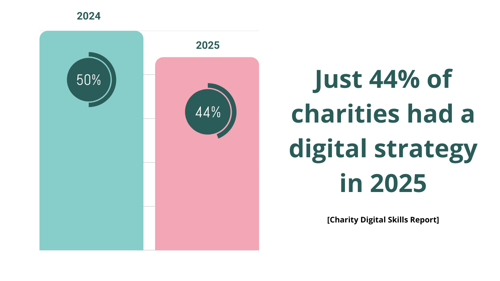 According to the latest Charity Digital’s Skills Report, just 44% of charities had a digital strategy in
place in 2025, down from 50% the year before. The picture is mixed:
- 63% of charities made progress with digital in 2025, compared to 76% in 2024
- 74% say digital is a medium or high priority
- 49% list developing a digital, data or AI strategy as a key focus
Perhaps most surprisingly, 35% of charities say they’re poor at digital fundraising, while 27% don’t do digital fundraising at all - despite attracting donations (52%) and improving digital communications and fundraising (51%) being among top priorities.
As Charity Digital puts it:
“Now more than ever, the sector needs co-ordinated support from support organisations to ensure responsible and impactful digital transformation.”
So, a clear charity digital strategy matters, and it's not easy to do alone. We hope this quick guide helps you make sense of what to focus on, and gives you a practical starting point.
What do we mean by a charity digital strategy?
A charity digital strategy is your plan for how digital supports your amazing mission. It doesn't just stop at being a digital marketing strategy for charities - it brings together digital fundraising, communications, marketing, data and supporter experience into a clear, joined-up direction.
It’s not - or shouldn't be - a long document that gathers dust. And it’s not about doing everything, everywhere, all at once.
At its best, a charity digital strategy helps you:
- Set clear priorities
- Focus limited time and budgets
- Make informed decisions
- Measure what’s actually working
Your digital marketing strategy for charities sits within this - shaping how you attract, engage and retain supporters across channels.
What are the four steps to success?
Step 1: before you look ahead, look back
Before steaming ahead to 2026, take time to think about previous months. Ask:
- Which digital activities delivered results last year?
- Where did engagement or income grow?
- What took effort but didn’t quite land?
This doesn’t need to be a heavyweight exercise. Reviewing website traffic, email performance, campaign results and online donations can quickly highlight what’s worth building on - and what’s not.
Reflection gives your charity digital strategy a realistic starting point, rooted in evidence rather than assumption.
Step 2: set clear, outcome-focused goals
Strong charity digital strategies are driven by outcomes, not activity. If a goal can’t be measured, it’s much harder to prioritise.
Instead of goals like “improve our digital presence”, focus on what success actually looks like:
- Increase online donations
- Grow your email list
- Improve campaign conversion rates
- Increase repeat giving or supporter retention
This is where your digital marketing strategy for charities plays a vital role - supporting awareness and engagement goals that feed directly into fundraising and long-term impact.
Step 3: understand your supporters
Effective digital strategy actually starts with people, not platforms.
- Who are your key audiences?
- What motivates them to support you?
- How do they prefer to hear from you?
Using real data - from donation history, campaign engagement or email interactions - helps you build clearer supporter profiles. These insights make it much easier to choose the right channels, messages and timing.
When you understand your supporters, your charity digital strategy becomes simpler, more focused and more human.

Start with the data you already have.
Your CRM is often the best place to begin here, giving you a clear view of supporter behaviour over time. Platforms built specifically for digital fundraising and campaigning, like Access Raise, can also help you understand how supporters engage with online campaigns - so your strategy is informed by evidence, not guesswork.
Step 4: focus on the channels that matter
Not every charity needs to be everywhere! A well-balanced charity digital strategy might include:
- A charity-specific website that clearly communicates impact and makes giving easy
- Email marketing to build long-term supporter relationships
- Social media channels that genuinely engage your audience
- Digital fundraising campaigns that are measurable and repeatable
Your digital marketing strategy for charities should support your wider organisational goals, not compete with them for attention or resource.
Quick self assessment:
With the above in mind, where are you at the moment? What have you already done? You don’t need to tick every box - this is about spotting gaps, not scoring yourself.
Reflect
| We’ve reviewed last year’s digital activity and results | |
| We know which campaigns or channels performed best | |
| We’ve identified what took effort without delivering impact |
Set outcomes
| We have clear digital goals linked to fundraising or engagement | |
| At least some of these goals are measurable | |
| We know what “success” looks like this year |
Understand supporters
| We can describe our key supporter audiences | |
| We understand what motivates them to engage or donate | |
| We use data (not just assumptions) to inform decisions |
Focus effort
| We’ve agreed which channels matter most right now | |
| We’re not trying to do everything at once | |
| Our digital activity supports wider organisational priorities |
If you can tick most of these, you already have the foundations of a strong charity digital strategy - even if it isn’t written down yet!
What makes a good charity digital strategy structure?
If you do want something written - and we recommend you do - then this simple structure keeps things practical and proportionate. It works just as well as a 3-page document as it does a slide deck, too.
1. Purpose and priorities
- Why digital matters to your charity
- What you’re trying to achieve this year
2. Where you are now
- What’s working well
- What’s not
- Key insights from last year’s activity
3. Your supporters
- Key audiences
- Motivations and behaviours
- How they currently engage with you
4. Focus areas
- Priority channels or campaigns
- What you’ll invest time and budget in
- What you’re not focusing on (just as important)
5. Measures of success
- How you’ll track progress
- What you’ll review and when
Don't forget, your strategy doesn’t have to be perfect or permanent. It should evolve as your charity, supporters and resources change.
Charity digital strategy in action

With a small team and growing digital demands, the Fashion & Textile Children’s Trust knew they needed to be more intentional about how digital supported their work. Instead of trying to do everything at once, they prioritised clarity, focusing on how people find the charity, access support, and engage as supporters.
This shift helped the team move from reactive activity to a more confident, joined-up charity digital strategy. As part of that journey, they brought key digital journeys together using Access Raise and made better use of Access Charity Ad Grants to drive relevant traffic to priority pages.
The result is a digital presence that works harder for a small team - supporting families more effectively, improving engagement, and creating a stronger foundation for future growth. It also shows that small charities can punch above their weight with the right support and tools.
“Our website is everything to us. We don’t have a centre for families to visit, so it is our charity.”
— Jill Haines, Marketing & Communications Manager
Bringing it all together
A confident charity digital strategy doesn’t need to be complex or resource-heavy. It just needs to be clear, realistic and rooted in what matters most to your organisation and your supporters.
By reflecting on what’s worked, setting meaningful goals, understanding your audiences and focusing your efforts, you can build a digital approach that supports your mission, not overwhelms it.
Want practical support with website strategy and digital fundraising?
If you’re thinking about how to bring your digital ambitions to life - from website strategy and content planning, to SEO and digital fundraising optimisation - our charity software experts can help.