AU & NZ
 SG
SG
 MY
MY
 US
US
 IE
IE


DATA & DIGITAL - Keynote: The use of digital in prevention and early intervention
“having that joined-up care from primary to secondary… is really powerful”
The very first talk of the day was at 9am sharp on the Data & Digital stage, with an hour-long session between:
- Paul Jones, Chief Digital Information Officer, Leeds Teaching Hospitals NHS Trust and host of the keynote session;
- Esther Provins, Chief Data, Digital and Registration Officer, Care Quality Commission;
- Ayub Bhayat, Director of Data Services and Deputy Chief Data and Analytics Officer, NHSE; and
- Eric Gardiner, Chief Finance Officer and Deputy CEO, North Staffordshire Combined Healthcare NHS Trust
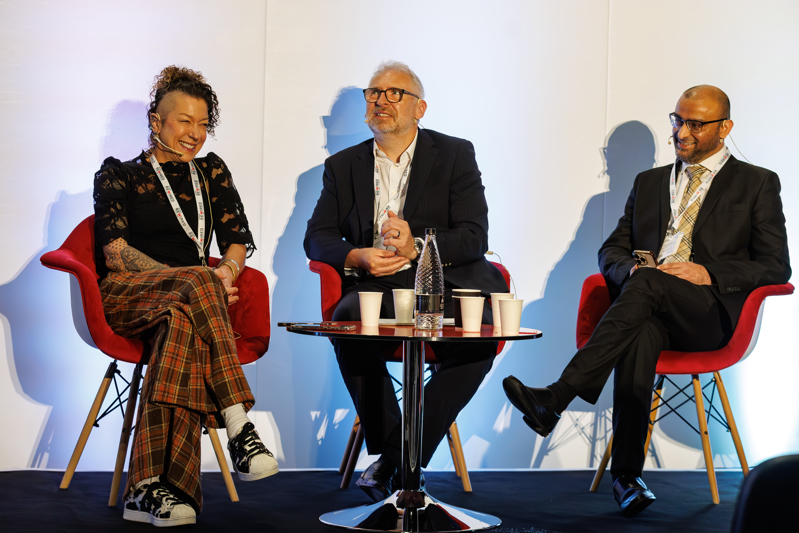
Esther Provins of the CQC ran through the organisation’s push for prevention and early intervention, speaking about their evolving regulatory role and areas of missed opportunities for the CQC – like event care and cosmetics – and how the Commission would be returning to sector-based frameworks in the future to better support care providers in meeting high standards.
Eric Gardiner of North Staffordshire Combined Healthcare NHS Trust followed on, providing insights on North Staffs’ data platform and the benefits of near-real time insights on performance. Eric explained how mental health is a big issue due to Stoke’s deprivation, and in his own words: “having that joined-up care from primary to secondary… is really powerful”.
Ayub Bhayat, Director of Data Services and Deputy Chief Data and Analytics Officer at NHS England talked about how “too often clinicians don’t have the data in front of them”. National reporting dashboards within PowerBI have helped alignment of reporting standards, but Ayub went on to say that “A transformed model of care isn’t going to be achieved by technology alone” and suggested that more needs to be done with both the NHS App and the Single Patient Record.
INTEGRATED CARE - Keynote: Achieving the digitalisation of healthcare at a national level
Over on the Integrated Care stage, their morning keynote talk focused on how we can achieve the digitalisation of health and social care at a national level. This session brought together speakers from Ireland, Wales, Estonia and England to explore what it takes to deliver digital transformation at national scale, drawing on countries at different stages of maturity.
The Ireland segment, presented by David Wall from HSE Dublin & South East, focused on their National Shared Care Record - a major programme to bring data from different sources into a single clinical portal, accessible regardless of where an organisation is on its EPR journey. Their vision is to harness digital to increasingly connect how health and social care services deliver for the population, with a focus on end benefits: increased time released to care, improved clinical decision-making, and better patient and clinician experience. Early survey data showed 45 minutes of released time to care per clinician, mainly from eliminating the need to request data from other organisations.
Rhidian Hurle from Digital Health and Care Wales described their journey to reduce paper use, noting there are more physical case notes in Wales than there are people. Wales operates a blended buy-and-build policy, with the Welsh Clinical Portal acting as a view into a "box of data" - pulling different data sources together so clinicians are two clicks away from seeing real images from test results. Primary care in Wales is moving to a single supplier, and their broader vision spans collecting, storing and sharing health data to empower individuals, assist clinicians, improve patient safety and continuity of care, and enable research and innovation.

DIGITAL FRONTLINE - Transforming health and care through Shared Care Records
The mid-morning session on Shared Care Records was led by:
- Matthew Hutton, Digital Lead, Integrated Care Northamptonshire
- Ravinder Kaur Sahota, Group Chief Information Officer, Sandwell and West Birmingham Trust and The Dudley Group NHS FT
- Dr Caroline Pritchard, Consultant Anaesthetist, Buckinghamshire Healthcare NHS Trust
- Paul Jones, Chief Digital Information Officer, Leeds Teaching Hospitals NHS Trust
- Kirstie Watson, Digital Director, Northamptonshire ICB
Ravinder Kaur Sahota from Sandwell and West Birmingham Trust and Dudley Group NHS Foundation Trust started things off with a rundown of how Dudley approached population health management through dbMotion but moved to a shared care record for a more holistic patient view and greater care coordination.
Dr Caroline Pritchard from Buckinghamshire Healthcare NHS Trust ran the audience through their Digital Perioperative Dashboard and how they have a rich, longitudinal record for each patient. For Buckinghamshire, they were keen to avoid duplication and wanted to give GP admins access to the PCN dashboard; an approach with no change in the patient experience but many benefits for clinical cooperation.
Kirstie Watson, Digital Director, Northamptonshire ICB and Matthew Hutton, Digital Lead, Integrated Care Northamptonshire followed on with insights about how Northamptonshire was the least digitally mature ICB and is now the second best in England, with a conservative estimate of £1 million saved through working efficiencies.
The session rounded off with a question about information governance, with the speakers explaining how much of a pain it is trying to utilise the same patient data between primary and secondary care. Perhaps the most insightful comment came from Kirstie Watson, who stated that we’ve got the ability to share for direct care purposes, but some clinical staff are worried the information shared would be used for performance management rather than solely the patient’s benefit, which might be causing hesitation.
BEST PRACTICE SHOWCASE - Streamlining workflows: improved access to data means more time with patients
At the same time, we also attended the Best Practice Showcase stage to listen in on a session about streamlining workflows, and how improved data access affords clinicians more time with their patients.
The session was led by:
- Mikkel Harbo, Director, Business Development & Product Management, Systematic
- Hazel Jones, Industry Director – Health, Made Tech
- Matthew Kent, Chief Nursing Informatics Officer, Oxford Health
- Tracie Miles, Associate Director of Nursing and Midwifery, South West Genomic Medicine Service Alliance; and
- Rachel Hanks, Head of Clinical Systems, Oxford Health
The session started with Systematic and explored the difficulties of patient flow management in hospitals in Scotland, pointing out that it’s extremely complex in larger hospitals to track patients, coordinate actions, and communicate between individual staff or dedicated teams. Amongst the proposed solutions was a mobile-first approach for chat, tasking, and relevant lists, with an eagerness to improve comms and deliver real-time access to these elements.
Made Tech went next, looking at NHS England’s patient record management and how to solve legacy issues. They discussed the national document repository – to access and store digital patient records – and spoke strongly of the need to eliminate print or paper records to help make savings long-term.
Oxford Health took a different approach. Rachel Hanks claimed they had ‘no interest’ in data but rather wanted to look at clinical information specifically. Ms Hanks advocated for better sharing of patient details through better systems, so that clinicians have more time with their patients. For them, improved structured data means an improved quality of care and more accurate dashboards or clinical portals.

PATIENT ENGAGEMENT - Responsible AI: ensuring AI is shaped by the views of the public and staff
“Patients are asking LLMs for quick answers rather than a GP etc. We have to ask why it’s happening.”
The final session we attended before lunch was perhaps the most… opinionated: a seminar on Responsible AI, hosted by Robin Carpenter, Head of AI Governance and Policy, Newton’s Tree, with guest speakers Ahmed Binesmael, Senior Improvement Analyst, The Health Foundation and Jordan Fulcher, Clinical Solutions Consultant EMEA, Wolters Kluwer Health.
The talk itself was a fairly straightforward run down of surveys and methodology performed by The Health Foundation to assess both public and NHS confidence in AI. The result is that the NHS staff are far more confident than the general public. This is good to know for the sake of working efficiencies and cultural shift, but it did warrant further questioning about whether the NHS attitudes are swayed by having better or more specific AI tools that do a set task. In contrast, the public’s experience of AI is typically limited to LLMs like ChatGPT, search tools like Google Gemini, or chat bots.
Before handing over to the Q+A section of the talk though, Robin asked the audience to raise their hands if they were NHS staff and using AI. Almost all hands went up. He then asked them to keep them up if they felt they’d had sufficient training or education about these tools. All hands went down.
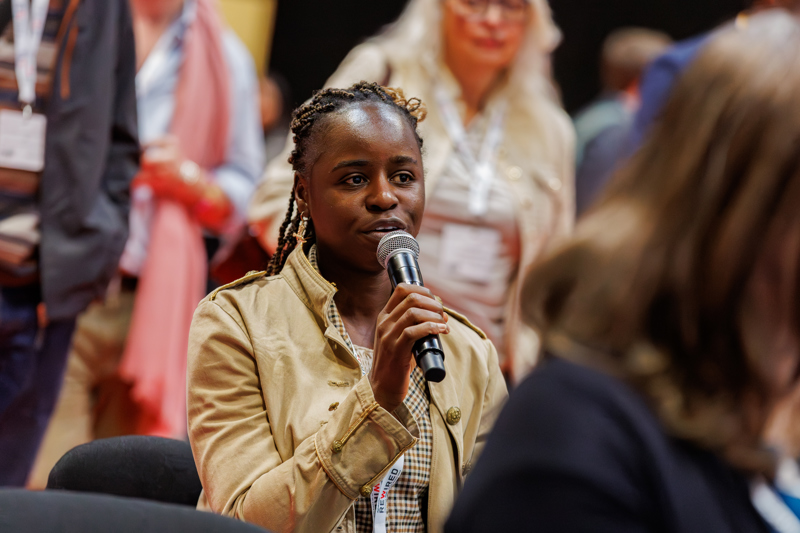
This was something soon followed up on by a GP who explained her concerns about how AI time-saving on workflow efficiency has been undermined by more time spent double-checking AI results for inaccuracies/hallucinations. She was also worried that patients were consulting AI and getting incorrect diagnoses and added “I’ll be your Google. I can give you tailored advice.”
The conclusion from Ahmed and Jordan was that transparency would be a massive driver for AI usage and would build confidence. Admin seems to be the best starting point to prove viability and value, and from there you could further explain the Human in the Loop approach and how safety and privacy are at the core of all development and extensions with AI. Ahmed added this finishing thought: “When it comes to convenience, some people will relax their objections. It’s the same with urgency – it’s a driving factor.”

Most stages had a short spell for lunch between 12:15 and 1:15, so it was a chance for people to grab a sandwich and sit, or to go and see stands like ours and speak to our experts to understand just what it is we can offer for clinicians to help optimise workflow, reduce duplicated efforts, and provide more meaningful data insights.
INTEGRATED CARE - Afternoon keynote: Integrating acute, mental health, social care and primary care in Northern Ireland
Lunch over and it was back to it, with an afternoon keynote hosted by Dr Paul Rice CDIO on Integrated Acute Mental Health social care & primary care in Ireland.
Dr Rice was pressed on health & care systems and explained there are significant similar challenges to the UK: demand is out stripping supply. For them the major causes of death and disability are cancer, cardiovascular issues, and respiratory problems.
At present six trusts across the country cover the local population, but there’s a reset plan that will expand this to eight key areas, though for Dr Rice this will require digital to come more to the forefront and provide the connectivity necessary to ensure a smooth transition and subsequent expansion of care; whether through data capture and insights, identifying gaps in coverage, creating opportunities for more tailored care delivery, and more.

DIGITAL FRONTLINE - Building a digitally capable clinical workforce
At the same time, we also attended the Digital Frontline stage for their talk on building a digitally capable clinical workforce – something flagged in the Responsible AI talk as an issue.
Speaking on stage were:
- Misbah Mahmood, Chief Information Officer & Clinical Safety Officer, Bradford District Care NHS FT and session host;
- Dr Alexander T Deng, Director, NHS Fellowship in Clinical AI;
- Zainab Qazi, Programme Support Officer, NHS Fellowship in Clinical AI; and
- Alexander Aubrey, Clinical Lead for Artificial Intelligence, Health Education and Improvement Wales (HEIW)
Alexander Aubrey started things off and summed it up neatly: “We’re asking clinicians to work in an environment where the knowledge is constantly expanding.”
He raised the 2-Sigma issue about how humans benefit from one-on-one education and how future users could get this from AI, though in a more advanced stage. At present we have courses, lectures and workshops which are fine, but there’s a gap between what clinicians need for their learning and what they get, which inevitably causes slower adoption of technology.
Dr Deng and Zainab Qazi both then followed up by talking about the NHS Fellowship in Clinical AI and how they were training the current generation of staff and had literally bought out staff time to ensure they contractually had the time necessary to study and develop – a really important step in ensuring digital development within the NHS.

INTEGRATED CARE - New Neighbourhood Framework: What it means for Digital in Mental Health
At 2:15pm it was the turn of The Access Group’s own Laura Thompson over on the Integrated Care stage, joined by:
- Professor Joe McDonald, Consultant Psychiatrist and Founder of the Great North Record;
- Dr Ayesha Rahim, Chief Medical Information Officer at Surrey and Boarders Partnership NHS Foundation Trust; and
- Dr Rowan Sil, Chief Clinical Information Officer at Leicester, Leicestershire and Rutland Integrated Care Boards and GP Partner at Ibstock and Barlestone surgeries.
This session was much more of a back-and-forth conversation between the four speakers than previous sessions, with Laura steering the conversation through the new neighbourhood framework and what it means for digital in mental health.
The general consensus was there’s fear of the unknown: staff still don’t know how restructuring will look, and some job losses are expected. The neighbourhood program exists and has good people at the table, but there needs to be a good push for partnerships and understanding to seal the deal.
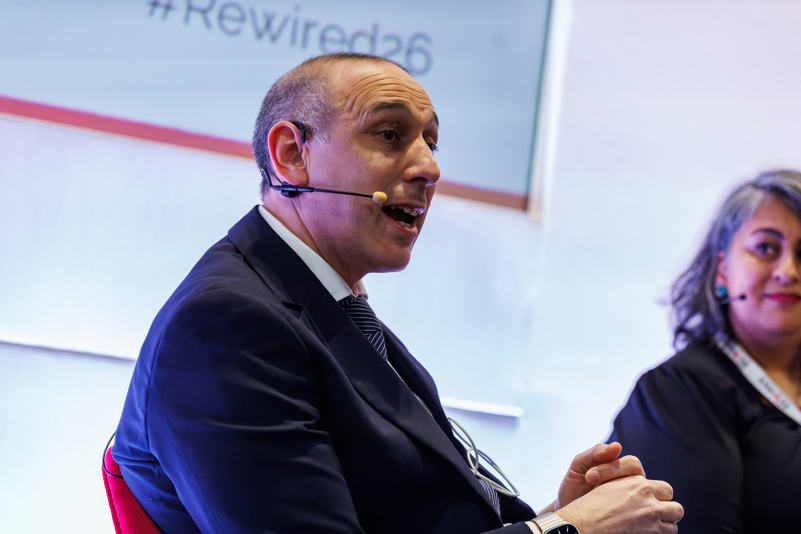
Professor McDonald flagged up how there’s a cycle that repeats where big is beautiful, then small, and how there are issues regarding authority and who will manage what. Dr Sil argued for digital teams to lead the way and iron out the processes but did err caution about a lack of maturity in Trusts and PCNs potentially undermining the cause.
Dr Rahim also highlighted the fact that the mental health sector is extremely underutilised and is ideally placed to link primary care, social care, voluntary, housing, and education – it just needs incorporation. This, says Professor McDonald, is where another system is needed, like how staff use Whatsapp; a connecting link between all tiers of care, and the prime opportunity for neighbourhood services to establish themselves.

INTEGRATED CARE - Integrated Care case study sessions: patient-centred innovation
One of the final sessions of the day was on Integrated Care case studies, featuring:
- Clare Green, Transformation Manager for the EHR Delivery Team, Leeds Teaching Hospitals
- Dr Rowan Sil, Chief Clinical Information Officer, Leicester, Leicestershire and Rutland Integrated Care Board and GP Partner Ibstock & Barlestone Surgeries
- Rosie Mawer, Senior Delivery Manager, Aire Logic
- Cara Afzal, Programme Director for Digital & Data, Health Innovation Manchester
- Dr Saif Ahmed, Clinical Digital Lead for Transformation, Health Innovation Manchester
Health Innovation Manchester went first and showcased the Greater Manchester Care Record and how strong adoption has led to properly joined-up care across the metropolitan area. Interestingly, Cara and Dr Ahmed did flag how 30% of inpatient beds are end of life and questioned if we properly know how many wished to be let go and DNR.
Leeds went next with their care record and explained how a trial with one ward and team was successful and was scaled up over time until it became one shared care plan supporting safety and independence. Importantly, it was clinically-led through development and this helped adoption.
Dr Rowan Sil was back on stage for his second talk in a row, this time exploring Leicester, Leicestershire and Rutland Integrated Care Board and the challenges around needing people to want to work together, rather than being comfortable to sit in silos. Dr Sil also flagged how important TEC was in spotting small changes and leading to prevention, and how this thread links community care and neighbourhoods into primary and secondary services.
DIGITAL TRANSFORMATION - Closing Panel Discussion: What are the next steps to deliver the 10-year plan?
The final session of the day brought together national and frontline leaders to reflect on the conference and discuss the practical steps needed to move from strategy to delivery on the NHS 10-year plan, covering workforce, culture, data, adoption and system alignment.
Helen Balsdon (CNIO, NHS England) observed that there is a lot of activity around assistive and virtual technology, but nurses often feel the digital agenda isn't about them - despite genuinely wanting to engage. She noted the sector is coming out of the AI hype cycle and starting to see actual, practical AI solutions, with good work in the National Innovation Accelerator, but acknowledged there is still much to do to educate the workforce. A key concern she raised was that while the digital agenda is expanding, the NHS is simultaneously losing good people.
Dr Chris Stanley said he was encouraged to hear more discussion about people and less about technology itself. He highlighted that there is still significant friction when trying to work across organisational boundaries, and argued that primary care should be used as the middleware to drive data sharing. He also challenged the sector to revisit data sharing agreements and DPIAs, which he felt were too restrictive and needed to be opened up to enable more effective sharing.
Dr Shanker Vijay acknowledged that the 10-year plan is ambitious but sits against a backdrop of real workforce and financial constraints. He made a notable call for the sector to be more open about failures – suggesting that future Rewired events should feature presentations on what went wrong and what could be done differently, reframing failure as a learning curve rather than something to avoid discussing.
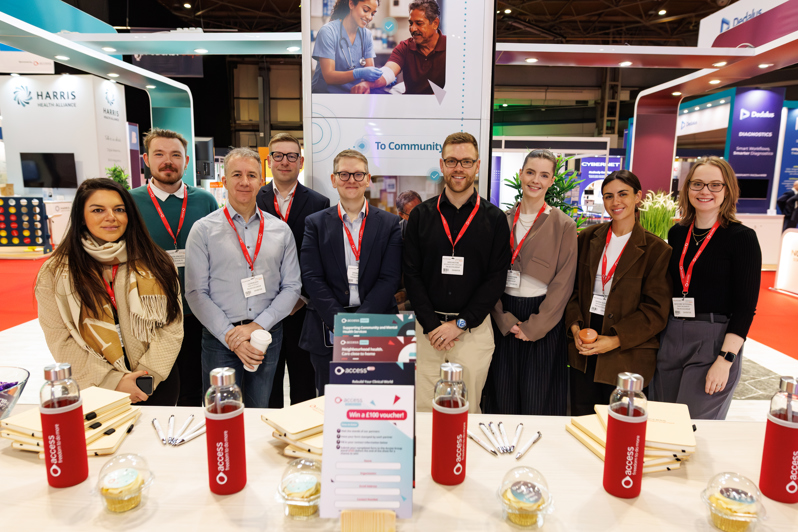
And with that, another Digital Health Rewired is over. We had an amazing time on our stand, with our brilliant staff engaging with hundreds of people to discuss and explore the ways in which The Access Group can support health and social care systems in delivering better outcomes through efficient workflows and communication. Our neighbourhood display counter was a particular hit, and we hope to bring more to the table (pun intended) for Rewired 2027!
With a clear focus on how technology can empower neighbourhood care and make healthcare more efficient and effective, if you’d like to hear more about how our solutions can help you, get in touch.