AU & NZ
 SG
SG
 MY
MY
 US
US
 IE
IE


At Access Hospitality, we’ve seen how difficult it can be to juggle legal requirements and shift patterns, especially in fast-moving industries like hospitality. That’s why we have built Hospitality People Suite to help you manage both compliance demands and your team’s needs without the stress.
In this guide, we’ll take you through the essentials of the ‘Working Time Directive’, what the law requires and how smart rota planning can help you stay compliant with the latest regulations.
What is the Working Time Directive (WTD)?
The legislation is there to safeguard your employees’ health and wellbeing by regulating working hours and promoting a work-life balance, ensuring that employees are not overworked and that they receive regular breaks for rest and recovery.
Under the WTD, several core requirements apply to most workers:
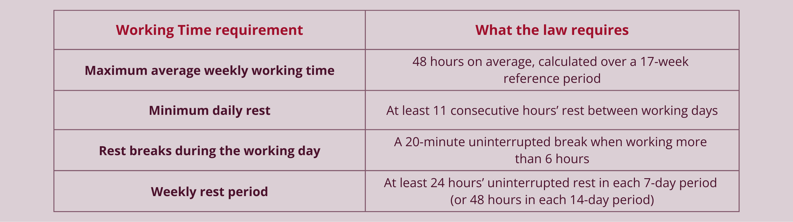
Employees do have the option to opt out of the 48-hour weekly cap if they wish, allowing for some flexibility. However, this has to be mutually agreed, and the employee must sign an opt-out form in writing. However, even if an employee opts out, their employer is still required to provide them with adequate rest breaks and rest periods, as outlined above.
What do you need to know about the Working Time Directive?
Let’s break down the essentials:
-
The 48-hour cap: The Working Time Directive (WTD) limits the average working week to 48 hours over a 17-week period, unless the employee agrees to opt out.
-
Average hours calculation: This is averaged over 17 weeks, which means employees can work over 48 hours in a single week, as long as the 17-week average stays within the limit.
-
Rest periods: Employers must ensure staff have at least an 11-hour break between shifts and one full day off every seven days.
-
Breaks: Employees are entitled to a 20-minute break every six hours they work.
How many 12-hour shifts can you work in a row in the UK?
UK law doesn’t explicitly state how many 12-hour shifts an employee can legally work in a row. However, the Working Time Directive (WTD) provides clear, easy-to-follow guidelines, so you can make sure employees receive the rest they need.
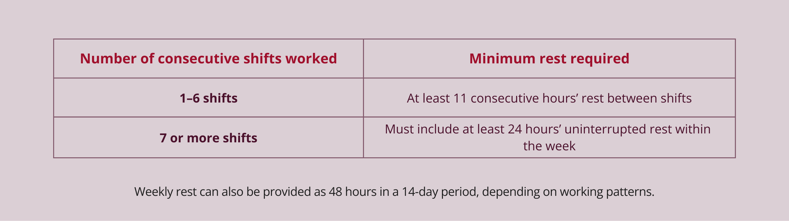
While there’s no direct limit to consecutive shifts, these rules mean that in practice, employees must have sufficient breaks between shifts to comply with the law. Working 12‑hour shifts back‑to‑back is possible under the WTD, provided the 11‑hour rest rule is respected and workers still receive at least 24 hours’ uninterrupted weekly rest (or 48 hours’ rest in each 14‑day period)
For under-18s, the rules are slightly different. They must have at least 12 hours of rest between their shifts plus two consecutive days off each week.
Ultimately, The WTD has employee wellbeing at the centre, preventing burnout and health risks from excessive working hours. These regulations must be taken into account, in order to create effective rotas that balance operational needs with legal compliance.
What are your legal obligations?
Here’s some clear rules to follow when you’re creating efficient rotas:
-
Remember that rest is non-negotiable: Your team is entitled to at least 11 hours of rest between shifts, a 20-minute break for every six hours worked and a full day off every seven days.
-
Keep hours in check: The WTD caps the average working week at 48 hours unless an employee has agreed to opt out. Make sure to keep records to prove you’re following this.
-
Be fair with notice: Nobody likes last-minute surprises. Give employees as much notice as possible if you need to make changes to their rota.
-
Young workers need extra care: For staff under 18, rules are stricter. They need at least 12 hours between shifts and two full days off each week.
-
Log everything: Keep at least two years of working‑time records (hours worked, breaks and rest days), so you can evidence compliance if the regulator or a tribunal asks.
How can you record employee working hours for rota compliance?
Accurate records of working hours are essential for complying with the Working Time Regulations and for preparing for newer requirements under the Employment Rights Bill. Employers should be able to evidence at least two years of working-time records, including hours worked, rest breaks and rest days.
1. Rotas that reflect reality
A planned rota is a good starting point since it shows who’s scheduled to work and when. But other factors get in the way like overtime, lateness or absences which can easily cause complications. It is best to keep your rotas updated to reflect the actual hours worked.
2. Moving beyond paper timesheets
Some businesses still use paper timesheets where employees log their start and end times by hand. While it’s simple, this method has its downsides as data can be lost, avoidable errors can creep in, and manual entry takes more time, especially when it’s used for payroll.
3. Digital time and attendance linked to the rota
With modern time‑tracking, employees can clock in and out on a tablet or mobile app, and the system logs hours automatically against the rota. They record actual start and finish times, calculate breaks and overtime, and feed that data through to payroll.
4. Advance notice and clear audit trails
Publishing rotas well in advance; two to three weeks is widely seen as best practice, supports both working-time compliance and emerging expectations around reasonable notice of shifts.
Rota history and progress dashboards track all changes for up to four weeks and show multi‑site managers the status across every venue, making it easier to evidence both working‑time compliance and “reasonable notice” under the Employment Rights Act.
All of the capabilities described above are exactly the kinds of workflows Rotaready Evo is designed to handle for hospitality teams.
How Rotaready Evo supports compliant, predictable rotas
Rotaready Evo brings scheduling and time-and-attendance into one place, so the rotas reflect actual hours worked, not just what was planned. This joined-up approach helps operators with evidence of compliance with the Working Time Regulations and prepare for newer expectations under the Employment Rights Bill.
Smart rotas and advance notice
-
Rotas can be published well in advance (we recommend 2–3 weeks' notice to align with best practice), supporting clearer expectations for shift workers.
-
When rotas are published or changed, employees automatically receive notifications by app or email, creating a clear, timestamped record of when shifts were communicated.
Time and attendance that reflects reality
-
Employees clock in and out using on-site devices or mobile, logging start and finish times directly against the rota.
-
Breaks and overtime are calculated automatically, and approved hours feed through to payroll. This reduces manual re-entry and creates a reliable audit trail if working hours are ever questioned.
Guaranteed hours and contractual commitments
-
Each employee’s contractual obligation, such as minimum guaranteed hours or days, can be recorded and surfaced directly in the rota editor.
-
Visual indicators highlight where contracted hours have not yet been met and where they have, helping managers respect guaranteed-hours commitments and prepare for future Employment Rights Bill requirements.
Document management and policy records
-
Contracts, policy updates and notices can be shared in bulk or with specific employees, ensuring access to current terms and conditions.
-
Acknowledgements and e-signatures provide a clear record that documents have been issued and accepted, supporting written-statement and policy-communication obligations.
Why a joined-up suite goes further
Rotaready Evo sits within Hospitality People Suite, where recruitment, HR, learning, payroll and benefits all draw from the same people data. This means scheduling decisions, contract changes, training records and pay outcomes stay aligned, giving you a clearer, more consistent view of compliance across every site, not just on individual rotas.
Ready to take the stress out of rota compliance?
The Working Time Regulations, alongside new expectations under the Employment Rights Bill, are designed to protect both employers and employees. As this article has explored, compliant rota planning supports fair working hours, proper rest and a healthier working environment. For hospitality businesses, that consistency plays an important role in retention, engagement and day-to-day performance.
Managing rota compliance manually can be challenging, particularly across multiple sites and changing shift patterns. Access Hospitality supports operators with both guidance and practical tools to help make compliance more manageable.
If you’d like to understand how this approach could work for your business, get in touch with our team or explore the Employment law & rota compliance hub to access practical resources designed for hospitality leaders navigating rota and working-time compliance.